


Web3 KOC marketing turns people who have genuinely used a crypto product into voluntary, disclosed advocates who can explain what they did and what they learned. A KOC—key opinion consumer—is defined by firsthand experience, not a small follower count. Start with a usable product, recruit from relevant user cohorts, verify the experience proportionately, permit honest criticism, and measure qualified actions rather than counting posts as customers.
The goal is not to manufacture “organic” praise. A paid user can be a credible KOC, but the relationship must be disclosed. This playbook gives wallet, exchange and DeFi teams a program design without claiming that KOCs always outperform KOLs.
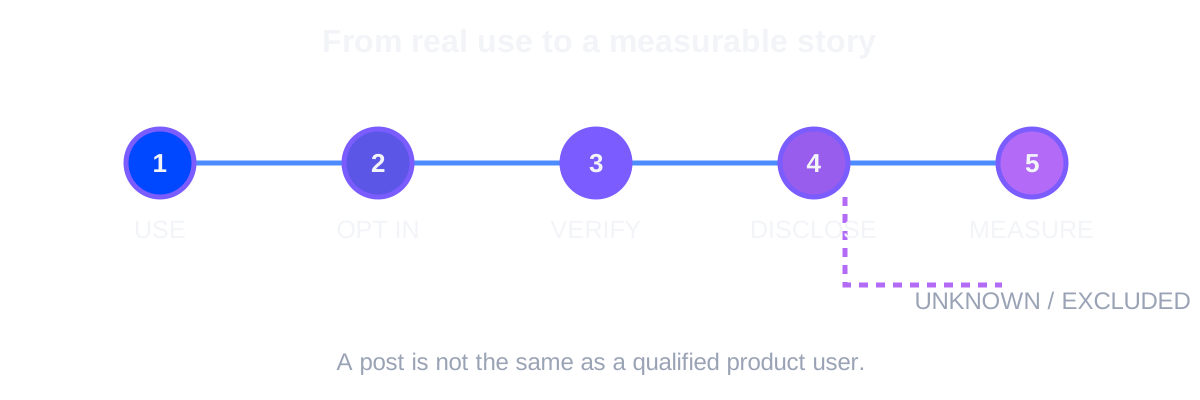
Key Takeaways
- A Web3 KOC should have firsthand product experience; follower count alone does not qualify or disqualify someone.
- Recruit with consent from relevant user cohorts, then verify the claimed experience without exposing private wallet data.
- Give contributors factual boundaries and disclosure rules, but never require a positive review or scripted endorsement.
- Measure eligible activations and retained product use separately from post volume, impressions and reward claims.
- Keep an unknown-source bucket and a documented pause process for inaccurate claims, scams or disclosure failures.
Table of Contents
- KOC, KOL and ambassador roles
- Product readiness and user sourcing
- Experience verification and incentives
- Content and disclosure rules
- Measurement and program scorecard
- Product-specific adjustments
What Is Web3 KOC Marketing—and When Does It Fit?
A Web3 KOC program invites actual users to describe a product journey in their own words: a wallet setup, an exchange feature, a DeFi transaction, a game session or an app built on a network. Their useful contribution is specific evidence about the user experience, including friction and limits. “I used it, here is the step that confused me” is more valuable to a prospective user than a generic “this project is the future.”
This model fits a testable product with a defined next action. It fits poorly when the team has only a token narrative or expects contributors to impersonate independent users. Label beta testers as beta testers, not established customers.
| Role | Source of credibility | Typical job | Main risk |
|---|---|---|---|
| KOC | Firsthand use of the specific product | Explain a real journey, answer practical questions | Paid praise disguised as organic experience |
| KOL | Subject-matter reputation or audience reach | Interpret a category, launch or market thesis | Reach mistaken for qualified adoption |
| Ambassador | Ongoing relationship and contribution | Support community, events or education over time | Role and incentives left unclear |
These are roles, not rigid follower-size tiers. One person can occupy more than one role, but the brief, payment and disclosure should match the work. The crypto KOL due-diligence checklist addresses creator vetting; this article begins with product use.
Step 1 — Define the Web3 KOC Marketing Job Before Recruiting
Choose one primary product behavior that the program should help a new user understand or complete. For a wallet, that might be an eligible first activation; for an exchange, an approved onboarding step; for a DeFi app, a successful interaction with a named feature. Do not combine awareness, token price, community joins and first transactions into one vague “growth” objective.
Document the market, eligibility rules, product version, support path and risks before anyone posts. Run the same journey a contributor will describe, including mobile and regional access. Fix broken onboarding before recruitment.
The Web3 user acquisition playbook in the Sybil era explains why counts of wallets or tasks can overstate useful participation. A KOC program should define relevant users, not merely “real humans”: a person can be unique yet have no reason to keep using the product. Conversely, an established user may have several wallets. Do not make a public wallet address the sole measure of either identity or value.
Step 2 — Recruit From Real Usage, With an Opt-In
Start with users who completed the relevant action and had a chance to form an opinion. Candidate sources may include opted-in product research, support conversations, community help threads, developer tutorials or a voluntary invitation inside the product. Review the candidate's jurisdiction, language and ability to explain the experience accurately. Avoid scraping private community data or treating an on-chain address as permission to contact its owner.
Use a neutral invitation: “Would you share what worked and what did not?” State proposed benefits before acceptance. Route a serious defect or safety concern to product and support first, not to a content assignment.
An illustrative pilot might use one product use case, one primary market and one content format before expansion; these are scope controls, not benchmarks. Record opt-in, claimed experience, reward, channel and approver.
Step 3 — Verify Experience Without Claiming Perfect Identity
Ask what the person did, when and on which product version. Evidence may include a permitted event, voluntary demonstration, support history or walkthrough. Verification should be proportional to the claim: a wallet-recovery tutorial needs more than a copied landing-page screenshot.
Use an evidence ladder, not a binary “real/fake” label:
| Evidence level | Example | What it supports | Limitation |
|---|---|---|---|
| Claim only | “I used the app” | A lead for follow-up | Not proof of use |
| Demonstrated journey | Contributor shows the relevant steps | Firsthand familiarity | May use a test account |
| Permitted product event | Consent-based internal action record | Defined behavior occurred | Does not prove one unique person |
| Repeated use | Eligible actions across a declared observation period | Ongoing product relevance | Can still be incentive-driven |
Privacy and anti-Sybil tools add signals, not absolute proof. Human Passport's documentation describes methods with application-chosen thresholds, not a universal “real user” rule. Do not publish wallet or account history without permission. Narrow unverified claims or exclude the contributor.
Step 4 — Set Incentives and Honest-Content Rules
Agree what is being compensated: time spent testing, a tutorial, a support session, an event contribution or a referral. Record cash, token, access, fee waiver and affiliate benefits separately. Do not pay only for positive sentiment, require a five-star review or promise rewards for unverified claims. Let contributors describe limitations and report errors; the brand may correct factual mistakes without rewriting an opinion into praise.
In the United States, the FTC's influencer disclosure guidance says material connections—including payment, free products or other benefits—should be made obvious with the endorsement. The FTC's Endorsement Guides Q&A also addresses review and social-content disclosures. Other markets have different rules; have qualified reviewers check the asset, channel and audience market. A visible disclosure is not optional merely because the contributor is a real user.
Give contributors approved facts, limitations, prohibited claims, disclosure language, URL and correction contact—not a ready-made testimonial. Prompt them to show the step completed, an obstacle and who the feature may suit. Exclude token-price predictions and implied guaranteed returns unless separately reviewed and lawful.
Step 5 — Measure Qualified Users, Not Just Content Volume
Keep three layers separate: content delivered, audience response and product outcome. Record live URLs and disclosures for the first; tagged visits or substantive questions for the second; and eligible activation or retained use for the third. The KOL attribution setup checklist provides the technical pattern for unique links, event definitions and unknown-source handling; reuse those controls without pretending they prove causation.
| Layer | Example fields | Decision it supports |
|---|---|---|
| Content quality | Correct feature, firsthand detail, disclosure, correction history | Is the story trustworthy and useful? |
| Conversation | Relevant replies, support questions, qualified referral visits | Did the right audience engage? |
| Product action | Eligible activation, excluded duplicates, unknown source | Did interested people complete the intended action? |
| Continued use | Illustrative 7-day and 30-day cohorts, defined in advance | Did initial activity persist? |
The 7-day and 30-day windows are examples, not standards. Google Analytics documents events such as sign_up and generate_lead, but these need implementation; Web3 teams must define their own product events and lawful joins. See Google Analytics' recommended events. A wallet connection is not a retained user.
Calculate qualified-user cost only when the denominator is defined and deduplicated. Keep creator fees, management, rewards and measurement costs in the numerator; keep unknown-source users visible rather than assigning them to the nearest post. A small pilot may be too noisy for a causal ROI claim. Use a decision record that says continue, revise or stop, with evidence and a date, instead of asserting that more KOC posts automatically mean more users.
Step 6 — Operate a Pilot With Clear Pause Rules
An illustrative 4-week sequence—not a prescribed duration—is: week 1, confirm product readiness and opt-in; week 2, verify experience and approve terms; week 3, publish disclosed stories; week 4, review accuracy, eligible actions and early retention. Observe longer when the product cycle requires it.
Pause a placement for hidden benefits, false use claims, unsupported financial claims, unsafe links or scam impersonation. Preserve the original post and correction trail. A KOC program needs written rights and correction rules proportionate to its scope.
Copyable Web3 KOC pilot checklist
[ ] One product use case and eligible audience market are defined.
[ ] The product journey works on the target device and in the target region.
[ ] Candidate opted in; no private wallet data is exposed without permission.
[ ] Firsthand experience is documented at an appropriate evidence level.
[ ] Benefit, payment, token or referral incentive is recorded.
[ ] Brief allows honest criticism and bans unsupported claims.
[ ] Disclosure wording and placement are approved for the channel and market.
[ ] Each placement has a unique, tested URL or documented no-link rationale.
[ ] One primary qualified action and exclusion rule are frozen before launch.
[ ] Unknown-source and repeat-user activity remain separate in reporting.
[ ] Correction, scam escalation and pause owners are named.
[ ] Pilot review compares content quality, product outcomes and cost.
How Should Wallet, DeFi and Exchange Teams Adapt the Program?
| Product | Good KOC story | Qualified action to define | Extra control |
|---|---|---|---|
| Wallet | First setup or feature walkthrough with a real obstacle | Eligible activation or feature use | Never reveal recovery phrases or private keys |
| DeFi app | A specific, reproducible product interaction | Eligible successful action in the right contract/version | Explain transaction risk and avoid return claims |
| Exchange | Onboarding or tool-use experience | Eligible account action under local rules | Review referral and trading claims by market |
| Layer 1/2 | Developer or app-user journey | Defined app/network action, not bridge-only activity | Separate testnet, bots and repeat users |
| Game or community app | First session and return experience | Eligible play or continued feature use | Distinguish reward farming from voluntary return |
Regional language and support matter. A useful KOC should be able to answer practical questions in the audience's language and refer people to official documentation, not just repost a translated slogan. Link the program to the relevant regional growth playbooks when the target market is specific, and check local rules before inviting token-related endorsements.
Final Answer
Web3 KOC marketing in 2026 works best as a disciplined real-user advocacy program: start with a product people can use, invite relevant users voluntarily, verify the experience they plan to describe, disclose every material benefit, and measure qualified product behavior over time. It is not a cheaper substitute for a KOL media buy, nor a way to make sponsored praise look spontaneous. Pilot one use case, preserve unknown and excluded activity in the data, and expand only when the stories remain accurate and the users remain relevant.
