


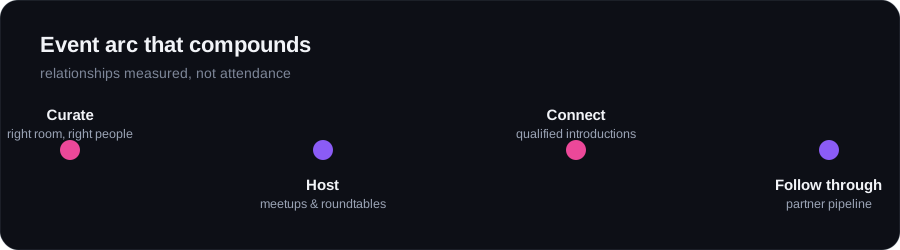
Web3 is a global industry that still runs on local trust. Capital, exchange relationships, institutional partnerships and community loyalty all form faster — and hold longer — when people have met the team behind the project. That is what regional events are for. Not booths, not badge scans, not logistics: a deliberate program of in-person engagement that gives a project real standing in the markets it wants to win.
01 · TrustWhy does in-person presence still decide trust in Web3 markets?
Web3 describes itself as a trustless industry, but nothing about how it actually grows is trustless. Exchange listings move on relationships. Ecosystem grants move on relationships. Institutional capital, enterprise pilots and even KOL conviction move on whether real people believe a team will still be here in two years. In most of the regions that matter for Web3 growth — East Asia, Southeast Asia, Oceania — that belief forms in person, over dinners, panels and repeated encounters, long before it shows up in a signed agreement.
This is why market entry cannot be done entirely from a screen. A project that exists only as a logo on X and a Telegram announcement channel is, to a local exchange, fund or media outlet, a stranger. Strangers get polite replies and slow processes. Teams that show up — at the right tables, introduced by the right people, more than once — get the fast path: warm introductions, honest feedback, and early access to opportunities that never reach a cold inbox.
Regional events are how that presence is built deliberately rather than accidentally. Treated as strategy instead of logistics, blockchain events become trust infrastructure: each meetup, roundtable and conference appearance is another verified data point that your team is real, competent and committed to the market.
02 · FormatsWhich event format does which job?
The word "event" hides very different instruments, and most disappointment comes from using the wrong one. A meetup cannot close an institutional partnership; a roundtable cannot build a mass community. Each format has a specific relationship job.
| Format | The room | Job to do |
|---|---|---|
| Community meetup | Open · local builders and users | Build local awareness, recruit early community, give the project a public face |
| Executive roundtable | Closed · invitation-only decision-makers | Open concrete partnership, listing and institutional conversations under one agenda |
| Conference side-event | Curated · timed to a major gathering | Capture relationships while the whole ecosystem is in one city |
| Speaker placement | Public · established stages and panels | Transfer credibility and position founders as voices worth seeking out |
Community meetups are the entry point. Run in the local language with local hosts, they turn online followers into people who have met you — and they surface the organizers, builders and superconnectors who end up anchoring a regional community.
Executive roundtables are the opposite instrument: small, closed and curated to the person. The value is the guest list and the agenda. Done well, a single evening of executive networking compresses months of cold outreach into a handful of genuine working conversations.
Conference side-events run on borrowed density. When a major industry conference brings the whole ecosystem to one city, a focused side-event — a dinner, a workshop, a themed mixer — lets you meet a year's worth of contacts in a week. ChainPeak has supported KOL and community promotion for major industry conferences in Asia, so we plan these weeks knowing how the surrounding attention behaves from the organizer's side as well as the sponsor's.
Speaker placement puts your founders on stages that already carry authority. A panel seat says the organizers vetted you; a strong session generates inbound conversations for months. We identify the right stages by region and secure the placement as part of the event program, not as an afterthought.
03 · SystemHow do events compound with the rest of regional growth infrastructure?
A standalone event produces a photo album. An integrated one produces compounding presence. That is why Regional Events sits inside ChainPeak's Regional Growth Infrastructure rather than beside it — every event is wired into the capabilities around it.
Introductions that open at a roundtable are handed to the ecosystem partnerships track, where they are developed into integrations, co-marketing and listings instead of stalling as exchanged business cards. Moments created on stage or at a side-event are amplified through PR & media so a single room becomes a regional audience. Attendees who showed up curious are folded into community growth programs — local-language channels, ambassador tracks, ongoing activity — so the energy of the night does not dissolve by the weekend. And localized campaigns give each event a before and an after: awareness built ahead of the date, follow-up content that keeps the conversation alive.
Run this loop several times in one region and the effects stack. The community recognizes the team, partners refer other partners, media starts calling first, and each new event costs less effort while opening bigger doors. That compounding is the actual product; the event itself is the mechanism.
04 · MeasurementWhat does a successful regional event actually produce?
Attendance is the easiest number to inflate and the least useful to have. Free drinks fill rooms; they do not build market presence. We measure ecosystem networking events on what remains after the room empties:
- Partner pipeline. Qualified conversations opened with funds, exchanges, infrastructure teams and enterprises — and how many progress to a second meeting.
- Relationship depth. Follow-ups accepted, introductions made in both directions, invitations to other people's tables.
- Community formed. Attendees who join local channels and are still active weeks later, and local organizers who now advocate for the project.
- Narrative assets. Coverage, speaker footage and co-created content that keep working long after the event ends.
- Compounding signals. Inbound requests, repeat attendance, and partners bringing partners to the next edition.
A full room is the cheapest thing an events agency can sell you. If the post-event report leads with headcount instead of the pipeline the evening opened, you paid for catering, not market entry. We plan every event backwards from the relationships it must create.
05 · The arcHow does ChainPeak run an event from guest list to follow-through?
The work divides into three phases, and the last one is where most of the value lives.
Before the event, we define the relationship goals with you, choose the format, and curate the room. Local teams in Hong Kong, Singapore, Australia and Vietnam — supporting programs across 7 core growth regions — build the invitation list from real networks: 10,000+ verified KOLs, 300,000+ active community users, and partner relationships developed across 450+ Web3 project engagements since ChainPeak was founded in Singapore in 2022. Curation is the difference between a crowd and a room.
During the event, the job is facilitation: hosting in the local language, making the introductions that would not happen by themselves, and keeping your executives in the right conversations instead of at the registration desk.
After the event, follow-through turns contact into relationship. Every priority conversation gets a structured next step — an introduction, a scheduled call, a handoff into a partnership or community track — and the pipeline is reviewed with you in the weeks that follow. This is the discipline most event programs skip, and the reason ours are judged by what they created a quarter later, not the morning after.
If you are planning regional expansion and want an in-person program built around relationships rather than headcount, talk to the ChainPeak team about where your next market should meet you.
