


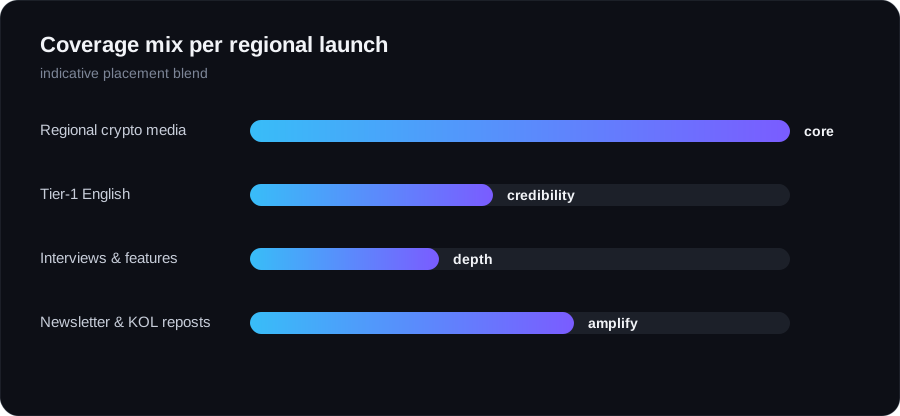
Most Web3 teams first meet PR as a package: one release, a few hundred placements, a link report read once and filed. The coverage exists; the credibility does not. ChainPeak treats PR & Media as the trust layer of regional expansion — media relations, interviews, thought leadership and founder positioning that compound over quarters, built to make every other growth channel convert better.
01 · CredibilityWhy is credibility, not publicity, the goal of crypto PR?
Publicity is attention. Credibility is the conclusion people reach after they check — and much of Web3 marketing optimizes the first while merely hoping for the second. In this industry, everyone checks. A user verifies a project before connecting a wallet. A fund analyst searches the name before taking a first call. An exchange team reads coverage history before a listing conversation moves. A prospective partner asks colleagues what they have heard. PR determines what all of that checking finds.
Short-term publicity depreciates fast. An announcement produces a spike of crypto news mentions measured in days, and a market that only hears from you at announcements learns to discount you between them. Credibility works the other way. Sustained, accurate presence in the blockchain media a region trusts changes the default assumption people carry into first contact: an interview here, a data-backed story there, a founder quoted on an industry question. When the name is already familiar from serious coverage, every later touchpoint starts from trust instead of skepticism.
The honest measure of Web3 PR is therefore not how many outlets republished a release. It is whether the users, partners and industry stakeholders who look into the project find reasons to take it seriously.
02 · Regional mediaHow does media actually work in Web3 markets?
In crypto, discovery is social and validation is editorial. Most users first hear of a project through a KOL thread, a Telegram forward or a community mention — which is why KOL campaigns sit beside PR in the same infrastructure. Media plays the second role in that sequence: when someone who discovered you socially goes looking for confirmation, coverage is what they find or fail to find. A project with strong social reach and no editorial footprint reads as a promotion. A project with both reads as real.
The editorial layer is also intensely regional. Each market has a short list of publications where trust actually forms, a long tail that adds nothing, and its own role for media in the user journey:
| Market | Where trust forms | Role in the trust journey |
|---|---|---|
| Chinese-speaking markets | PANews · Odaily · BlockBeats | Validation and analysis; coverage circulates onward through Telegram, X and WeChat ecosystems |
| Korea | Portals + crypto verticals | Legitimacy signal for retail; portal presence shapes sentiment quickly |
| Japan | Established crypto outlets | Slow-building institutional trust; editorial standards are cautious and consistency outweighs volume |
| Global English tier-1 | Tier-1 crypto publications | The record of note for funds, partners, analysts and AI answer engines |
Two practical consequences follow. First, media relations must be native: pitches and stories localized by people who write for these editors rather than machine translation, and relationships maintained between announcements, not opened the week news breaks. Second, outlet selection beats outlet volume. In the Chinese-speaking market, the right three placements outperform three hundred syndicated links, and the same arithmetic holds in Seoul and Tokyo.
03 · Thought leadershipWhat does founder positioning actually involve?
Founder branding in Web3 is often mistaken for personal fame. The working definition is narrower and more useful: giving each target market a reasoned, consistent voice to associate with the project, so that trust in the person transfers to the product.
A positioning program has concrete parts. It starts with a point of view — the two or three things the founder believes about the sector that are specific, defensible and not already said by everyone. That point of view is then placed: commentary offered to regional journalists when relevant news breaks, interviews with the publications and podcasts a target market follows, bylined analysis in industry publications, and remarks timed around the conference moments each region cares about. None of this depends on company announcements, which is precisely the value. Thought leadership keeps a project present and credible in the months between milestones, when distribution-only PR goes silent.
Format is regional too. Chinese-speaking crypto media, Korean outlets and English-language publications each have distinct norms for how expert commentary should read, and a voice that works in one market can land poorly in another when translated literally. ChainPeak develops founder positioning per region, in native language, with the same editors who handle media relations.
The compounding effect is easy to recognize once it starts. Journalists begin calling for comment instead of waiting to be pitched, analysts borrow the founder's framing, and event invitations arrive inbound. The project stops paying for every mention.
04 · IntegrationWhere does PR sit inside Regional Growth Infrastructure?
PR & Media is one of eight capabilities in ChainPeak's Regional Growth Infrastructure, and it is deliberately not sold as a standalone shortcut. The methodology runs Market Validation → Growth Strategy → Growth Execution → Regional Expansion, and media work enters once validation confirms that a region justifies the investment — there is no reason to build press relationships in a market the data says to skip.
Inside an active region, PR runs alongside the other capabilities rather than in parallel silence. Localized campaigns give coverage a reason to exist, and coverage gives those campaigns third-party weight. KOL activity creates the discovery that media then validates. Ecosystem partnerships generate the legitimate news editors actually want, while existing coverage shortens every partner's diligence. Community growth turns each placement into material that 300,000+ active community users can circulate, extending a story's life well past its publication date.
The sequencing logic — what runs when, and why — is documented in the Regional Growth Playbook. The short version: a story that lands alongside a coordinated push compounds, and the same story published in isolation is forgotten within a news cycle.
05 · MeasurementHow do you know long-term PR is working?
Reputation resists dashboards, but it is not unmeasurable. ChainPeak reports against directional indicators of trust rather than placement counts:
- Share of voice. How often the project appears in each region's trusted outlets relative to named competitors, tracked quarter over quarter.
- Coverage quality. Whether mentions are substantive — interviews, analysis, cited data — or syndicated filler, and whether accuracy and sentiment hold over time.
- Citation by AI engines and analysts. Increasingly, the first summary a stakeholder reads is generated by an AI answer engine from published coverage. Whether those answers describe the project accurately, and whether research analysts cite it, is a direct read on editorial footprint.
- Inbound interest. Journalist queries, partner and exchange approaches, and speaking invitations that arrive without outreach.
None of these indicators move in a week, and that is the point. They are the measurable shadow of the thing PR is actually for: a market that trusts you before you ask it to.
PR cannot fix a weak product, and no honest agency guarantees editorial coverage in independent publications. What disciplined media work does is make every real milestone worth more — because the market already knows who you are when the news lands.
If a launch, a market entry or a founder platform is on your roadmap, talk to us before the dates are set. Credibility takes quarters to build, and the earlier the media groundwork starts, the more each milestone returns.
