
Live · 24h ETH ETH $3,482 +2.4% BTC BTC $94,208 +1.2% SOL SOL $212.07 -0.6% TON TON $5.83 +4.1% SUI SUI $4.27 +6.9% BNB BNB $718.92 +0.9% AVAX AVAX $38.61 -1.2% LINK LINK $22.84 +3.4% ARB ARB $0.842 +2.2% DOGE DOGE $0.385 -2.7% USDT USDT $1.000 +0.0% OP OP $1.78 +5.2% MATIC MATIC $0.492 -0.3% Live · 24h ETH ETH $3,482 +2.4% BTC BTC $94,208 +1.2% SOL SOL $212.07 -0.6% TON TON $5.83 +4.1% SUI SUI $4.27 +6.9% BNB BNB $718.92 +0.9% AVAX AVAX $38.61 -1.2% LINK LINK $22.84 +3.4% ARB ARB $0.842 +2.2% DOGE DOGE $0.385 -2.7% USDT USDT $1.000 +0.0% OP OP $1.78 +5.2% MATIC MATIC $0.492 -0.3%

China Web3 Market Entry, Built on 500+ Chinese Crypto KOLs

The Chinese-speaking crypto market operates across multiple jurisdictions. We help projects reach it through the channels, communities and creators that actually influence adoption.

500+ Vetted Chinese-speaking crypto KOLs in our network
X + Telegram Where offshore Chinese crypto discussion happens
Simplified + Traditional Chinese Native content for every major Chinese-speaking market
Cross-border Trading Trading across global exchanges and Hong Kong–licensed venues
TL;DR

The Chinese-speaking crypto market is global by nature. Conversations happen across X, Telegram, and private WeChat communities, while trading is concentrated on major global exchanges and regulated venues in Hong Kong. Influence is driven by trusted creators and communities rather than paid advertising. Since 2022, ChainPeak has executed Chinese-language campaigns and built a network of 500+ vetted Chinese-speaking crypto KOLs alongside long-term relationships with leading Chinese crypto media.

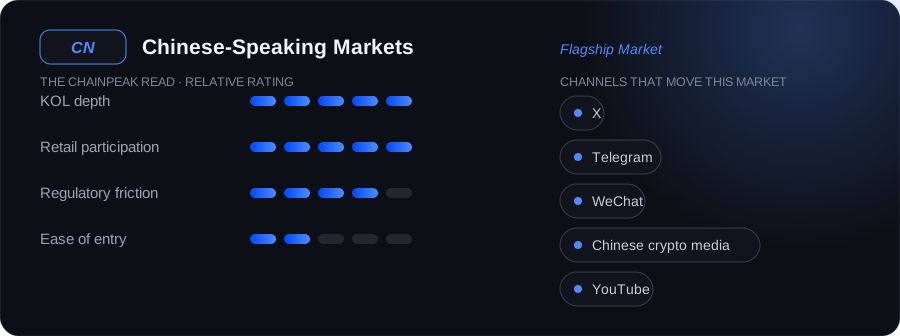
Chinese-Speaking Markets market snapshot: ChainPeak's qualitative read and the channels that move this market

01 · Market RealityWhat "crypto marketing China" actually means

Mainland China prohibited cryptocurrency trading and mining in 2021. Many outside observers assume the Chinese crypto market disappeared at that point. It did not. It reorganized into a global Chinese-speaking ecosystem operating across multiple jurisdictions.

Today, that ecosystem spans Hong Kong, Taiwan, Singapore, Malaysia, and Chinese-speaking communities worldwide. Discussion is driven through X, Telegram, private WeChat networks, and Chinese-language media, while trading takes place primarily on offshore exchanges and regulated venues in Hong Kong.

Chinese-speaking users remain one of the largest single-language crypto communities in the world. Hong Kong's regulatory framework has provided a compliant gateway for institutional participation, while the broader market continues to operate through its own creators, communities, and information networks.

Perhaps most importantly, the Chinese-speaking ecosystem follows its own news cycle. Narratives, communities, and buying interest often develop independently from English-language crypto media. If you only monitor English, you are only seeing part of the market.

Practical consequence

Success in the Chinese-speaking Web3 market is built through trusted networks, not advertising. Paid media plays a limited role, while discovery happens through KOLs, communities, and native-language conversations. Access to the highest-value communities is earned through relationships, credibility, and consistent participation—not simply through media spend.


02 · MechanismWhat actually works in the Chinese-speaking market

Trust is KOL-driven. Chinese-speaking KOLs remain the primary discovery channel for new Web3 projects, often ahead of media coverage, paid advertising, or exchange announcements. The most effective launches are rarely driven by one celebrity post. Instead, they are built through a coordinated wave of respected mid-tier voices, creating repeated exposure across trusted communities over several days.

Chinese-language media provides validation rather than discovery. Coverage in outlets such as PANews, Odaily, BlockBeats, and Foresight News reinforces credibility once projects have already entered community discussions.

Language is part of the product experience. Simplified Chinese serves mainland-rooted communities and much of Southeast Asia, while Traditional Chinese is essential for audiences in Hong Kong and Taiwan. Native execution signals commitment. Literal translation often signals the opposite.

Successful teams localize messaging, timing, and community engagement—not just language. Market entry succeeds when local operators, creators, and communities feel the project was built with them in mind rather than translated for them.


03 · NetworkKOL and community landscape

We maintain 500+ vetted Chinese-speaking crypto KOLs, and the network breaks into distinct tiers. The table below is what we use to allocate budget on a typical Chinese market entry.

Tier Surface Audience Role in the wave
Top tier X, YouTube 500K+ Shapes market attention. Best reserved for major launches.
Mid tier X, Telegram 10K–100K Drives discovery and sustained engagement.
Alpha group owners Telegram 2K–40K Smaller reach, far higher trust, where deal flow sits.
Traditional Chinese creators YouTube 20K–200K Builds credibility among Traditional Chinese audiences through long-form analysis and commentary.
WeChat moderators WeChat 50–500 / group Private layer. Entered by relationship, not budget.

Community has two layers. Telegram is the public layer where anyone can find you. WeChat is the private layer where conviction forms, and you enter it through relationships with group owners and moderators. A Chinese crypto marketing agency that cannot get you into that second layer is only selling you half the market.

Community operates on two layers. Telegram is the public discovery layer, where projects gain visibility and conversations begin. WeChat is the private relationship layer, where trust is built, information circulates, and long-term communities form. Effective market entry requires access to both—not just public exposure.


04 · Anti-PatternsCommon Market Entry Mistakes

  • Machine-translating English content instead of properly localizing it. Poor localization undermines trust before your campaign even starts.
  • Buying one big-name KOL post instead of a coordinated mid-tier wave. Generates attention, but rarely builds lasting market presence.
  • Treating Chinese-speaking users as a single audience. Simplified and Traditional Chinese serve different communities and should be planned separately.
  • WeChat is relationship-driven. Broadcast-style promotion is rarely effective.
  • Measuring vanity metrics instead of business outcomes. We prioritize wallet activity, exchange actions, and community retention over impressions alone.

Channels That Drive the Chinese-Speaking Market

No single channel wins this market. Successful campaigns coordinate multiple channels, each serving a different role in the user journey.

X

The primary public narrative layer where market discussions begin, KOLs shape sentiment, and new narratives spread first.

Primary · Public Narrative
Telegram

Public communities where projects, alpha groups, and ecosystem discussions stay active.

Primary · Community
WeChat

Private relationship networks where trusted discussions, community coordination, and long-term engagement take place.

Primary · Relationships
Chinese crypto media

Editorial coverage that reinforces credibility, provides deeper context, and extends campaign visibility.

Primary · Credibility
YouTube

Long-form content for Traditional Chinese audiences, supporting education, trust, and deeper product understanding.

Primary · Long-form Content

How We Execute in the Chinese-Speaking Market

Our regional growth framework follows the same three-phase methodology across every market, with execution tailored to local behavior, channels, and community dynamics.

Phase 01 · Validate
  • Test 8-12 mid-tier Chinese crypto KOLs against one narrative before paying for top-tier names
  • Publish Simplified and Traditional Chinese versions of your core thread and compare response
  • Map which Telegram alpha groups already discuss your category
  • Interview community members about how they discovered comparable projects
Phase 02 · Launch
  • Run a coordinated KOL wave on X staggered over 7-10 days, not a single day
  • Place launch coverage in 2-3 Chinese crypto outlets timed to the KOL wave
  • Open an official Chinese Telegram group with native moderators before the first post goes live
  • Run AMAs inside 2-3 anchor KOLs' own communities
Phase 03 · Scale
  • Reallocate budget to the KOLs that drove measurable wallet or exchange actions
  • Build WeChat presence through moderator relationships, not broadcasts
  • Localize every product announcement within 24 hours as standard practice
  • Extend the program to Traditional Chinese audiences across Hong Kong, Taiwan, and the wider diaspora where relevant

Frequently Asked Questions About the Chinese-Speaking Market

Is crypto marketing in China legal after the mainland ban?

Crypto marketing aimed at mainland China is subject to significant legal and regulatory restrictions. When international teams refer to the "Chinese market," they are typically referring to the broader Chinese-speaking crypto ecosystem, including Hong Kong, Taiwan, Singapore, Malaysia, and overseas Chinese communities. Campaigns are executed through offshore platforms such as X, Telegram, and global exchanges, with strategies tailored to each jurisdiction's applicable regulations.

How do I find and vet Chinese crypto KOLs?

Building and maintaining a high-quality KOL network takes years of campaign history, native market knowledge, and continuous performance validation—not simply buying a spreadsheet of creator contacts.

What does China Web3 market entry cost?

There is no standard budget. The right investment depends on whether your goal is market validation, product launch, or long-term growth. Most successful teams start with a small validation program before committing larger budgets to KOL campaigns, media, community building, and localization. The cost of entering the market is usually lower than the cost of entering it incorrectly.

What should I look for in a Chinese crypto marketing agency?

Look for four things: native Chinese-speaking execution, direct relationships with creators instead of reseller databases, experience across both Simplified and Traditional Chinese markets, and reporting tied to measurable business outcomes rather than social metrics. A capable partner should also explain how they validate creators, localize messaging, and adapt campaigns to different Chinese-speaking audiences.

Should I localize into both Simplified and Traditional Chinese?

Yes. Simplified and Traditional Chinese serve different audiences with different media habits, platforms, and cultural expectations. Treating them as a single market usually reduces campaign effectiveness.

Can I enter the Chinese-speaking market without WeChat?

Yes — but only to a point. X, Telegram, KOLs, and media can build awareness and drive acquisition. Long-term trust, partnerships, and high-value relationships often develop inside private WeChat networks.

Other regions

Ready to enter your next market?

Tell us what you're building and where you want to grow. We'll come back with a practical regional growth plan tailored to your project.

Request a Growth Plan Chat on Telegram

Reviewed by a regional growth strategist · reply within one business day