


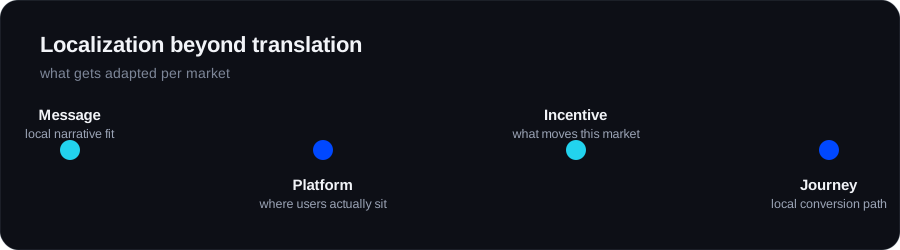
Most Web3 projects expand the same way: take the campaign that worked at launch, translate the copy, and run it in five more markets. The words change; the structure does not. Localized campaigns start from the opposite premise — each market gets a campaign designed around how its users actually discover, evaluate and adopt crypto products. The difference sounds subtle. In performance terms, it rarely is.
01 · The problemWhy do translated global campaigns underperform?
A translated campaign keeps every assumption of the original: where discovery happens, whose opinion carries weight, what incentive feels worth acting on, and how a user moves from first touch to wallet. Those assumptions are the campaign. Change the language without changing them, and you are running an English-market playbook with foreign subtitles.
The assumptions break quickly on contact with real markets. Korean users research projects on Naver and form conviction inside KakaoTalk rooms, not in X reply threads. Vietnamese crypto activity concentrates in Telegram and Zalo groups where admins and local voices set the tone. Japan is genuinely X-native, but it rewards a different register — sustained, detailed posting from accounts with a track record, not one-off sponsored threads. In Chinese-speaking markets, the public layer is only the surface; conviction forms in WeChat private communities that a global campaign never touches.
This is why market localization is not a production task bolted onto the end of a campaign. It is a design decision made at the start. Regional campaigns built this way cost more to plan than a translation pass — and considerably less than a global campaign that ships to seven regions and converts in one.
02 · Campaign layersWhat actually changes in a localized campaign?
When ChainPeak localizes a campaign, six layers are on the table. Some markets need all six rebuilt; others need two or three adjusted. The discipline is that each layer gets examined against local evidence instead of being inherited from the global plan.
- Messaging. The core narrative is reframed around what the market cares about — yield, technical credibility, community identity, or regulatory safety — and the proof points are reordered to match.
- Content. Formats follow platform culture: long-form analysis where research habits run deep, short video where mobile-first behavior dominates, live sessions where communities expect direct access to the team.
- Incentives. Reward size, structure and claim mechanics are tuned to local behavior. An incentive that drives genuine adoption in one region gets industrially farmed in another.
- KOL selection. Credibility is local. Our regional KOL campaigns draw on 10,000+ verified creators — including 500+ Chinese-speaking KOLs — matched by market, language and format rather than follower count.
- Community activities. AMAs, events, moderation style and posting rhythm are set by native-language teams who know what the local community reads as authentic.
- User journeys. The path from first touch to wallet activation is mapped onto local platforms, then handed to regional user acquisition programs to scale.
None of these layers is exotic on its own. The compounding effect comes from adjusting all of them together, per market, against a single campaign objective — which is what separates localized marketing from a batch of translated assets.
03 · Regional textureHow does the same campaign change across markets?
The table below shows how one campaign brief turns into different regional executions. The objective stays constant; almost everything else moves.
| Market | Where decisions form | Messaging emphasis | KOL & incentive fit |
|---|---|---|---|
| Vietnam | Telegram + Zalo groups | Practical upside, simple mobile onboarding | Group admins and local voices; rewards with fast, visible payoff |
| Korea | KakaoTalk rooms, Naver research | Technical depth, legitimacy, team credibility | Analyst-style KOLs; structured events with clear rules |
| Japan | X, native-language threads | Long-term credibility, detail, consistency | Established X accounts with track records; conservative incentive framing |
| Chinese-speaking markets | WeChat private communities | Trust built inside the private layer | Chinese-speaking KOLs; community-gated rewards over public airdrops |
Africa and Southeast Asia extend the same pattern rather than breaking it. African crypto communities organize through WhatsApp and Telegram, which favors campaign mechanics that travel well inside group chats. Southeast Asia is overwhelmingly mobile-first, which changes content length, landing flows, and how much friction a user journey can carry before it loses people. A campaign structure that assumes desktop research and public-feed discovery quietly filters these users out before the first conversion event.
04 · InfrastructureWhere do localized campaigns sit in regional growth?
Localized campaigns are not a standalone marketing service, and buying them as one is how budgets get wasted. In ChainPeak's model they are one of eight capabilities inside a Regional Growth Infrastructure, and they occupy a specific position in the methodology: Market Validation → Growth Strategy → Growth Execution → Regional Expansion.
Market validation comes first, because localization without validation is guesswork with better production values. Validation establishes which markets justify a campaign at all, and what local users already believe about your category. Growth strategy converts that evidence into per-market positioning and budget. The localized campaign is the execution layer — the point where messaging, KOLs, community activities and acquisition fire in a coordinated sequence inside one market. Regional expansion then repeats the framework in the next region, reusing what held constant and re-localizing what did not.
In practice, a localized campaign always runs alongside the other capabilities rather than instead of them. KOL waves supply reach, community growth holds the audience the campaign attracts — ChainPeak's teams moderate channels reaching 300,000+ active community users — and user acquisition converts attention into wallets. The full sequence, and how the capabilities interlock across the 7 core regions, is documented in our regional growth playbook.
05 · EvidenceHow do you know localization is paying off?
The failure mode of global campaigns is invisible in global dashboards, because impressions aggregate while adoption does not. A campaign can look healthy in the worldwide total and be dead in four of the five markets it paid for. So we judge localized campaigns on market-level behavior:
- Native-channel engagement. Discussion quality in Telegram, Zalo, KakaoTalk or WeChat groups — not reply counts on the global X account.
- Local retention. Whether users recruited during the campaign are still active in local communities weeks later.
- KOL resonance. Whether local creators generate real conversation, follow-up content and questions — or just contractual posts.
- Regional wallet activity. Product and on-chain actions traceable to the target market, not folded into a global number.
ChainPeak was founded in Singapore in 2022 and is headquartered in Hong Kong; this model has been applied across 450+ Web3 projects and refined market by market since. The pattern across those projects is consistent: regional expansion succeeds when campaigns are designed for each market, and stalls when one campaign is asked to work everywhere.
A global campaign optimizes for the market you already won. Localized campaigns optimize for the markets you have not. If your growth targets include a region where your current presence is translated copy on the wrong platforms, that region is underpriced attention — until a competitor localizes first. Tell us which markets you are targeting and we will map the gap: talk to the ChainPeak team.
