


Market entry has a cold-start problem. A project arriving in Korea, Vietnam, or any unfamiliar region starts with no distribution, no credibility, and no map of who actually decides anything locally. The fastest legitimate way to close that gap is through the people who already have all three — the local ecosystem. This page explains how ecosystem partnerships compress market entry, who the partners actually are, and how ChainPeak brokers the relationships.
01 · Trust transferWhy do partnerships shorten market entry?
Trust does not travel across borders. A community that has followed a local exchange, a developer group, or a media outlet for years extends those institutions something no advertising budget can buy: default credibility. When one of them publicly works with your project — co-hosts an event, integrates your protocol, publishes your story — a share of that credibility transfers to you. That is the core mechanism, and it is why partnership-led entries consistently outpace campaign-only entries.
A well-chosen partner contributes three distinct assets. First, borrowed credibility: association with a known local player answers the "is this real?" question before it gets asked. Second, existing distribution: the partner already has the audience, channels and formats a newcomer would spend months assembling. Third, local intelligence: partners know which narratives land, which regulations bite, and which competitors quietly failed last year — knowledge that never appears in a market report.
The mistake most teams make is treating partnerships as press releases. A logo-swap announcement with no co-execution behind it transfers nothing, because audiences have learned to discount it. Trust transfers through visible joint work, not through adjacent logos.
02 · The landscapeWho actually makes up a regional web3 ecosystem?
Every region's ecosystem is assembled from the same categories of players, but their relative weight varies sharply by market. The table below shows the recurring partner types, what each contributes, and what an engagement typically looks like in practice.
| Partner type | What they contribute | Typical engagement |
|---|---|---|
| Chain regional arms (L1/L2 ecosystem teams) | Grants, builder access, co-marketing muscle | Grant applications, joint campaigns, ecosystem showcases |
| Developer communities & hackathon organizers | Builder credibility, integrations, technical word of mouth | Sponsorships, workshops, bounty programs |
| Universities & research groups | Talent pipeline, long-horizon legitimacy | Blockchain club activations, guest lectures, research collaboration |
| Local exchanges | Market access, liquidity, mainstream visibility | Listing advisory, co-marketing around market events |
| Wallets & payment providers | Distribution at the moment of intent, on-ramps | Feature placements, integrations, joint user campaigns |
| Media groups & industry associations | Reach, editorial legitimacy, policy visibility | Content partnerships, memberships, co-hosted events |
Which of these matters most depends on the market. Korea and Japan are exchange- and media-weighted; Vietnam and much of Southeast Asia reward builder and community relationships; markets with active regulators elevate industry associations. Exchange relationships in particular are a specialized discipline with their own rules and their own scams, which is why they sit in a dedicated program — our exchange partnership advisory covers listing readiness and launch co-marketing, and holds to one principle throughout: never listings for sale.
03 · BrokeringHow does ChainPeak identify and broker these relationships?
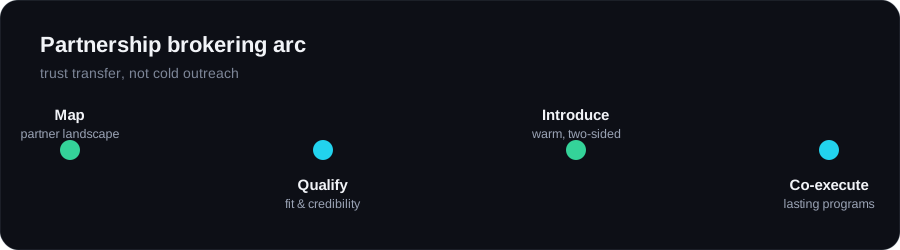
The work runs in four stages, and the order matters.
- Mapping. We build the partner landscape for your target region: who holds real influence, what each player wants, and where your project plausibly fits. Because ChainPeak keeps teams in Hong Kong, Singapore, Australia and Vietnam and has supported 450+ web3 projects, most of this map already exists and only needs updating for your case.
- Qualification. Not every possible partner is a good one. We screen for mutual fit — what you can genuinely offer them, not just what you want from them — and for track record: has this partner actually delivered for projects like yours, or only collected announcements?
- Introduction. Qualified introductions are made warm, with context prepared on both sides and a concrete first proposal on the table. A cold intro wastes the relationship capital that makes brokering valuable in the first place.
- Co-execution. The introduction is the start, not the deliverable. We design the joint campaign, event or integration, define what each side commits, and stay involved until it ships — because a partnership only becomes real when something is executed together.
Qualification is where an agency earns its role. Anyone can produce a list of ecosystem contacts; the value is knowing which of them follow through, and being trusted enough on both sides that an introduction carries weight.
04 · IntegrationWhere do partnerships fit in a regional growth plan?
Ecosystem partnerships are one of eight capabilities in ChainPeak's Regional Growth Infrastructure, and they rarely work well in isolation. Market validation comes first: a partner introduction lands very differently when you can show evidence of local demand rather than a hypothesis. Regional events are where many partnerships actually form — a co-hosted side event does more for a new relationship than a quarter of calls. PR and media coverage makes partners comfortable saying yes, because association risk runs in both directions. And community growth gives partners a concrete reason to co-market: an active local community is the asset they want access to in return.
Sequencing matters more than intensity. Validate first, build initial presence, then broker partnerships from a position of demonstrated commitment to the region — partners can tell the difference between a project investing in their market and one extracting from it.
05 · MeasurementHow do you know the partnership work is succeeding?
Partnership programs drift into vanity faster than any other growth lever, because announcements are easy and follow-through is not. We measure three things:
- Partner pipeline quality. How many qualified, mutually-fit partners are in active conversation — not how many logos appear on a slide. A short pipeline of partners who deliver beats a long list of signed MOUs that never activate.
- Co-marketing outcomes. What each joint campaign actually produced: referred users, integration usage, event attendance, coverage reach — attributed per partner, so budget follows the relationships that perform.
- Retained relationships. Which partners come back for a second and third collaboration. A partner who re-engages after the first campaign is validation no announcement can fake.
A partnership that exists only as an announcement is a cost, not an asset. The test of partnership work is what both sides do after the press release — and that is the phase most projects never plan or budget for. We plan it as part of the engagement, not as an afterthought.
If you are planning a market entry and want to know what the partner landscape looks like in your target region, contact us. The first conversation is an honest read of which relationships would actually move your project — and which announcements would just be noise.
