


Most regional expansion decisions in Web3 are made on anecdote. A founder sees engagement from Korean wallets, a competitor announces a Vietnamese community, an exchange partner mentions Turkey — and the budget moves. Three months later the numbers are flat and nobody can say which assumption was wrong, because nothing was ever written down as an assumption. Research & Validation exists to fix that. It is stage one of the Regional Growth Playbook: the phase where a market has to prove itself before a single launch dollar is committed.
01 · DefinitionWhat does market validation mean in Web3?
Market validation is a short, structured investigation that answers one question: does this market want your product, and on what terms? It is not a 60-page industry report. It is a working process that combines desk research, native-language community listening, competitor mapping and small live tests, compressed into weeks and ending in a decision.
Web3 makes this harder than conventional crypto market research suggests. Demand does not sit in survey panels or app-store rankings — it sits inside Telegram groups, KOL comment sections, regional exchanges and language-specific corners of X. Two markets that look identical on a dashboard can behave completely differently the moment you post in them. Generic research tools read the surface; validation requires people who are already inside the rooms where the market actually talks.
That is the core of how ChainPeak executes this capability. The research is run by native-language operators embedded in each of our 7 core growth regions — not by analysts translating screenshots from a head office.
02 · StakesWhy do regional launches fail without it?
Because the most expensive market research in Web3 is the launch you run to find out the market was never there. When validation is skipped, failure usually arrives in one of four forms: the narrative that worked at home means nothing locally; the channel mix is wrong, so budget is spent on platforms the market does not use; the KOL market is mispriced, so half the spend buys audiences that never convert; or a regulatory or platform constraint surfaces mid-campaign and forces an unplanned stop.
Each of these is cheap to discover in week two of a research sprint and expensive to discover in week six of a live campaign. Regional expansion compounds the cost: enter the wrong region first and you lose not only the budget but the quarter, the narrative momentum, and often the internal appetite to try the right region next. Validation does not remove risk from market entry. It moves the risk to the phase where it costs the least.
03 · MethodHow does a ChainPeak validation sprint run?
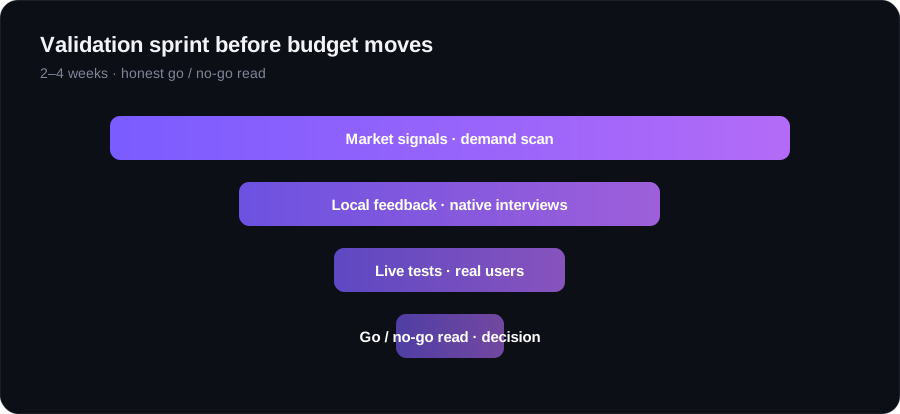
A typical sprint runs two to four weeks and moves through four phases. Nothing in it is exotic — the difference is that every phase is executed in-market, in the local language, against live communities rather than published data.
| Phase | Focus | What comes out |
|---|---|---|
| Landscape | Week 1 | Competitor and narrative mapping, regulatory and platform posture per candidate region |
| Listening | Week 2 | Native-language monitoring of Telegram, X and regional platforms; KOL and community interviews |
| Live probes | Week 3 | Small KOL posts, community AMAs and localized landing tests with real users |
| Decision | Week 4 | Scoring, entry sequencing, and a go / no-go / go-with-conditions verdict with the launch brief |
The live-probe phase is what separates this from a report. Before recommending a market, we test it: a handful of posts through verified KOLs, a small AMA, a localized page. The probes are cheap by design, but they produce the one thing desk research never can — the market's actual response to your project. With 10,000+ verified KOLs (500+ Chinese-speaking) and 300,000+ active community users across our regions, these tests run quickly, quietly, and without announcing a launch.
04 · SignalsWhich signals decide whether a market passes?
Six, weighted differently in every region:
- Narrative resonance. Does your category story already exist locally, and who is telling it?
- Community pull. Do people join and ask questions unprompted after a probe, or does every interaction have to be bought?
- KOL trust economics. What does credible reach cost, and how much of the local KOL market is real?
- Competitor saturation. Is the category open, contested, or already owned?
- Platform and regulatory posture. Which channels are viable, and which quietly throttle crypto content?
- Conversion friction. On-ramps, wallets, language, KYC — how many steps sit between interest and action?
The weighting is where regional experience matters most. In Chinese-speaking markets, trust chains through private communities and KOLs decide almost everything, and public-platform metrics are close to noise. In Vietnam, velocity inside Telegram groups is a leading indicator that shows up weeks before anything registers on X. Reading the right signal per market is the difference between validation and decoration.
05 · OutcomesWhat does validation change about the launch that follows?
Everything downstream starts warm instead of cold, and the effects are measurable in three places. First, budget concentration: instead of spreading launch spend across three speculative regions, you fund the one or two that passed — with documented evidence for why. Second, campaign efficiency: the KOL campaigns that follow start from a shortlist that has already been probe-tested, so the first wave converts instead of calibrating, and messaging enters the market already localized because the brief was written from what the market said, not from a translation pass. Third, accountability: every launch decision traces back to a documented finding, so when something underperforms the team knows which assumption to revisit instead of arguing from memory.
The long-term effect is sequencing. Regional growth compounds when markets are entered in the right order — each successful entry funds and de-risks the next one. Validation is what makes that order knowable in advance rather than visible only in hindsight.
06 · InfrastructureWhere does this sit in ChainPeak's Regional Growth Infrastructure?
Research & Validation is the first stage of a four-stage methodology: Market Validation → Growth Strategy → Growth Execution → Regional Expansion. It is deliberately not a standalone product. The output of every sprint is written as the input to the next stage — strategy inherits the scorecard, execution inherits the tested KOL shortlist and the localization brief, and expansion inherits the sequencing logic.
That is what Regional Growth Infrastructure means in practice: validation working alongside KOL campaigns, community growth, user acquisition and localized campaigns as one connected system rather than a menu of services. Since its founding in Singapore in 2022 — now headquartered in Hong Kong — ChainPeak has run this process across 450+ Web3 projects and 7 core growth regions, and the pattern holds: projects that validate first spend less to grow and keep more of what they build.
Some markets fail validation — that is the point. A no-go verdict in week three costs a fraction of a failed launch in month three, and it usually comes with a better market to enter instead. If a sprint tells you to wait, that is the research paying for itself.
