


A crypto KOL outreach email template is a short, personalized invitation to discuss a specific creator partnership. A useful first message identifies the project, cites one verifiable reason the creator fits, describes the audience and proposed format, states whether the opportunity is paid, gives a realistic window, and asks for one next step. It does not promise returns, imply a token listing, or treat an email reply as approval to publish.
The five templates below cover a paid post, a technical review, an exchange campaign, a token-related inquiry and one follow-up. Replace every bracketed field with confirmed facts. These are message cores; add the sender identification, address, opt-out method and other elements required by the recipient's market before sending commercial email.
Key Takeaways
- Research one relevant creator post and audience segment before writing a personalized pitch.
- State the proposed format, market, timing and compensation status without inventing performance claims.
- Keep token offers and product claims subject to asset- and market-specific review.
- Use one clear question per message, then stop following up when a creator opts out.
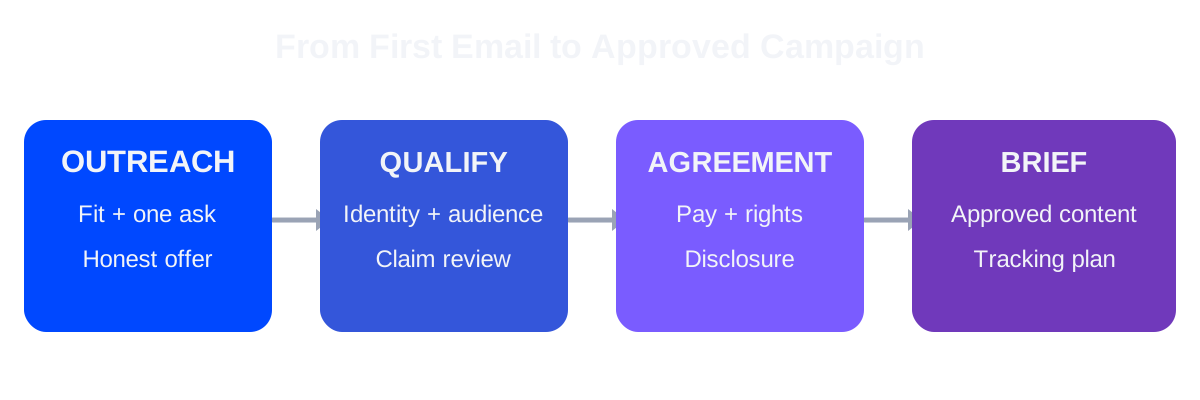
- Move interested creators into diligence, contract, brief and reporting workflows before publication.
Table of Contents
- What belongs in the first email
- Pre-send checks and personalization
- Five copyable crypto KOL outreach emails
- Email, DM and follow-up rules
- How to evaluate replies and hand off a campaign
What Should a Crypto KOL Outreach Email Include?
The first email should make the opportunity easy to accept, decline or route to a manager. It is not the campaign brief or contract. Give only enough detail for an initial decision, then send the full documentation to creators who express interest.
| Field | What to write | What to avoid |
|---|---|---|
| Identity | Real sender, project and website | Anonymous Telegram handle or unverifiable brand claim |
| Fit | One specific public post and audience connection | Generic praise or fabricated familiarity |
| Offer | One format and an honest paid/affiliate/token status | Vague “partnership” or undisclosed incentive |
| Timing | Proposed campaign window and target market | Artificial urgency or a deadline not approved internally |
| Next step | One question: interest, rate card or manager contact | Several meetings, forms and wallet requests at once |
This structure is deliberately narrower than a crypto KOL campaign brief. The brief contains approved messages, links, deliverables and measurement definitions after a creator is shortlisted. A first email should not ask for a public endorsement or wallet connection before both parties have reviewed the project.
Before Sending: Verify Fit, Offer and Contact Route
Start with the creator's public channel, a recent relevant post and the audience you want to reach. Record why that post shows topic fit rather than assuming follower count equals buyer fit. The crypto KOL due-diligence checklist covers deeper identity, audience and conflict verification; outreach needs a lighter pre-screen so the pitch is not indiscriminate.
Confirm that the contact address is published for business inquiries or supplied by the creator or manager. Do not scrape personal addresses and assume they are cleared for marketing. For UK contacts, the ICO's B2B marketing guidance distinguishes corporate subscribers from sole traders and notes that personal-data rules can still apply to business contact details. Review the relevant local rules before building a list.
Prepare a one-page offer sheet: product category, target market, preferred channel, deliverable idea, disclosure expectation, compensation type, approval owner and date window. Do not substitute token units for a clear compensation explanation. If budget is not approved, say that you are asking about rates rather than implying an approved paid campaign.
For teams using email, sender reputation matters too. Gmail's sender guidelines require SPF or DKIM for senders to personal Gmail accounts and specify additional requirements for senders over 5,000 messages per day. The same page says spam rates should stay below 0.3%. Those are platform rules, not a reason to send large quantities of near-identical creator pitches.
Crypto KOL Outreach Email Template: Five Copyable Pitches
The brackets below are instructions, not claims to send unchanged. Example timing and quantities are planning examples, not benchmark response rates. A compliance reviewer should approve any regulated product claim and the final outbound footer for the recipient's market.
1. Paid educational post: first contact
Subject: [Project] × [Creator]: paid [topic] post in [month]
Hi [Name],
I’m [Name] from [Project]. Your [specific post and date] explained [specific concept] to [relevant audience], which fits our planned [wallet/DeFi/infrastructure] education campaign for [market].
We are considering one paid [video/thread/AMA] during [date window]. We can share the product documentation, proposed scope, disclosure requirements and compensation range after you confirm interest. We would not ask you to make investment or performance claims.
Are you open to receiving a short brief? If a manager handles partnerships, please point me to the right contact.
[Sender name, project site and compliant contact/opt-out footer]
If your budget is approved, use a genuine range; do not invent one to induce a reply.
2. Technical creator: review access without a forced endorsement
Subject: [Project] technical walkthrough for [Creator]
Hi [Name],
Your recent explanation of [specific technical issue] raised the same question our team is working on at [Project]. We can provide [public documentation/demo access] and arrange a product specialist to answer questions about [feature].
If you are open to a paid independent walkthrough, we can discuss your rate, the proposed format and what access you need. We will identify the sponsorship clearly and will not require a positive conclusion.
Would you like the documentation first?
[Sender name, project site and compliant contact/opt-out footer]
Keep editorial opinion separate from factual-claim approval. Do not call paid access “independent research” if the material connection will be concealed. The FTC influencer disclosure guide says money, free products or other benefits can create a material connection requiring disclosure.
3. Exchange or wallet: audience and action fit
Subject: [Exchange/Wallet] creator collaboration for [market]
Hi [Name],
I’m [Name] with [Project]. Your [specific post] reached people discussing [trading workflow/self-custody problem] in [language/market]. We are planning an educational [format] about [approved product feature], not a price or returns promotion.
The proposed window is [dates]. This is a paid inquiry; we can share the compensation structure and any permitted referral terms after an initial fit check. We will provide the approved claims and tracking plan before any content goes live.
Are you the right person to discuss this format and market?
[Sender name, project site and compliant contact/opt-out footer]
An exchange may define success as an eligible verified user or first trade; a wallet may use a privacy-safe activation event. Put the metric in the brief and KOL campaign reporting template, not in a promised result. Explain referral compensation and disclosure before agreement.
4. Token-related inquiry: review before any offer
Subject: [Project] creator inquiry — [topic], [market]
Hi [Name],
I’m [Name] at [Project]. Your [specific, verifiable post] suggests your audience follows [relevant topic]. We are exploring a possible [educational format] about [approved product topic] for [market], subject to legal and product review.
Compensation may include [cash / token component under review]; we are not asking you to post, recommend a purchase or discuss price now. If you are interested, we can send the factual materials and proposed commercial terms for your review.
Would you like us to send those materials to you or your manager?
[Sender name, project site and compliant contact/opt-out footer]
Use this only after counsel approves the outreach for the asset and audience. Do not imply a listing, guaranteed liquidity or future price. The crypto KOL contract checklist addresses token valuation, payment, disclosures and rights.
5. One follow-up, then close the loop
Subject: Re: [original subject]
Hi [Name],
Following up once on the [format] inquiry for [Project] and [market]. If it is not a fit, no reply is needed and we will close this outreach. If you would like the one-page brief, I can send it to you or your manager.
Thanks, [Name]
[Sender identification and compliant contact/opt-out footer]
An illustrative internal rule is one follow-up after 5 business days, then stop unless the creator engages. That is a respectful operating choice, not a legal safe harbor or a proven optimal cadence. Record an explicit “no” or opt-out immediately. Under the U.S. FTC CAN-SPAM business guide, commercial email rules apply to B2B messages too, and a recipient's opt-out must be honored within 10 business days; teams should act sooner operationally.
Email vs DM: Which Channel Should You Use?
Use the creator's stated business-contact route. Email helps a manager review scope; a short manual DM can request the correct contact. Do not copy the full pitch across channels.
| Channel | Best first action | Record to keep |
|---|---|---|
| Published business email | Send one tailored pitch with a compliant footer | Contact source, sent date, reply and opt-out status |
| Manager/agency email | Name the creator and summarize the one opportunity | Representative identity and routing confirmation |
| Manual social DM | Ask whether business inquiries are welcome and where to send details | Platform, date and response |
| Automated DM | Avoid unsolicited bulk outreach | Platform-policy review and documented permission |
X's automation rules prohibit spammy automated Direct Messages and warn against unsolicited messages. UK ICO guidance also treats stored social-media direct messages as electronic mail for its direct-marketing analysis. Rules differ by platform and jurisdiction; the safest operational default is a small, relevant list with a clear stop condition.
What to Do When a Creator Replies
Do not jump from “interested” to a live post. Request native audience evidence, relevant markets, previous sponsorships, rates and manager details. Confirm account control and disclosure fit before contracting.
A crypto KOL rate request should specify the proposed format, rights and timing. A quote for one organic post is not automatically a quote for paid amplification, translation, exclusivity or a live AMA. Compare bids on the same scope; otherwise a lower number may hide a narrower license or missing reporting obligation.
Keep a compact outreach log with creator handle, contact source, fit note, template version, sent date, reply status, opt-out status, proposed scope and owner. For an illustrative 20-creator shortlist, the log should contain 20 individual fit notes, not one generic justification copied across all rows. Count positive replies, qualified replies, signed agreements and delivered placements separately. None is an ROI result until product outcomes and costs are reconciled in the reporting stage.
Pre-Send Quality Check
Before sending, check the creator example, project URL, territory, approved claims, compensation status and opt-out method. Route regulated claims to counsel. Never request a wallet connection in a first pitch.
The U.S. CAN-SPAM guide requires accurate headers and subject lines, a valid physical postal address, a clear opt-out method and prompt opt-out handling for covered commercial messages. UK rules require a different assessment depending on recipient type and personal-data use. This article gives an editorial workflow, not a universal legal checklist; local counsel should confirm the outbound method for each campaign.
Conclusion
The crypto KOL outreach email template 2026 is useful when it saves the creator time without hiding the facts that matter. Send a relevant, verifiable pitch; state the proposed format and compensation honestly; ask one question; and stop when the answer is no. Then route a qualified reply through diligence, a signed agreement, an approved brief and measured reporting. The template starts a conversation—it does not replace those controls.
