


A crypto KOL contract checklist is a pre-signature review of the commercial, creative, measurement and compliance terms in a paid creator campaign. The contract should state who delivers what, where and when; how cash or token compensation works; who approves claims; what rights the brand receives; and what happens if content is late, inaccurate or removed. The campaign brief can carry the creative detail, but the signed agreement must identify the controlling version of that brief.
Use the 15-point checklist below before a token launch, exchange acquisition push, wallet partnership or DeFi education campaign. It is a procurement aid, not a universal contract or legal advice. Have qualified counsel review the asset, audience markets and promotion route before anyone signs or posts.
Key Takeaways
- Define every placement, deadline, channel and acceptance test; a vague promise to “promote the project” is not a deliverable.
- Document cash, token and in-kind compensation, including valuation, payment triggers and cancellation treatment.
- Assign an owner for disclosure, factual-claim approval and market-specific financial-promotion review.
- Separate organic posting, paid amplification, content reuse, exclusivity and creator likeness into distinct rights.
- Link the signed agreement to a versioned brief and a measurable reporting plan, then preserve evidence of delivery.
Table of Contents
- Contract, brief and reporting plan: the boundary
- The 15 contract terms to review
- Copyable pre-signature checklist
- Terms by project type
- Final approval workflow
What Should a Crypto KOL Contract Include?
A workable crypto KOL agreement identifies the parties and creator account, defines deliverables and review windows, records all compensation, assigns disclosure and claim responsibilities, grants only the content rights needed, and sets reporting, correction and exit procedures. Add a jurisdiction and product review before launch. The exact language depends on the asset, audience, platform and law; the checklist is a negotiation map, not a substitute for counsel.
| Contract area | Decision to make before signature | Evidence to retain |
|---|---|---|
| Scope | Placement, format, account, channel, territory and deadline | Versioned deliverable schedule |
| Commercial | Fee, token/in-kind value, invoice and payment trigger | Approved budget and payment record |
| Governance | Claims, disclosures, approver and escalation owner | Approved creative and review trail |
| Rights | Organic posting, reuse, paid ads, duration and likeness | Signed license and asset register |
| Measurement | Live URL, reporting window, metrics and exclusions | Native export and tagged-link record |
| Exit | Revision, cancellation, removal and dispute process | Notice and decision log |
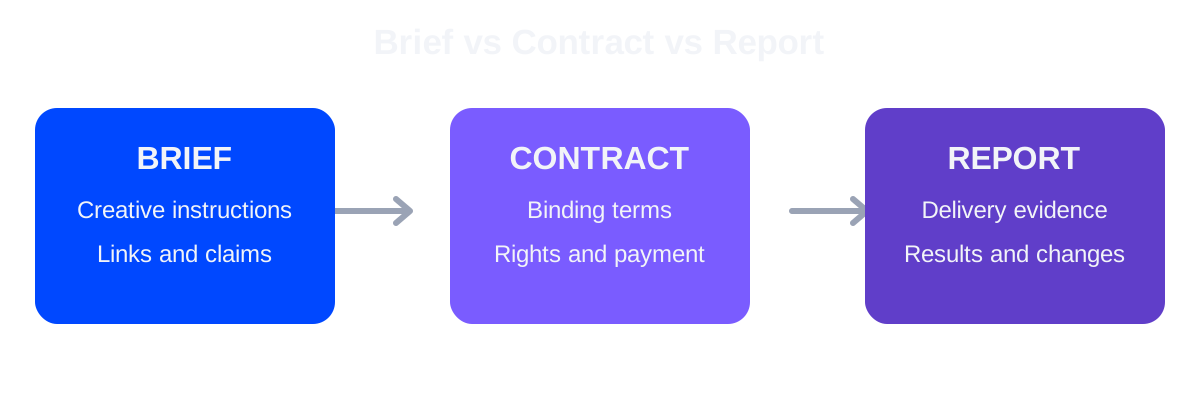
For creator selection, use the crypto KOL due-diligence checklist. For messages, tracking links and creative examples, use the campaign brief template. This article is about the binding terms that connect those documents.
The 15 Terms to Review Before Signing
1. Parties, accounts and authority
Record the legal contracting entity, payment recipient, creator handle and platform account. Confirm who can approve work for the brand and who can bind the creator or agency. If an agency signs on the creator's behalf, have counsel confirm its authority. A handle alone is not a reliable contracting identity.
2. Campaign purpose and product boundary
Name the product, campaign and permitted claims. Is the creator explaining a wallet feature, inviting exchange registrations, discussing a token, or covering a DeFi protocol? The distinction matters because approval and promotion rules vary by product and market. Do not let a generic “crypto partnership” clause silently expand to another asset.
3. Deliverables and acceptance criteria
Specify the number, format, platform, account, language, approximate duration and live URL for each item. A schedule might illustrate 2 posts and 1 live AMA; those numbers are examples, not industry standards. Define what counts as delivery: a post that stays live for the agreed window, carries the agreed disclosure and uses approved links and claims. State whether edits, reposts or clips are separate deliverables.
4. Dates, dependencies and approvals
Set draft, feedback, revision and publication deadlines, with time zones. A 48-hour review window can be written as an illustrative planning assumption, but make exceptions for factual or legal concerns. Say what happens if the brand misses its review deadline or a platform outage blocks publication. Silence should not be treated as legal approval unless counsel deliberately drafts that result.
5. Cash, token and in-kind compensation
List the cash amount and currency, payment milestones, invoicing details and reimbursable expenses. If tokens or other benefits are involved, record the asset, quantity or calculation method, valuation reference and date, transfer conditions, vesting or lockups if applicable, and who handles taxes. Do not imply a token has a stable market value. Record free access, travel, gifts or referral commissions too: material connections may require disclosure even without a cash fee. The FTC's influencer disclosure guide explains this U.S. principle.
6. Disclosure responsibility and placement
Specify who drafts the sponsorship disclosure, where it appears, who checks it and how the published version is archived. A contract instruction alone does not make a post compliant. Under FTC guidance, a disclosure should be clear and conspicuous in the endorsement itself; a platform's disclosure tool may not be sufficient on its own. For video or live formats, review the actual audience experience, not only the caption. The rules for each audience market and platform need separate review.
7. Financial-promotion and claims review
Identify a legal/compliance approver for price, returns, safety, licensing, listing and investment-related claims. The creator should not improvise promises or represent speculation as fact. Where U.S. securities law applies, the SEC's paid crypto-promotion enforcement release describes disclosure of the nature, source and amount of compensation for promoting a crypto asset security. This does not mean every token is a security; asset classification requires legal review.
For UK consumers, the FCA's cryptoasset marketing guidance describes 4 routes by which qualifying cryptoasset promotions may lawfully be communicated, including rules relevant to overseas firms. In the EU, MiCA Article 7 sets conditions for marketing communications within its scope, including clear identification and fair, clear, non-misleading information. The agreement should make audience targeting and counsel sign-off an explicit gate, not assume one approval covers every market.
8. Permitted markets, language and audience
State where content may be targeted or amplified and which languages are approved. Organic content can cross borders; targeting restrictions and creator instructions should still be documented. If the campaign changes from a regional education brief to global paid distribution, require a new review. Regional capability is also relevant when choosing creators, as discussed in ChainPeak's Asia KOL channels and ROI guide.
9. Content accuracy, links and change control
Attach a versioned brief with approved facts, risk language, landing pages, referral codes, token tickers and forbidden claims. Identify which document controls if the brief and contract conflict. If a product feature, listing status or campaign date changes, require a written change request and a new approval before the creator updates a live post.
10. Organic rights, reuse and paid amplification
Distinguish the creator's organic posting from the brand's right to repost, edit, translate, whitelist or run the content as a paid ad. A 30-day paid-usage license is an example of a negotiable term, not a default right. Record channels, territory, duration, edit permissions, attribution, archival use and additional fees. Do not assume buying a post transfers copyright or the creator's name and likeness.
11. Exclusivity and conflicts
Define any restricted competitor category, platform, geography and time period narrowly enough to price and administer it. Ask the creator to disclose current partnerships that could make the campaign misleading or operationally difficult. An undefined “no competitors” promise creates avoidable disputes and may block unrelated work.
12. Data access and reporting
Specify what the creator will provide: live URL, publication time, native platform screenshots or exports, audience geography where available, and dates of measurement. Require tagged links or referral IDs when lawful and technically possible. An illustrative 7-day delivery report may be followed by a later product-outcome report; define both clocks. The crypto KOL campaign reporting template separates reach, tagged traffic and qualified actions so impressions are not described as customers.
13. Fraud, invalid traffic and metric disputes
Define what happens if bought engagement, bot traffic, altered screenshots or an incorrect tracking link is discovered. Identify the evidence source and a review process before withholding payment. Do not make a creator warrant product conversions that the brand's own analytics cannot observe. The agreement can require cooperation and authentic reporting without promising a fixed commercial outcome.
14. Corrections, removal and incident response
Set an escalation path for an inaccurate claim, missing disclosure, compromised account or regulator/platform notice. Name who can request a correction or pause and how quickly the creator must acknowledge it. Preserve the original and corrected versions. A removal clause should address live posts, scheduled content, paid ads and screenshots already distributed; deletion alone may not erase the original exposure.
15. Cancellation, termination and dispute terms
Define cancellation before draft, after approval and after publication; payment for completed work; unused token or expense treatment; and surviving rights or obligations. Specify governing law, notice method and dispute process with counsel. A missed milestone, changing token launch or platform ban should have an agreed path instead of an improvised negotiation during the campaign.
Copyable Crypto KOL Contract Checklist
Copy this into an RFP, contract review sheet or signing ticket. Mark each line Agreed / Open / Not applicable, name an owner, and link the evidence. An unchecked item is a decision to resolve, not a clause to paste blindly.
| # | Pre-signature check | Status / owner / evidence |
|---|---|---|
| 1 | Legal parties, creator account and signing authority verified | ___ |
| 2 | Product, campaign objective and permitted claims defined | ___ |
| 3 | Every placement, format, language and acceptance test listed | ___ |
| 4 | Draft, review, revision and live dates with time zones agreed | ___ |
| 5 | Cash, tokens, benefits, valuation and payment triggers documented | ___ |
| 6 | Disclosure wording, placement, reviewer and archive method assigned | ___ |
| 7 | Asset and audience-market compliance review completed | ___ |
| 8 | Approved territories, languages and paid targeting recorded | ___ |
| 9 | Versioned brief, URLs, claims and change process attached | ___ |
| 10 | Organic, reuse, paid-ad, editing and likeness rights separated | ___ |
| 11 | Exclusivity limited by category, time and territory | ___ |
| 12 | Reporting fields, source data and deadlines agreed | ___ |
| 13 | Invalid-traffic and disputed-metric review process agreed | ___ |
| 14 | Correction, pause, removal and incident contacts named | ___ |
| 15 | Cancellation, payment-on-exit and dispute terms reviewed | ___ |
Adjust the Contract to the Project
| Project | Extra questions for counsel and the growth team |
|---|---|
| Token launch | What can be said before and after launch? Are paid promotion, token compensation and listing statements reviewed for each market? |
| Exchange | Which registration or trading claims are permitted? Who approves referral language, risk disclosures and affiliate terms? |
| DeFi | Are yield, reward, custody and smart-contract-risk statements accurate and current? Who updates changed figures? |
| Wallet | Is the action a download, verified activation or transaction? What privacy-safe event can be measured? |
| Layer 1/2 | Which ecosystem statistics and partner claims are substantiated, and when do they expire? |
These are review prompts, not a claim that all projects face identical legal treatment. Keep the measurable event in the brief and reporting plan, while the contract states the creator's evidence obligations and the approval process. Do not pay for impressions and later expect wallet activations unless that outcome was explicitly defined and technically measurable.
A Practical Sign-Off Workflow
The growth owner drafts the deliverable schedule and commercial sheet. The creator confirms feasibility and account access. Legal/compliance reviews the asset, audience market, disclosure and claim rules. Finance confirms compensation and token handling. The campaign owner then locks the brief version, tracking links and signatories. Only after those gates should publication be authorized.
Treat approval as a recorded event, not a chat message someone remembers. Save the signed agreement, brief version, approved creative, publication URL, screenshots and reporting exports under one campaign ID. This creates a defensible handoff from creator selection to execution to post-campaign analysis, while leaving market-specific legal judgments to qualified counsel.
Conclusion
The best crypto KOL contract checklist is the one your team can actually use before money or tokens move. It makes deliverables, compensation, disclosures, rights, evidence and exit decisions explicit; it does not promise that a template alone makes a campaign compliant or successful. Resolve the 15 items above, attach the approved brief, and give each unresolved legal or commercial question a named owner before signing.
