


Crypto KOL rates in 2026 run from 20 USD for a KOC post in Vietnam to 30,000 USD and above for a top Korean YouTube channel. There are no public rate cards, quotes for the same creator vary threefold by buyer, and price correlates weakly with performance. Real negotiated ranges follow below, market by market.
After coordinating creator campaigns for 450+ projects since 2022 through a vetted network of more than 10,000 KOLs, our position is that KOL marketing in Asia is an economics problem before it is a content problem. Know the real rate bands, the right platform per market, and how to measure past impressions, and the channel works. Buy follower counts, and it does not.
Key Takeaways
- Crypto KOL rates run 100–1,500 USD mid-tier across most Asian markets; Korea commands 1,000–5,000 USD.
- Tier creators by following for pricing only; follower counts never predict conversion performance.
- Cost per retained user is the only KOL metric comparable across creators and markets.
- The top quartile of creators typically delivers most attributable conversions; test broadly, then concentrate.
- Budget 25–40 percent above quoted creator rates for production, coordination, and management overhead.
- Coordinated KOC waves of 50–200 posts often beat one head KOL at equal cost.
How Much Do Crypto KOLs Charge Per Post?
Global benchmarks give a starting frame. Western-market pricing guides from agencies such as Coinbound and rate trackers like CryptoKOLz put micro-influencers at 200–1,000 USD per post, mid-tier accounts at 1,000–10,000 USD, celebrity KOLs at 10,000 USD and up, and in-depth YouTube reviews at 2,000–20,000+ USD as of 2026.
Asia sits differently. Southeast Asian and Vietnamese creators price well under those bands, Chinese-speaking creators near the bottom of them, and Korean and Japanese creators at or above the top. Two adjustments apply everywhere: quoted rates are opening positions, not prices, and the all-in cost of a managed campaign runs 25–40 percent above creator fees once translation, review, scheduling, attribution setup, and payment handling are counted.
Crypto KOL Rates by Market: The 2026 Tables
We tier creators by following, but treat tiers only as a pricing baseline — never as a performance predictor.
| Tier | Following | Typical role in a campaign |
|---|---|---|
| KOC (key opinion consumer) | 500–10k | Volume, authenticity, community seeding |
| Mid-tier | 10k–100k | Workhorse of most campaigns |
| Head | 100k–500k | Credibility and reach moments |
| Top | 500k+ | Launch spikes, narrative-setting |
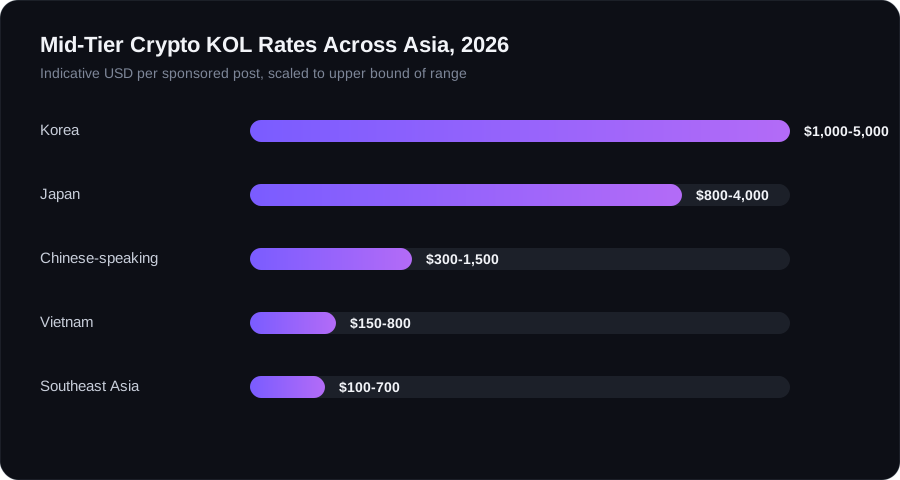
The ranges below are for a single sponsored post or video from our 2026 negotiations, quoted in USD and usually paid in stablecoins. Treat them as bands, not quotes: exclusivity, token-versus-cash mix, content format, and market conditions all move prices.
| Market | Mid-tier (10k–100k) | Head/top (100k+) | Primary platforms |
|---|---|---|---|
| Chinese-speaking | 300–1,500 | 1,500–20,000+ | X, Telegram |
| Korea | 1,000–5,000 | 5,000–30,000+ | YouTube, Telegram, Kakao |
| Japan | 800–4,000 | 4,000–25,000+ | X, YouTube |
| Vietnam | 150–800 | 1,000–6,000 | Telegram, Facebook, YouTube |
| Southeast Asia (ID/PH/TH/MY) | 100–700 | 800–5,000 | TikTok, X, Telegram |
Three structural notes. Korea prices high because distribution is concentrated: a handful of YouTube channels and Telegram communities reach most active traders, most deals run through intermediaries, and video production is real work. Japan prices reflect compliance caution — established creators decline most token promotions outright, so the supply of credible voices is small. Vietnam and Southeast Asia are the cheapest per post but require volume and native-language management to matter. Regional depth is exactly what a KOL marketing partner should bring; rate access alone is not the hard part.
Which Platforms Work in Which Asian Markets?
Matching platform to market matters more than creator selection. In Korea, long-form YouTube reviews outperform everything else for consideration, with Telegram and Kakao open chats carrying the trading conversation. Chinese-speaking audiences live on X and Telegram. Japan is X-first with YouTube for depth. Vietnam runs on Telegram and Facebook groups with YouTube for discovery. Indonesia and the Philippines respond strongly to TikTok and quest-driven Telegram funnels.
Running a TikTok-native brief at Korean YouTubers, or long-form scripts at Vietnamese Telegram admins, wastes both the fee and the relationship. Brief per platform, not per campaign.
Measuring KOL Marketing ROI Beyond Impressions
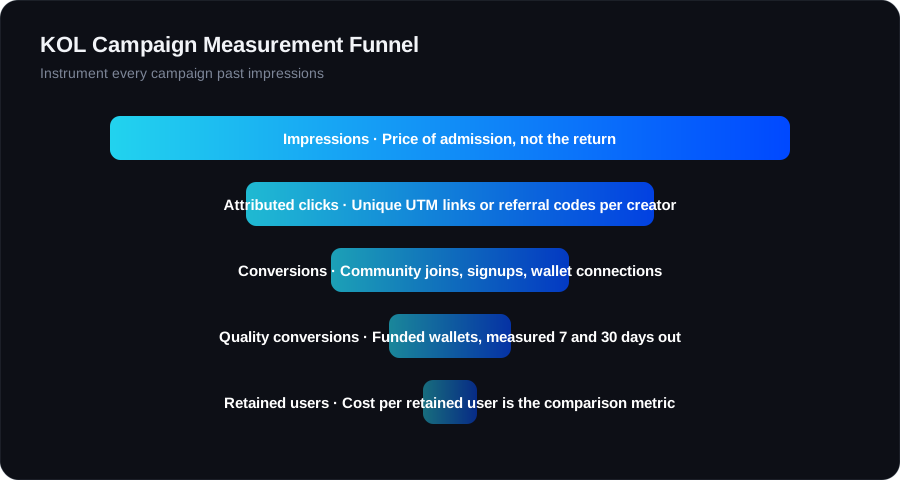
Impressions are the price of admission, not the return. We instrument every campaign as a funnel:
- Attributed clicks — unique UTM links or referral codes per creator, no exceptions.
- Conversions — community joins, signups, or wallet connections attributed to each creator.
- Quality conversions — funded wallets, first transactions, or deposits, measured 7 and 30 days out.
- Cost per retained user — the only number worth comparing across creators and markets.
Two practices change outcomes more than any negotiation. First, tag cohorts by creator and read 30-day retention, not day-one volume: creators whose audiences stay are rebooked, the rest are not, and after a few campaigns this compounds into a performance-ranked roster. Second, benchmark against a holdout: if branded search, organic joins, and direct traffic did not move during the flight, the impressions were probably bots or indifference.
Expect wide dispersion. In our campaigns, the top quartile of creators routinely delivers the majority of attributable conversions — the strongest argument for testing many creators small before concentrating spend.
Red Flags That Waste KOL Budgets
- Follower-to-engagement anomalies. 200k followers with 30 likes per post, or engagement that arrives in the first ten minutes then stops — bought audiences behave like bought audiences.
- Engagement pods. The same rotating accounts commenting across a creator's posts. Check the commenters, not the count.
- Guaranteed outcomes. Anyone promising price action or a "guaranteed 100x community" is a compliance liability, not a partner.
- Recycled case screenshots. Dashboards with cropped dates and no verifiable links are the industry's most reused asset.
- Telegram view inflation. Channel views are cheap to buy; insist on click-through and join data instead.
- No disclosure. Financial regulators such as Korea's Financial Services Commission and Japan's Financial Services Agency have tightened crypto promotion rules, and Japan bans undisclosed stealth marketing outright. Creators who refuse disclosure are pricing in a risk you will pay for.
KOC vs KOL: Where Each Fits
KOCs — key opinion consumers with 500–10,000 followers — cost 20–100 USD per post but deliver something big accounts cannot: they read as users, not billboards. In markets like Vietnam and Indonesia, and in Chinese-speaking Telegram ecosystems, a coordinated wave of 50–200 KOC posts often outperforms one head KOL at the same total cost, both on engagement quality and on sybil resistance — real small accounts have history; bot networks do not.
The blend we typically run: KOCs for continuous presence and social proof, mid-tier KOLs for campaign waves, and head accounts reserved for moments when there is real news to amplify. Head-KOL spend without an announcement behind it is the most common way budgets die.
FAQ
How much do crypto KOLs charge in 2026?
Indicatively, 100–1,500 USD per post for mid-tier creators in most Asian markets, rising to 1,000–5,000 USD in Korea. Head and top accounts run from 1,500 to 30,000 USD and above depending on market. Every quote is negotiable and moves with exclusivity, format, and market conditions.
Do crypto KOLs accept tokens as payment?
Some do, usually as a cash-plus-token blend with vesting, and it can align incentives. Top creators in Korea and Japan generally require stablecoins, and heavy token compensation attracts creators who sell into your community. We recommend majority-stablecoin deals with modest, vested token upside.
What is a realistic ROI for crypto KOL marketing?
Measured on cost per retained user rather than impressions, well-run Asian KOL campaigns are usually competitive with or cheaper than paid social. Dispersion is extreme: the top quartile of creators delivers most of the return, so budget to test broadly, measure per creator, and cut fast.
How much does KOL marketing cost beyond creator fees?
Plan for 25–40 percent on top of quoted rates. The overhead covers briefing and translation, content review, scheduling across time zones, UTM and attribution setup, stablecoin payment processing, and the management time to vet creators and remove fakes. All-in cost per retained user is the honest comparison.
Are paid crypto promotions required to be disclosed in Asia?
Increasingly, yes. Financial regulators such as Korea's Financial Services Commission and Japan's Financial Services Agency have tightened crypto promotion rules, and Japan bans undisclosed stealth marketing outright. Creators who refuse disclosure are pricing in a legal risk that the sponsoring project ultimately pays for.
Final Thoughts
Crypto KOL rates reward buyers who treat the channel as a measured acquisition system rather than a reach auction. The 2026 bands are knowable — 100–1,500 USD mid-tier across most of Asia, 1,000–5,000 USD in Korea, 20–100 USD for KOC volume — but the bands are the easy part. The return is decided by structure: platform-matched briefs, unique attribution per creator, 30-day retention reads, holdout benchmarks, and the discipline to cut the bottom three quartiles fast and rebook the top one.
The trap is symmetrical. Overpaying for followers wastes budget directly; underinvesting in measurement wastes it invisibly, by making every creator look average. Add the 25–40 percent management overhead honestly, insist on disclosure in regulated markets, and let cost per retained user arbitrate every decision. Our regional benchmarks and sequencing logic live in the ChainPeak playbook; for a scoped estimate against your target markets and budget, contact us and we will price the campaign creator by creator.
