


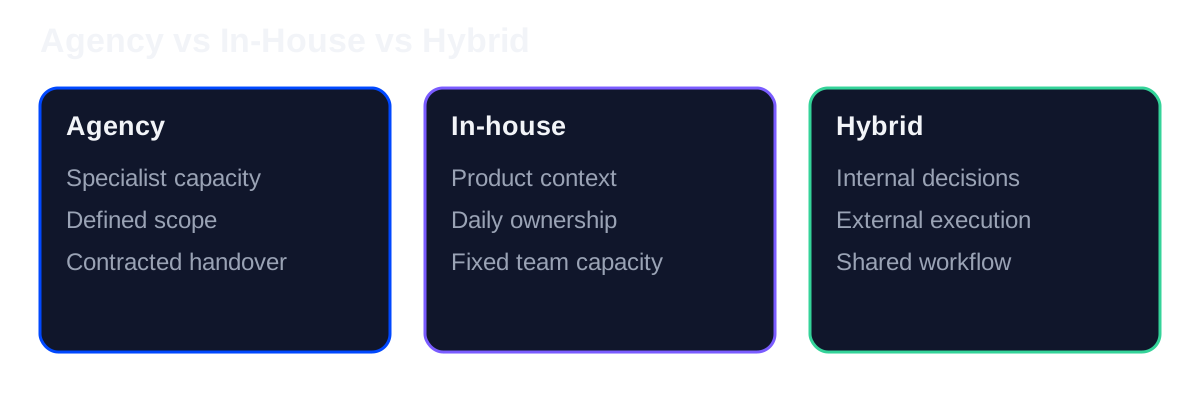
For a Web3 marketing agency vs in-house team decision, the strongest default is often a small internal owner plus external specialists—not an all-or-nothing choice. Keep positioning, product truth, community policy, customer data and budget approval inside the company. Buy specific execution capacity when a launch, region or channel demands skills you cannot hire quickly. Compare the full cost and ownership of each model, not a retainer against one salary.
An agency can help execute across several channels, but it does not automatically know your product or own your customer relationships. An internal team has more context and direct control, but recruiting and managing specialists takes time. The comparison below helps founders and heads of growth choose a structure that can change as the project matures.
Key Takeaways
- Keep strategic decisions, access credentials, community rules and first-party data under company control.
- Compare agency fees with loaded payroll, recruiting, tools and management time, not salary alone.
- Use an agency for defined specialist work; require named owners and acceptance criteria.
- Build in-house when continuous product learning and community relationships outweigh short-term flexibility.
- A hybrid model works only when one internal lead can brief, approve and measure vendors.
Table of Contents
- Side-by-side comparison
- Real cost and capacity
- Ownership and accountability
- Which model fits each stage
- A 90-day transition plan
- Decision checklist
Web3 Marketing Agency vs In-House Team: Quick Comparison
| Dimension | Agency | In-house team | Hybrid |
|---|---|---|---|
| Best use | Defined launch, specialist channel or regional test | Continuous product learning and community stewardship | Internal direction with external execution |
| Capacity | Contracted scope and staff availability | Hired roles and management bandwidth | Flexible, but coordination is required |
| Time to start | Depends on procurement and onboarding | Depends on hiring and ramp | One accountable lead can start a scoped pilot |
| Cost shape | Retainer/project fee plus pass-through spend | Loaded payroll, recruiting, benefits, tools | Payroll plus selected vendor fees |
| Product context | Must be transferred through briefs and access | Accumulates inside the business | Retained internally if documented |
| Data and accounts | Contract-dependent | Usually company controlled | Company owned by design |
| Main failure mode | Activity without institutional learning | Fixed payroll without needed specialist depth | No internal owner to integrate work |
The table is a decision aid, not a claim that agencies are inherently faster or cheaper. An experienced internal hire may outperform a poorly scoped vendor. Conversely, a company with a narrow six-week launch requirement may not need a permanent multi-channel team.
What Does Each Model Really Cost?
Build a 12-month comparison using the same deliverables and markets. For in-house work, add base pay, employer costs, recruiting, tools, contractors and the manager's time. For agency work, add retainer or project fees, creator and media spend, production, data tools, internal oversight and any termination or transition cost. Count token compensation at an agreed valuation method; do not hide it because no cash changes hands.
As a U.S. labor reference—not a Web3 salary quote—the U.S. Bureau of Labor Statistics reports a $166,790 median annual wage for marketing managers in May 2025. One manager at that wage is roughly $13,899 per month before employer costs. Geography, seniority, token compensation and role mix can move an actual Web3 hiring budget substantially; request local offers rather than treating the median as your price.
Public agency prices also vary by scope. NinjaPromo's pricing page, checked in October 2026, listed 40 hours at $3,200/month, 80 hours at $5,600/month, and 160 hours at $9,600/month on the displayed plan terms. Those are one vendor's capacity plans, not an industry average or a guarantee that every hour is a Web3 specialist's hour. ChainPeak's Web3 marketing agency pricing guide separates general market guides from publicly listed vendor prices.
Here is an illustrative formula to use with your own quotes:
12-month in-house cost = loaded payroll + recruiting + tools + contractors + internal management time
12-month agency cost = fees + pass-through spend + tools + internal management time + transition cost
Do not compare $9,600 of contracted monthly capacity with a $13,899 monthly salary and declare a winner. The former may cover multiple disciplines at limited hours; the latter buys one full-time employee who can own context and decisions. Normalize by outputs, skill depth, coverage hours, geography and rights to assets. If a proposal includes $20,000 in creator fees and the internal plan does not, the comparison is not like-for-like.
Who Should Own Strategy, Community, Accounts and Data?
The company should appoint an internal decision-maker even when an agency does most execution. This is especially important for token statements, roadmap claims, regional restrictions and incident response. Put the ownership model in the contract before granting access.
| Asset or decision | Recommended company owner | External partner's legitimate role |
|---|---|---|
| Positioning and approved claims | Founder/product/marketing lead | Research, challenge and draft |
| Website, ad accounts and analytics | Company-controlled admin accounts | Scoped operator access |
| Community rules and escalation | Internal community/product lead | Moderation and reporting under policy |
| Creator relationships and contracts | Named procurement owner | Sourcing, vetting and management |
| Creative files, research and playbooks | Company under written IP terms | Production and documentation |
| Compliance approval | Qualified legal/compliance reviewer | Route claims and keep approval records |
| KPI definitions and raw data | Internal growth/analytics owner | Instrumentation and analysis |
This is an operating recommendation, not legal advice. Confirm intellectual property, data protection, advertising and crypto-promotion obligations with counsel in each target market. A practical Web3 marketing agency RFP checklist helps turn these rights and responsibilities into questions vendors must answer.
When Is an Agency the Better Fit?
Use an agency or specialist when the work is bounded and the internal team can judge quality: a regional validation sprint, a defined PR program, creator sourcing, technical SEO or a launch communications package. Specify deliverables, named staffing, source-of-truth metrics and a handover date. A six-week pilot with weekly decisions is easier to evaluate than an open-ended promise to “grow awareness.”
Agency scope must also match the product. A wallet seeking funded active users needs different conversion events from a layer-2 ecosystem seeking developers. A DeFi protocol may need education and risk review before acquisition at scale. Asking one vendor to own strategy, compliance, product positioning, community trust and measurable growth without an internal counterpart creates an accountability gap.
Evaluate agencies by a comparable RFP, not a pitch deck. Ask who will do the work, which prior outcomes can be independently verified, how creator fees and media markups appear, what happens when KPIs miss, and how account and content access transfers at exit. Keep the same evaluation questions across bidders.
When Should You Build an In-House Web3 Marketing Team?
Hire internally when marketing needs daily product access, a sustained feedback loop and durable institutional memory. Community trust, developer relations, founder narrative and user research often benefit from direct ownership. The first hire should fill the largest decision bottleneck, not merely copy an agency's channel roster.
An early company with uncertain positioning may need one strong growth or product-marketing lead before a content factory. A funded project with repeatable acquisition might add analytics and lifecycle ownership. An exchange running continuous regional programs may need local and compliance coordination alongside centralized strategy. These are planning patterns, not universal org charts; product risk, market and runway determine the sequence.
Before hiring, write the job around recurring decisions and outputs. If you cannot list work that will fill the role after the launch period, a project contract may preserve flexibility. If the same external brief has been rewritten for months because no one owns product context, an internal role may be overdue.
Is a Hybrid Web3 Marketing Model Better?
A hybrid model can separate long-term ownership from short-term specialist capacity. One internal lead owns the goals, positioning, calendar, approvals, data and post-campaign learning. Vendors own specific work packages with documented interfaces. It fails when the internal lead has neither authority nor time to review work; “hybrid” then becomes several disconnected suppliers.
Use a simple responsibility map for every campaign: one accountable owner, one execution lead, one approval path and one measurement owner. In a token launch, for example, internal product and legal teams approve claims; an agency coordinates creative and regional distribution; the internal analytics owner checks qualified actions after launch. For creator programs, add a signed disclosure and conflict-review step before any post goes live. ChainPeak's Web3 marketing ROI guide details the event and cost definitions needed for that review.
A 90-Day Build, Buy or Hybrid Plan
Days 1–15: diagnose. Name the growth constraint, target users, markets and two or three qualified outcomes. Inventory all accounts, data, assets and existing contractors. Calculate a 12-month cost envelope that includes pass-through spend.
Days 16–30: choose work packages. Keep product narrative, risk review and data ownership inside. Decide which capabilities need permanent context and which are temporary. Issue a consistent RFP for the temporary work; document the first internal hire's job separately.
Days 31–60: run a pilot. Set a fixed scope, a weekly evidence review and a stop/go condition. Track hours or deliverables, actual pass-through cost, approval latency and qualified product actions. Do not use follower growth alone as a success criterion.
Days 61–90: decide and transfer. Continue, narrow or end the external scope using pre-agreed evidence. Export creative masters, audiences where permitted, measurement definitions, account permissions and decision notes. If the work is persistent and central to product learning, convert that workstream into an internal hiring brief.
Web3 Agency Ownership Checklist Before Signing
- [ ] The company owns admin access to site, CRM, community, ad and analytics accounts.
- [ ] Deliverables, staff roles, capacity and exclusions are written down.
- [ ] Creator, media, rewards and publication costs are itemized separately.
- [ ] Legal/compliance approval and emergency escalation owners are named.
- [ ] Qualified outcomes, attribution rules and reporting access are specified.
- [ ] Creative files, research, content, creator records and IP transfer terms are explicit.
- [ ] The contract states minimum term, cancellation, unused budget and handover format.
- [ ] The pilot has a date and evidence standard for a continue/stop decision.
Final Answer
The Web3 marketing agency vs in-house team choice is about where knowledge and accountability should accumulate. Keep product truth, community policy, approvals, accounts and data in the company. Hire for recurring decisions that require daily context; contract for bounded specialist execution. Compare all-in 12-month cost, capacity and ownership on the same scope, then reassess after a measured pilot. The best structure can change with the product stage—and should be designed to do so without losing its data or audience relationships.
