



To measure Web3 marketing ROI in 2026, define a qualified product action, connect campaign sources to consented wallet or account events, remove invalid activity, compare retained cohorts, and divide attributable contribution by the full campaign cost. Report attributed ROI as a directional estimate; use a controlled holdout when you need evidence that marketing caused the result.
A wallet connection is an entry point, not revenue. Likewise, a deposit raises TVL without necessarily creating fees for a protocol, and trading volume is not an exchange's net revenue. The six steps below give founders and growth teams a repeatable measurement system across KOL, paid, PR, community and regional campaigns.
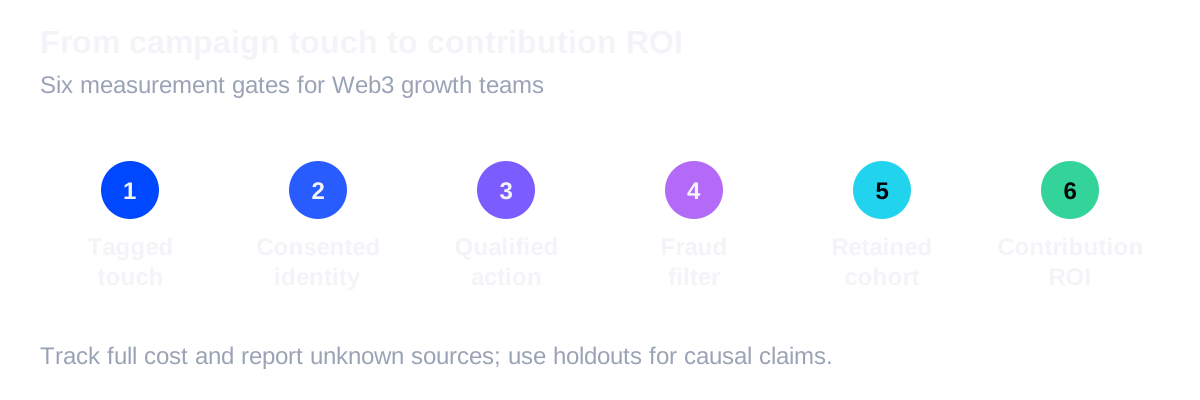
Key Takeaways
- Choose a qualified activation event before launching any campaign or tagging links.
- Connect UTMs or referral codes to consented product identities and later on-chain events.
- Calculate cost per qualified, retained user after excluding bots and incentive-only behavior.
- Use fee or contribution data for financial ROI; show TVL and volume separately.
- Attribute channel outcomes consistently, then test incrementality before claiming causation.
Table of Contents
- What you need before measurement
- Six steps to measure ROI
- Worked channel example
- Copyable reporting template
- Reporting decisions and FAQ
What You Need Before Measuring Web3 Marketing ROI
Assign one owner for campaign tagging and one owner for product or on-chain events. Gather a campaign cost ledger, landing-page analytics, creator and referral IDs, wallet or account events, and a definition of qualified activation. Agree on a time zone, reporting window and permitted identity links before collecting data.
The measurement unit should match the business model. For DeFi, it may be a first valid deposit followed by fee-generating activity. For an exchange, it may be a KYC-approved first depositor who trades. For a wallet, it may be a funded user who completes a meaningful transaction. ChainPeak's Sybil-aware acquisition guide explains why raw wallet counts can distort growth reporting.
Step 1 — Define the Conversion and Economic Value
Create an event dictionary before spending. Record an event name, precise inclusion rules, source system, owner and verification method. Distinguish a diagnostic action such as wallet_connected from a qualified action such as first_valid_swap or first_funded_trade.
| Metric | Example definition | Use |
|---|---|---|
| Reach | Served impression or article view | Diagnose distribution |
| Visit | Tagged landing-page session | Diagnose traffic |
| Activation | First valid product action within 30 days | Compare acquisition |
| Retention | Another valid action 30 days after activation | Compare user quality |
| Revenue | Protocol fees or exchange net fees attributable under stated rules | Calculate contribution |
Set the value basis explicitly. A $10,000 deposit is not $10,000 of marketing return; it becomes a return only to the extent it produces revenue or contribution that the business recognizes. Do not treat token-price moves, gross trading volume, TVL or fundraising as campaign revenue.
Step 2 — Connect Off-Chain Sources to Product Events
Tag every controlled destination with a consistent utm_source, utm_medium and utm_campaign; add a stable creator or placement ID when relevant. Google's campaign URL guidance explains how these parameters identify referring campaigns. Keep the same naming dictionary across paid, KOL, partner, email and community links.
When a visitor consents and connects a wallet or signs into an account, persist the campaign ID to an internal pseudonymous user record. Join later product events to that record using an approved analytics design. Capture event time, chain, contract or product event, wallet/account ID, transaction hash where useful, and a validity flag. A tagged visit without a reliable identity join remains an unattributed visit; report it as such.
On-chain queries can validate transactions, while web analytics records acquisition touchpoints. Dune's query documentation describes querying blockchain data. Neither a blockchain query nor a web session alone establishes which campaign caused a user's action.
Step 3 — Remove Invalid and Reward-Only Activity
Define fraud rules before viewing results. Flag repeated self-referrals, suspicious clusters of fresh wallets, scripted event timing, circular funding and actions performed only to claim a reward. Apply rules consistently to every channel, document exclusions and retain both gross and net counts.
Do not assume all new wallets are unique people. One user may control several wallets, and a shared wallet may represent multiple users. Where identity cannot be resolved, label the metric qualified wallets, not unique customers. For privacy, use only permitted joins and limit access to raw wallet-to-account mappings.
Step 4 — Calculate CAC, Retention and Contribution ROI
Use the same cohort window for every channel. For example, define activation within 30 days of first tracked touch and retention as a second valid action during days 31–60. This is an editorial example, not a universal standard; choose windows that match the product cycle and keep them stable across comparisons.
| Calculation | Formula | Interpretation |
|---|---|---|
| Cost per activated user | All-in acquisition cost ÷ qualified activations | Efficiency of first useful action |
| Cost per retained user | All-in acquisition cost ÷ retained qualified users | Efficiency after churn and fraud |
| Attributed contribution | Attributed net revenue − variable servicing costs | Economic value before marketing |
| Attributed ROI | (Attributed contribution − all-in marketing cost) ÷ all-in marketing cost × 100% | Directional financial return |
All-in marketing cost includes agency fees, creator payments, ad spend, PR placements, affiliate commissions, rewards, production and allocated analytics costs. Separate one-time setup from recurring delivery, and state any allocation method. ChainPeak's agency pricing guide provides a cost breakdown that can feed this ledger.
Step 5 — Compare Channels Without Double Counting
Pick a documented attribution rule. First-touch shows discovery, last-touch shows the final recorded interaction, and multi-touch distributes credit under a chosen model. Google's attribution documentation explains that models assign different credit to the same path. No model by itself proves that a channel caused a conversion.
If one person sees a KOL post, joins Telegram and later clicks a paid ad, the combined channel report must reconcile to the deduplicated total. Show both channel-assigned outcomes and total unique qualified outcomes. Include an “unknown source” row instead of forcing missing journeys into direct traffic.
For PR and organic community work, tagged links may capture only part of the effect. Report direct response separately from broader branded search, referral traffic and market-level change, and avoid assigning all of that change to one article or moderator.
Step 6 — Test Incrementality and Make a Budget Decision
Run a holdout when scale and risk justify it: split comparable audiences or regions, expose one group to the campaign, and measure the difference in qualified outcomes against a control. Google's Conversion Lift guidance distinguishes incremental conversions from ordinary attributed conversions. A Web3 team can apply the same experimental logic to eligible product events, while checking for spillover and small sample sizes.
Decide before the test what would trigger a scale, revise or stop decision. Review not only cost per activation but also 30-day retention, contribution per retained user, fraud share and confidence in the attribution link. A cheap channel that produces reward seekers may be less valuable than a smaller source of repeat users.
Worked Example: How Do You Calculate Web3 Marketing ROI?
The figures below are illustrative arithmetic, not ChainPeak client results or market benchmarks. Suppose a 60-day campaign spends $20,000 in total: $8,000 agency labor, $7,000 creator payments, $3,000 media and $2,000 rewards. It generates 500 connected wallets, 200 qualified activations and 100 retained qualified users.
Cost per activation is $100 ($20,000 ÷ 200); cost per retained user is $200 ($20,000 ÷ 100). Suppose the cohort produces $12,000 in net fees and $2,000 in variable servicing cost, leaving $10,000 in contribution. Attributed ROI is −50%: ($10,000 − $20,000) ÷ $20,000. The campaign may still have long-term value, but the measured 60-day contribution has not repaid the spend.
If the same wallets also deposited $1 million, that figure belongs in a separate balance or activity column. It does not change the −50% result unless and until it produces recognized contribution. A later cohort review can update the calculation with additional fees and retention.
Copyable Crypto Marketing ROI Dashboard
Use one row per channel and acquisition cohort. Keep the data source and rule version alongside every number.
| Field | What to enter |
|---|---|
| Cohort and market | Start month, country, product, campaign ID |
| Spend | Agency + media + KOL + PR + rewards + allocated tools |
| Funnel | Tagged visits → consented identities → qualified activations → 30-day retained users |
| Quality | Excluded bots/Sybil wallets, reward-only actions, unknown-source share |
| Economics | Net fees, servicing cost, contribution, cost per retained user, attributed ROI |
| Evidence | Event definition, attribution model, lookback window, query/dashboard owner |
| Decision | Scale, revise or stop; reason; next review date |
A weekly view should show delivery and data quality; a monthly view should show cohorts, economics and decisions. If an agency supplies the report, retain access to the underlying accounts and query logic. ChainPeak's agency RFP checklist lists the measurement and ownership questions to include before signing.
Conclusion
To measure Web3 marketing ROI in 2026, begin with a qualified product event and a complete cost ledger. Connect consented campaign touchpoints to product actions, remove invalid activity, measure retained cohorts and calculate return from contribution rather than deposits or volume. Use attribution to guide operations and holdouts to test causal claims.
The first practical step is a one-page event dictionary and a dashboard row for each campaign. Once the team agrees on definitions, reporting becomes comparable across agencies, creators, regions and months.
