


Most web3 user acquisition metrics are not measurements — they are invoices submitted by sybil farms. As of 2026, post-airdrop attrition commonly runs 70–95 percent, and every serious counterparty — exchanges, market makers, investors — discounts raw user counts by default. Acquisition that lasts means designing sybils out, not filtering them out afterward.
This post covers the three design filters that make farming unprofitable — cost of action, regional distribution, creator-attributed funnels — and the measurement ladder that keeps reporting honest.
Key Takeaways
- Sybil resistance in web3 user acquisition is a design problem, not a post-hoc filtering problem.
- LayerZero's CEO estimated only 400,000–600,000 of roughly 6 million airdrop accounts were real users.
- A $0.50–2 cost-of-action gate removes most farm traffic while barely denting genuine conversion.
- Relationship-gated regional communities are structurally hostile to farms; distribution itself becomes the filter.
- Report D30 retained funded wallets; every rung above it on the ladder is diagnostic, not achievement.
Why farmed metrics collapse at TGE
The 2023–2025 airdrop meta industrialized fake participation: wallet farms running thousands of addresses through testnets, quest platforms, and points programs, inflating every top-of-funnel number a growth team could report. Incentivized acquisition has an adverse-selection engine at its core — the lower the friction and the more legible the reward, the more attractive the campaign is to professional farmers, who respond faster than genuine users because responding is their job. An open quest with a click-based task list and a hinted airdrop is optimally designed for sybils and roughly neutral for everyone else.
The collapse is then mechanical. Farmed wallets have no use for the product; they hold exactly until reward realization, exit in the same week, and take your liquidity, your chart, and your credibility with them — the repeated pattern behind post-airdrop attrition of 70–95 percent and post-incentive TVL drawdowns of 40–80 percent. On-chain research from firms like Chainalysis shows most airdrop recipients selling within weeks of distribution. Worse, the numbers poison decision-making for months beforehand: teams tune products against bot behavior and negotiate listings on user counts that will not survive contact with TGE.
What is sybil resistance in web3 user acquisition?
Sybil resistance means making fake or duplicate identities unprofitable to operate, so that each acquired account maps to one human with a plausible reason to stay. The industry's reference case is LayerZero's 2024 screening — self-reporting windows plus bounty-driven hunts — which disqualified hundreds of thousands of addresses from a single airdrop; its CEO estimated that only 400,000–600,000 of roughly 6 million eligible accounts belonged to real users.
Since then, forensics has become table stakes: machine-learning cluster analysis of the kind Trusta Labs open-sourced, proof-of-personhood systems like Human Passport, wallet-age heuristics (a referred wallet older than 30 days with prior transactions), and behavioral scoring.
Our position, after supporting 450+ projects since 2022: all of that is downstream. Sybil resistance is an acquisition design problem. You either acquire humans through channels farms cannot cheaply enter, or you acquire bots and pay forensics to tell you so later. Three design filters do most of the work.
Filter one: make each identity cost more than its reward
A farmer's economics are simple: expected reward per wallet, minus cost per wallet, times N wallets. Raise the cost side and N collapses.
Practical mechanics, in rising order of friction: gas-bearing transactions rather than off-chain clicks; small non-refundable commitments (a paid boost, a Telegram Stars purchase, a nominal stake); time-locked participation that forces capital or attention to sit for weeks; and escalating quest chains where meaningful rewards only arrive after cumulative real usage. In our campaigns, even a $0.50–2 cost-of-action gate typically removes the majority of farm traffic while barely denting genuine conversion — humans who want the product pay small costs; scripts do not.
The tradeoff is honest: cost-of-action suppresses top-of-funnel volume, and your dashboard will look worse before it looks real. Full proof-of-personhood (biometrics, KYC) filters harder still but at real privacy and drop-off cost; we reserve it for high-value allocations, not general acquisition.
Filter two: regional distribution as a sybil filter
Sybil farms concentrate where distribution is broadcast and anonymous — global quest platforms, open airdrop aggregators, English-language campaign pages. They are structurally weak where distribution is relationship-gated: a Vietnamese Telegram group with active admins, a Chinese-speaking WeChat community, a Korean Kakao chat. Entering through native-language communities — the core of regional growth — is itself a sybil filter, because each acquired user arrives vouched by a context that scripts cannot cheaply fake.
Regional targeting also makes anomalies visible. A campaign run through 40 Vietnamese communities that suddenly shows Eastern European IP clusters and uniform wallet funding patterns is easy to flag; the same traffic hidden inside a global quest feed is not.
Filter three: KOC funnels you can audit
Key opinion consumers — small creators with 500–10,000 followers — are the acquisition channel farms imitate worst. A KOC wave of 100 small, historied accounts across target communities produces referral trees that can be audited creator by creator: humans refer bursty, socially clustered, variably sized downlines; farms refer uniform ones.
We attribute every campaign at the creator level and read 30-day retention per cohort, which turns the KOC roster itself into a quality-ranked asset over time — the operating core of our KOL and KOC programs.
How do you measure real crypto users?
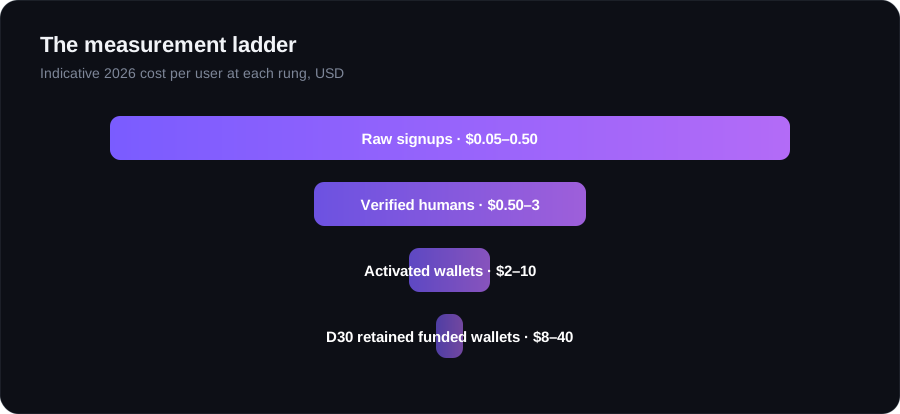
The measurement standard that keeps everyone honest is a ladder, with reporting anchored at the bottom rungs:
| Metric | What it counts | How gameable |
|---|---|---|
| Raw signups / quest completions | Clicks with an account attached | Trivially |
| Verified humans | Passed cost-of-action or personhood gate | Moderately |
| Activated wallets | First real product transaction | Weakly |
| Funded wallets | Wallet holds or deposits meaningful value | Weakly |
| D30 retained funded wallets | Still active a month later | Barely |
The north-star metric we hold campaigns to is D30 retained funded wallets, with D90 as confirmation. Everything above it on the ladder is diagnostic, not achievement — useful for debugging the funnel, useless as proof of user growth.
What does quality CAC look like in 2026?
Indicative ranges from our 2025–2026 campaigns, which vary widely by vertical and region: raw quest signups cost $0.05–0.50; verified humans $0.50–3; activated wallets $2–10; and D30 retained funded wallets commonly land at $8–40 — cheaper in Southeast Asian consumer categories, more expensive for DeFi in Korea or Japan.
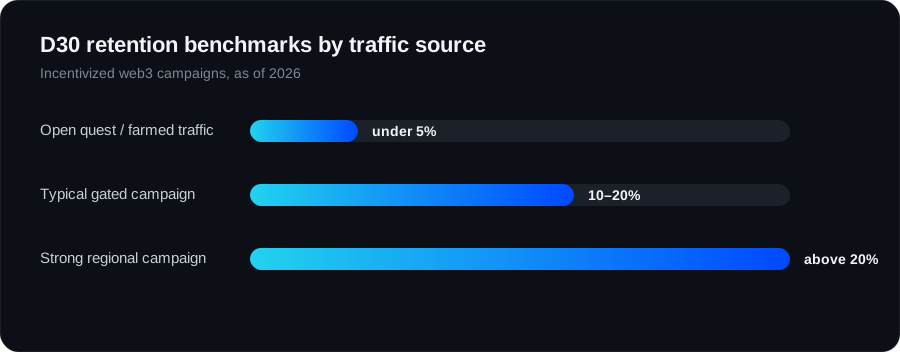
The psychological hurdle is that quality CAC looks expensive next to vanity CAC — $20 per retained wallet against 10 cents per signup. The comparison is false: open quest traffic often retains under 5 percent at D30, while gated campaigns hold 10–20 percent and strong regional campaigns clear 20 percent, so the signup pool's implied cost per retained user is often similar or worse — before counting the token allocation burned on farmers and the credibility cost of a post-TGE cliff. One mid-cap exchange we worked with cut incentivized signup volume by more than half after moving budget behind cost-of-action gates and regional KOC funnels; total signups fell, while retained funded accounts per dollar roughly doubled. That trade is the whole thesis.
FAQ
What is a sybil attack in crypto marketing?
A sybil attack floods a campaign with fake or duplicate identities — wallet farms running hundreds or thousands of addresses through quests, testnets, and points programs to harvest rewards. In web3 user acquisition terms, it converts your incentive budget into farmer revenue while inflating every top-of-funnel metric you report.
How do you filter sybils from an airdrop?
Design them out before launch: per-identity costs such as gas-bearing actions, small stakes, and paid boosts; wallet-age and history requirements; relationship-gated regional distribution; and creator-attributed referral trees. Post-hoc screening — clustering analysis, self-report windows, bounty hunts like LayerZero's 2024 program — catches farms later, after they have already shaped your data.
What retention is good for web3 user acquisition in 2026?
For incentivized campaigns as of 2026, D30 retention of 10–20 percent of verified users is solid and above 20 percent is strong; open quest traffic often retains under 5 percent. If most 'users' never fund a wallet or return after week one, the campaign bought traffic, not users.
Is buying quest-platform users ever worth it?
Sometimes — for awareness, social proof, and funnel testing — if you price it as advertising rather than user acquisition and never report it as users. The moment quest volume feeds a token allocation or a listing narrative, it becomes a liability that surfaces at TGE.
What does a real crypto user cost in 2026?
Indicatively, from 2025–2026 campaigns: raw quest signups run $0.05–0.50, verified humans $0.50–3, activated wallets $2–10, and D30 retained funded wallets $8–40 — cheaper in Southeast Asian consumer categories, more expensive for DeFi in Korea or Japan. Compare campaigns at the bottom rung only.
Final Thoughts
The sybil era did not make web3 user acquisition impossible; it made honest acquisition a design discipline. The three filters — per-identity costs, relationship-gated regional distribution, and creator-attributed KOC funnels — work because they attack farm economics before the first signup, not after the dashboard is already poisoned. The measurement ladder keeps everyone honest afterward: report D30 retained funded wallets, treat every rung above it as diagnostic, and accept that $8–40 per retained wallet beats 10 cents per signup once you price in what farms actually cost — the allocation they drain, the chart they dump on, and the credibility they take with them at TGE.
The teams that internalize this in 2026 get a quiet advantage: their numbers are smaller and true, which is exactly what exchanges, market makers, and investors now underwrite. Our full acquisition framework, including gate designs and cohort benchmarks by region, is in the playbook. If your funnel is producing numbers you do not quite believe, talk to us — pressure-testing acquisition design before TGE is far cheaper than explaining a cliff after it.
