


India web3 user acquisition is the largest opportunity in crypto and the easiest to waste money on: 100–150 million estimated users depending on methodology, the top rank in grassroots adoption for three straight years — and a tax regime that pushes activity away from funded accounts. Winning here means funnels built on education, language, and filtering, budgeted against retained cohorts.
The numbers set the frame. Chainalysis has ranked India first in grassroots crypto adoption through 2025, industry estimates as of 2026 cluster between 100 and 150 million users, and roughly 75 percent of new participation comes from tier-2, tier-3, and tier-4 cities. This guide covers the educator channel, language strategy, sybil discipline at Indian scale, and the CAC ranges we consider defensible.
Key Takeaways
- India web3 user acquisition budgets should target $1.50–5.00 per 30-day retained community member.
- India's 30 percent gains tax and 1 percent TDS remain unchanged for 2026–27, suppressing funded conversion.
- YouTube educators in Hindi and Hinglish are the highest-trust acquisition surface, not X or Telegram.
- Unfiltered Indian campaigns routinely show 60–80 percent sybil shares — the world's highest farming pressure.
- Roughly 75 percent of new Indian crypto users come from tier-2, tier-3, and tier-4 cities.
Scale at the top, friction at the bottom
Hold both facts at once. Top of funnel, India is unmatched: the world's largest YouTube audience, more than half a billion smartphone users on some of the world's cheapest mobile data, and a crypto-curious demographic bulge under 30 — adoption depth that Chainalysis has ranked first globally three years running and that ownership surveys from Triple-A corroborate at nine figures.
Bottom of funnel, the friction is legislated. India taxes crypto gains at a flat 30 percent, deducts 1 percent TDS on most transactions above small thresholds, and allows no loss offsets — rules confirmed unchanged for 2026–27 in the February 2026 budget cycle, with Schedule VDA reporting now embedded in income tax returns and the OECD's crypto reporting framework (CARF) scheduled for adoption by April 2027, per guidance summarized by Koinly. Policy researchers estimated that the large majority of Indian trading volume migrated offshore after the 2022 rules, and the FIU's registration drive brought major offshore exchanges into Indian compliance during 2024–2025 without changing the tax math.
Good India funnels therefore optimize for durable engagement before monetized action: wallet creation, testnet and quest participation, community roles, learn-to-earn completion. Projects that measure India by first-week deposit volume conclude it underperforms; projects that measure six-month cohort participation find their largest and cheapest contributor base. Both are looking at the same country.
Why is YouTube the core channel for Indian crypto users?
India's highest-trust crypto surface is not X, not Telegram, and not the news media — it is a few hundred YouTube educators producing Hindi, Hinglish, and regional-language explainers to audiences from fifty thousand to several million subscribers. The format that works is education-first: what a wallet is, how an L2 differs from an L1, how to evaluate a project — with the sponsor integrated as the worked example rather than the pitch. Indian audiences went through the 2021–2022 pump-channel era and its enforcement aftermath; overt shilling now reads as a scam signal, and the surviving educator tier protects its credibility accordingly.
Practical notes from our KOL practice: educator integrations outperform dedicated promo videos on retention per dollar; mid-tier educators (100k–500k subscribers) are the efficiency sweet spot at roughly $200–1,000 per integration; head educators run $1,500–8,000; and every placement must be disclosed — India's advertising standards body extended influencer disclosure rules to financial content, and the compliant educators are, not coincidentally, the trusted ones. Short-form cutdowns for YouTube Shorts and Instagram Reels extend each integration's reach at marginal cost.
Hindi first, regional next: the language strategy
English reaches metro India — a large but atypical minority. Hindi and Hinglish open the northern population belt where most new adoption is happening, and the major regional languages — Telugu, Tamil, Bengali, Marathi — each represent audiences the size of a mid-sized Southeast Asian country with materially less crypto content competition. Our standard sequence: English documentation as the base layer, Hindi/Hinglish as the first campaign language, then one or two regional languages chosen by where analytics show organic pull.
Machine translation fails hardest in Hinglish — the register is conversational code-switching, not textbook Hindi — so native creators and writers are a requirement, not a premium. A regional-language wave typically costs 30–50 percent of the equivalent Hindi wave and converts comparably where organic interest already exists; the mistake is picking the language by population table instead of by observed traffic.
Sybil discipline at Indian scale
Whatever sybil pressure you have seen elsewhere, India multiplies it. The same scale that makes the market attractive makes it the world's largest source of airdrop farming: organized Telegram farming collectives, device farms, referral-fraud rings, and quest-completion services that industrialize within hours of a campaign going live. Unfiltered Indian campaigns routinely show sybil shares of 60–80 percent — of every 100 raw participants, roughly 20–40 survive honest filtering, and only mid-to-high single digits remain active at day 30. Any CAC computed on raw participants is fiction.
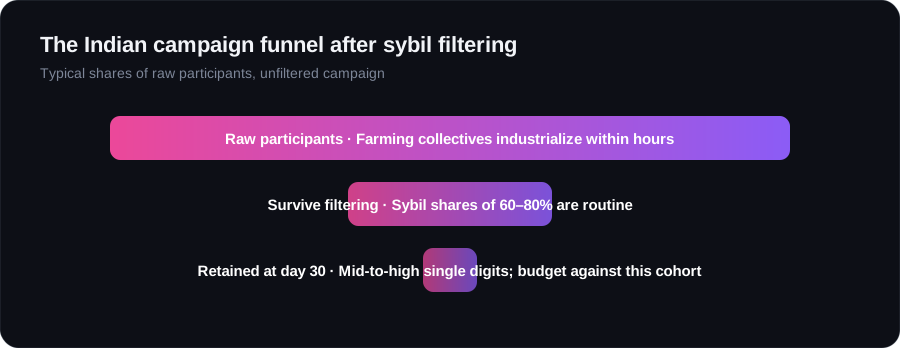
The discipline that works, drawn from our user growth practice: cost-of-action gating scaled to local purchasing power (small but nonzero commitments filter farms without excluding genuine users), staged rewards vesting over 30–90 days of continued activity, behavioral clustering to catch device farms, and — most importantly — contracting KPIs on retained verified users rather than participation counts. India rewards this discipline more than any market: the genuine users behind the noise are numerous, young, and durable.
What does India web3 user acquisition really cost?
Indicative 2026 ranges from our campaign data and market observation, in USD:
| Funnel stage | Realistic CAC range | Notes |
|---|---|---|
| Raw quest/campaign participant | $0.05–0.30 | Meaningless without filtering; quoted for comparison only |
| Verified unique participant (post-filter) | $0.50–2.00 | After sybil and device filtering |
| 30-day retained community member | $1.50–5.00 | The number to budget against |
| KYC-complete funded user (exchange/fintech) | $5.00–15.00 | Tax friction makes this the expensive step |
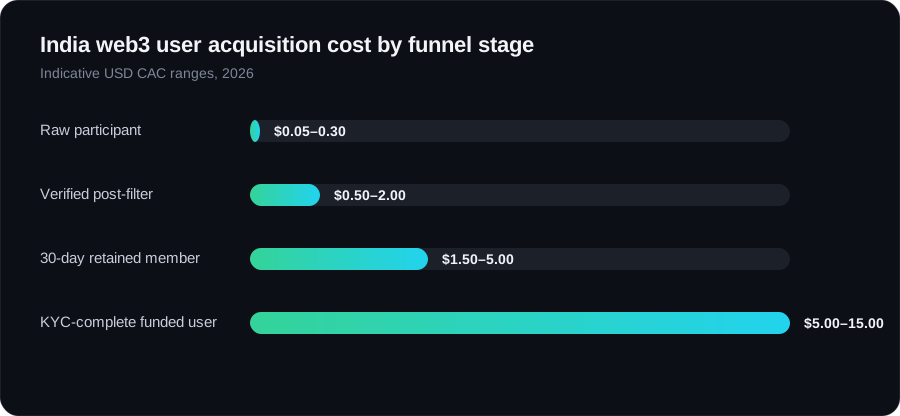
Two honest caveats. First, ranges vary widely by vertical — gaming and consumer quests sit at the low end; anything requiring funded accounts sits at the high end, with the 1 percent TDS documented by the Income Tax Department adding measurable drag at the final step. Second, the spread between raw and retained CAC is the largest of any market we operate in; comparing an Indian raw-participant CPA against a filtered Korean number is comparing different commodities.
The education-first funnel design
The India funnel we build for South Asia entries, per our playbook:
- Discover — YouTube educator integrations in Hindi/Hinglish plus regional pilots; Shorts and Reels cutdowns for compounding reach.
- Educate — a Telegram community with structured learn-to-earn content and active Indian-hours moderation; WhatsApp broadcast for announcement reach where appropriate.
- Activate — gated quests with cost-of-action design, testnet participation, and staged rewards.
- Retain — community roles, regional-language sub-communities, and 30/60/90-day cohort measurement feeding creator selection for the next wave.
The sequencing matters: campaigns that open with the activation step recruit farmers; campaigns that open with two weeks of education content recruit users the farmers then hide among far less successfully.
FAQ
What is a realistic CAC for web3 user acquisition in India?
As of 2026: $0.50–2.00 per verified post-filter participant, $1.50–5.00 per 30-day retained community member, and $5.00–15.00 per KYC-complete funded user. Raw participant costs of $0.05–0.30 are widely quoted and widely misleading — India web3 user acquisition budgets should be set against retained cohorts, never raw counts.
Do we need Hindi content, or is English enough for India?
English covers metro India only. Hindi and Hinglish are the first campaign languages for mass reach, with regional languages — Telugu, Tamil, Bengali, Marathi — as high-upside second waves. Native creators are mandatory: machine-translated Hinglish is instantly recognizable and undermines the educator-channel trust that Indian crypto acquisition depends on.
How does India's crypto tax affect user acquisition strategy?
The 30 percent gains tax and 1 percent TDS, confirmed unchanged for 2026–27, suppress domestic trading, so funnels built around quick funded-account conversion underperform. Design for engagement-first metrics — wallets, quests, community roles — and treat funded conversion as a later, costlier step. Never market around tax avoidance.
Which Indian crypto KOLs deliver the best acquisition ROI?
Mid-tier YouTube educators with 100k–500k subscribers are the efficiency sweet spot at roughly $200–1,000 per integration; head educators run $1,500–8,000. Education-first integrations outperform dedicated promo videos on retention per dollar, and disclosed placements — required under Indian influencer advertising rules — come from exactly the creators audiences trust.
How do you filter sybil participants in Indian campaigns?
Layered design: cost-of-action gating scaled to local purchasing power, staged rewards vesting over 30–90 days of activity, behavioral clustering to catch device farms, and KPIs contracted on retained verified users. Unfiltered Indian campaigns routinely show 60–80 percent sybil shares, so filtering is the acquisition strategy, not an add-on.
Final Thoughts
India is not an exchange-listing market like Korea or a licensed-perimeter market like Japan — it is a funnel market, won or lost on education, language, and filtering. The teams that succeed hold two truths simultaneously: the top of the funnel is the largest in the world, with 100–150 million users and the deepest grassroots adoption Chainalysis has ever ranked, and the bottom of the funnel carries legislated friction that will not change before 2027 at the earliest. So they build for the shape of the market: YouTube educators as the trust layer, Hindi and Hinglish before regional waves, quests gated against the world's most industrialized farming economy, and every rupee of budget held to 30-day retained cohorts at $1.50–5.00 per member. Done this way, India delivers the largest and most durable contributor base in Web3 at costs no other major market approaches. For an India web3 user acquisition plan with creator lists, language sequencing, and cohort-based KPIs, talk to us.
