


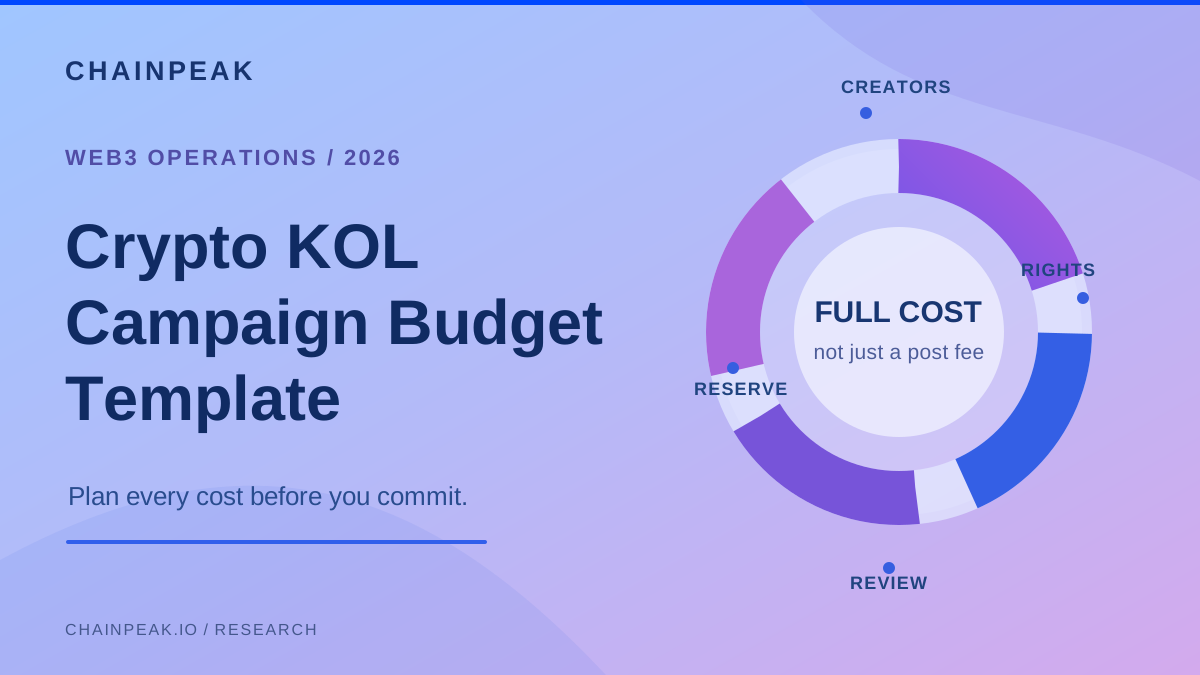
A crypto KOL campaign budget template is a pre-approval worksheet that shows every creator payment, production cost, content right, management fee, tracking expense and reserve in one currency. The useful number is the total funding required, not a creator's quoted post fee. Build the budget from a defined deliverable and market, then keep planned, contractually committed and actually paid amounts in separate columns.
This guide gives Web3 founders and growth teams a copyable worksheet, quote-comparison method and fictional worked example. It does not supply a universal 2026 crypto-influencer rate card: real quotes depend on the creator, channel, rights, territory and timing. Use approved quotes and finance inputs in place of the example amounts before committing funds.
Key Takeaways
- Budget creator compensation separately from production, rights, media, management, compliance and measurement.
- Compare creator quotes only after matching format, audience, territory, duration and usage scope.
- Record token compensation as a contingent commercial term, not guaranteed cash equivalence.
- Keep planned, committed and actual spend separate so a signed deal cannot disappear into estimates.
- Hold a clearly labeled reserve and require approval before turning it into committed spend.
Table of Contents
- What belongs in the budget
- Copyable budget worksheet
- How to normalize creator quotes
- Worked example and formulas
- Approval and variance controls
- Product-specific adjustments
What Costs Belong in a Crypto KOL Campaign Budget?
Start with the campaign objective and the exact action you want a creator to explain or prompt. A wallet activation, eligible exchange signup and DeFi product tutorial are different jobs. The product and target market determine the creator profile, review burden and measurement setup. The campaign brief template defines the approved content; this worksheet prices it before the team makes a commitment.
| Cost bucket | Enter separately | Why it matters |
|---|---|---|
| Creator compensation | Cash fee, referral arrangement or proposed token component | A post price is not the whole deal |
| Production | Filming, editing, translation, extra revisions or live-event support | Formats demand different work |
| Rights and restrictions | Brand reuse, paid amplification permission, account access and exclusivity | Scope and duration can change the quote |
| Agency/management | Sourcing, negotiation, coordination and reporting fee | Keep the fee distinct from pass-through creator spend |
| Paid media | Ad spend and platform charges | Do not count paid reach as organic KOL reach |
| Compliance | Legal and claims review, disclosures, local market review | A blocked claim can change the plan |
| Tracking | Links, codes, analytics setup and data handling | Without measurement, comparisons are weak |
| Reserve | Uncommitted funding for approved changes | Reserve is a funding allowance, not a creator fee |
The ANA and 4A's influencer pay equity guide advises defining usage and exclusivity rather than overreaching, and documenting compensation factors. Price only the rights the campaign actually needs. A 30-day brand repost and a perpetual paid-media license should not sit in the same unlabeled “one post” line.
Copyable Crypto KOL Campaign Budget Template
Create one line per cost component, not one line per creator. For a creator with an organic post, a translated edit and paid amplification rights, use three rows so you can change one term without silently changing the others. Put the underlying quote or approval link in an internal evidence column; do not publish private creator rates without permission.
| Campaign | Creator/vendor | Market | Channel | Deliverable/cost type | Quantity | Unit price and currency | Planned | Committed | Actual | Quote source | Owner | Approval status |
|---|---|---|---|---|---|---|---|---|---|---|---|---|
| [ID] | [handle] | [country] | [X/YouTube/etc.] | [one post] | [1] | [quoted amount] | [amount] | [signed amount] | [paid amount] | [link/date] | [name] | [pending] |
| [ID] | [vendor] | [country] | [channel] | [usage right/production/etc.] | [1] | [quote] | [amount] | [signed amount] | [paid amount] | [link/date] | [name] | [pending] |
Add fields for content-right duration, exclusivity category and dates, payment milestone, tax treatment, FX conversion date and source, token units and vesting, and cancellation terms when applicable. A creator due-diligence check should verify who owns the channel and whether the quoted audience is relevant before a fee is approved. The contract checklist turns the approved commercial scope into binding terms; this spreadsheet does not replace it.
For a spreadsheet, use these formulas, with each row's quantity and unit price in the same currency:
Line planned cost = quantity × agreed unit price
Base planned cost = sum of all planned cost lines, excluding reserve
Funding request = base planned cost + approved reserve
Remaining uncommitted = funding request - committed spend - reserve already released
Variance = actual spend - approved planned cost
If a vendor bills in a different currency, keep the original amount and conversion assumption alongside the reporting-currency amount. Record when the rate was taken. A token promise requires its own units, reference valuation method, payment date, lockup and legal review; do not use a speculative future token price to make a quote look cheaper.
How Do You Compare Two Creator Quotes Fairly?
Ask both creators or agencies for the same scope: channel, placement count, format, length, posting window, audience geography, language, review rounds, analytics evidence, usage rights, exclusivity and cancellation policy. A “$X per post” quote can omit editing, translations, whitelisting or manager fees. The brand should compare scope-adjusted total cost, not two headline numbers.
The ANA and 4A's guide treats audience size as only one compensation consideration and advises documenting the factors behind decisions. Ask for recent native analytics and relevant content examples, then verify audience fit. Do not assume a follower count or projected impressions will become verified users.
| Comparison field | Quote A | Quote B | Decision note |
|---|---|---|---|
| Organic deliverables | [count, format] | [count, format] | Match format before price |
| Target market/language | [territory] | [territory] | Does the audience match the product? |
| Rights | [organic/paid, duration] | [organic/paid, duration] | Price extra rights separately |
| Exclusivity | [category, dates] | [category, dates] | Remove if unnecessary |
| Evidence | [native analytics/date] | [native analytics/date] | Check recency and source |
| Total payable | [all fees] | [all fees] | Include management and taxes |
An agency proposal should identify whether creator spend is a pass-through cost, whether the agency takes a markup, and who owns the resulting analytics and content license. If the terms cannot be separated, mark the comparison not comparable and request a revised quote. That is a procurement decision, not a claim that the higher or lower quote is inherently better.
Worked Example: An $18,000 Funding Request
The numbers below are fictional worksheet inputs for arithmetic only, not observed 2026 market rates, ChainPeak pricing or a recommended budget. Suppose a team has seven planned cost lines and wants a funding cap for one small campaign:
| Fictional line item | Planned amount |
|---|---|
| Creator fees | $9,000 |
| Content rights | $1,200 |
| Production and localization | $1,600 |
| Campaign management | $2,000 |
| Paid amplification | $1,000 |
| Legal and claims review | $800 |
| Tracking setup | $400 |
| Base planned cost | $16,000 |
| Uncommitted reserve | $2,000 |
| Funding request | $18,000 |
Creator fees are 50% of the $18,000 funding request; the $2,000 reserve is 12.5% of the $16,000 base cost. Those percentages are consequences of this invented scenario, not industry benchmarks. If the paid-media plan is canceled before approval, remove its $1,000 line and recalculate; do not quietly reassign it to creator fees. If the reserve is unused, it is not actual spend.
This example can also test a cap. If a real quote makes the plan exceed $18,000, reduce scope, remove optional rights, change the creator mix, or seek a new authorization. Do not book a cheaper, unapproved creator merely to preserve a total. The worksheet makes the trade-off visible before contract signing.
Approve, Commit and Reconcile the Spend
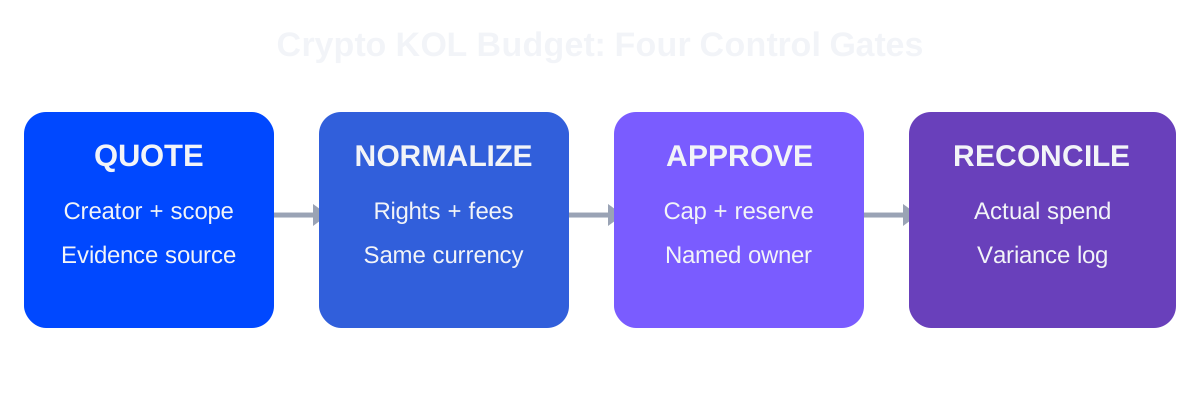
The budget has three states. Planned is an estimate or quote; committed is an approved obligation under a signed agreement or purchase order; actual is the paid or recognized amount under your finance policy. A creator can appear in all three states at different amounts. Keep a change log rather than overwriting the original approved figure.
Set a decision gate for each move: growth confirms the creator and format; finance verifies the total, currency and payment terms; product/legal approves claims, market and asset constraints; an authorized signer commits funds. Release reserve only with a written change reason, revised total and named approver. This is especially important for token compensation, where units, vesting and valuation can change the economic exposure.
For U.S.-relevant endorsements, the FTC's influencer disclosure guide says material connections can include money, free products or other benefits. YouTube creators must also flag paid placements, sponsorships and endorsements in video settings under YouTube's paid-promotion help. Where a campaign reaches UK consumers, the FCA social-media promotions guidance calls for a fair, clear and not misleading approach and discusses influencer communications. Budget for qualified local review; this template is not legal advice.
After publication, reconcile each line with an invoice, proof of delivery and the agreed reporting window. The KOL reporting template holds the delivered placement, traffic and qualified action evidence. Do not label the unused reserve a saving from creator performance, and do not present paid amplification impressions as unpaid creator reach.
Adjust the Template by Web3 Product Type
Exchange: identify whether the goal is an eligible signup, verified account, first deposit or first trade. Add affiliate and referral terms as separate lines. A quoted fee should not imply that a creator can guarantee a trading action or that every signup is compliant in every territory.
Wallet: budget for a product walkthrough, safe user education and privacy-conscious activation measurement. If a paid demonstration needs extra production or localization, show those rows. Never incentivize a creator to ask users for seed phrases or private keys.
DeFi: allow time for technical and risk-claim review. A creator may need product access, documentation and an independent editorial position. Budget the work without purchasing a positive investment conclusion.
Token or L1/L2: separate ecosystem education from token promotion, and review the asset, target market and compensation structure before outreach. A token component belongs in a reviewed agreement with units and timing, not in a vague “upside” cell. The budget should never depend on future price appreciation to balance.
Conclusion
A crypto KOL campaign budget template 2026 should let a founder or CMO answer three questions before signing: what exactly is being bought, what is the full authorized exposure, and which changes require a new approval? Start with defined deliverables and verified quotes, then add rights, management, compliance, tracking and a labeled reserve. Keep planned, committed and actual figures distinct. Once the team approves the scope, move it into the creator agreement and brief; use the reporting record to learn what the spend actually delivered.
