


A crypto KOL attribution setup checklist is a pre-launch test of the path from a creator's published link to an eligible product action. It identifies the campaign, creator and placement; preserves permitted source data; defines a qualified event; and records where attribution becomes uncertain. Build this path before a post is approved, because a reporting dashboard cannot recover missing links or unrecorded product events afterward.
This guide is for Web3 growth, product and analytics teams preparing exchange, wallet, DeFi or token-related creator campaigns. It supplies a copyable tracking specification, a test plan and a handoff to reporting. It does not promise that every wallet action can be tied to one creator or that a referral code proves incremental acquisition.
Key Takeaways
- Give every creator placement a distinct ID and final destination URL, then test the actual link the audience will open.
- Define the eligible product event and its exclusion rules before collecting clicks.
- Treat UTM data, referral claims and wallet events as separate evidence layers; a wallet address does not reveal its acquisition source by itself.
- Document the attribution window, touch rule, consent conditions and unknown-source bucket before launch.
- Do not approve publication until mobile, in-app browser, redirect, code and event tests pass.
Table of Contents
- Define the qualified action
- Build creator and placement IDs
- Specify the data handoff
- Choose an attribution rule
- Run the launch QA checklist
- Handle product-specific edge cases
What Does Crypto KOL Attribution Actually Measure?
Attribution is an evidence-based association between a creator touchpoint and a later action under a declared rule. It is not a proof that the creator caused that action. A tracked click may lead to a visit; a referral code may identify a claim; a product event may show an eligible signup or activation. The team must decide how those records connect and what to do when they do not.
| Evidence layer | What it can establish | What it cannot establish alone |
|---|---|---|
| Creator platform | Post URL, publication time, native reach | Who completed a product action |
| Tagged link | Source, campaign and placement on a visit | That every visitor is a new or eligible user |
| Referral code | A code was entered or claimed | Whether the user first discovered the product through that creator |
| Product event | A defined action occurred | Which off-platform touchpoint caused it |
| Wallet transaction | An on-chain action happened at an address | The human's identity or an earlier creator touchpoint |
The crypto KOL campaign reporting template starts after these records exist. Its results should preserve the quality and gaps of this setup, not collapse platform impressions, tagged visits and qualified actions into one number.
Step 1 — Define One Primary Qualified Action
Write the campaign objective as a product event that an analyst can query. “Awareness” can be a valid objective, but do not quietly replace it with an unplanned signup metric after publication. Choose a primary action, its eligibility rule, observation window and data owner. Add secondary events only if they clarify the path.
| Product | Illustrative primary action | Eligibility questions |
|---|---|---|
| Exchange | First completed trade by an eligible, verified new account | Which markets, duplicate accounts, internal trades and bot patterns are excluded? |
| Wallet | First successful wallet activation or approved feature use | Is this a new wallet or a returning user? What lawful identity join exists? |
| DeFi app | First eligible protocol interaction | Which contracts, chains, test transactions and self-transfers count? |
| Layer 1/2 | First eligible app or network action | Are bridge-only and repeat-user events separated? |
| Token launch | Approved signup or permitted participation step | Are restricted markets, claim rules and compliance checks encoded? |
These are examples, not universal success definitions. For a lead campaign, Google Analytics recommends events such as generate_lead and qualify_lead; they require implementation rather than appearing automatically. A Web3 transaction usually needs a separate product-event design and, if relevant, an approved on-chain query. See Google Analytics' recommended events.
The event specification should state its exact name, trigger, timestamp basis, actor key, environment, contract or app version, exclusion logic, and whether reversals or failed transactions are removed. Assign an owner from product analytics and get approval from compliance where the action has regulated implications.
Step 2 — Build a Placement-Level Link Plan
Create three stable identifiers: campaign_id, creator_id and placement_id. A creator's X thread, YouTube description and Telegram AMA should have different placement IDs even if their commercial contract is one line. Record the exact final URL and expected redirect chain, not just a shortened link.
Google Analytics maps manually tagged utm_source, utm_medium, utm_campaign and utm_content to traffic-source dimensions. The team should agree on a naming convention and verify its own reports; an arbitrary medium value does not guarantee a preferred default-channel grouping. See Google Analytics' manual-tagging documentation and Google's URL builder guidance.
campaign_id: wallet_launch_2026
creator_id: creator_017
placement_id: x_thread_01
utm_source: x
utm_medium: creator
utm_campaign: wallet_launch_2026
utm_content: creator_017_x_thread_01
referral_code: CP017

Illustrative final URL:
https://example.org/start?utm_source=x&utm_medium=creator&utm_campaign=wallet_launch_2026&utm_content=creator_017_x_thread_01&ref=CP017
The example IDs and code are placeholders. Keep private identifiers and personal information out of public URLs. If the platform strips parameters or a redirect loses them, fix the destination and retest before the creator publishes. Do not issue the same link to multiple creators merely because the landing page is identical.
| Copyable tracking-spec field | Enter before launch |
|---|---|
| Campaign and placement | Campaign ID, creator ID, placement ID, platform, format, market |
| Destination | Approved landing page, final URL, redirect owner, mobile fallback |
| Tags and code | Source, medium, campaign, content, unique referral code if used |
| Product action | Event name, trigger, eligibility and exclusion rules, event owner |
| Join and privacy | Permitted first-party key, consent state, retention/access rule |
| Attribution | Touch rule, lookback window, dedupe rule, unknown-source treatment |
| QA evidence | Test device, in-app browser, timestamp, screenshots/logs, approver |
Step 3 — Specify the Data Handoff Without Assuming a Perfect Join
The web or app team needs a lawful way to associate a tagged arrival with a later account or product event. That might be a first-party session, authenticated account or submitted referral code, depending on the product and permissions. Record when the association is created and how it survives a legitimate redirect or app handoff. A raw wallet address can be a pseudonymous identifier in some contexts, but it does not automatically connect a creator click to a person or to all their devices.
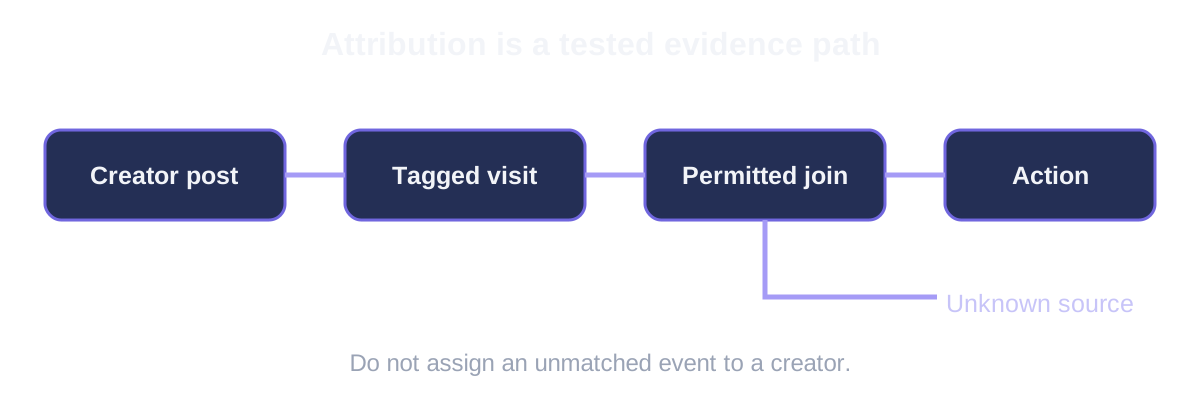
Use an explicit event contract, for example: placement ID captured at eligible arrival; account creation event with an approved internal key; qualified action event with the same permitted key; deduplication by the chosen actor and event definition. If any link fails, preserve the action under unknown or unattributed rather than assigning it to the nearest creator. Do not infer attribution from a public on-chain transaction that lacks a valid off-chain join.
Online-tracking rules depend on market and technology. For UK users, the ICO's cookies and similar-technologies guidance discusses consent for analytics cookies. Have privacy counsel or your responsible team review tracking, storage, disclosures and cross-device joins for the campaign's markets. Do not treat this article as legal advice.
Step 4 — Freeze Attribution Rules Before the First Post
Choose a touch rule—such as first eligible tagged touch, last eligible tagged touch or code-claim priority—and a lookback window suited to the product journey. Record the decision with the brief and analytics specification. A creator can have several placements, users can encounter multiple creators, and someone may enter a code after arriving through another source. Those cases need a written precedence rule; otherwise two rows may claim the same user.
At minimum, define what counts as a new user, whether returning users are reported separately, how overlapping creator touches are handled, how paid amplification is labeled, and how expired windows are treated. Use one campaign-level deduplicated total alongside creator-level attributed totals. The two may differ; explain the difference instead of forcing them to match. The crypto KOL campaign budget template should include the setup and QA costs, while the campaign brief should carry the approved CTA and link instructions.
Step 5 — Run the Pre-Launch QA Checklist
Open the exact production link on the device and app surface the audience will use. Test at least one mobile browser and the likely in-app browser; add desktop or regional devices if the placement requires them. These are test surfaces, not a claim that two devices are always enough. Save screenshots or logs with a test timestamp and owner.
[ ] Creator and placement IDs are unique in the campaign registry.
[ ] The approved post, CTA and landing page describe the same offer.
[ ] Final URL resolves and all required UTM/referral parameters survive redirects.
[ ] Landing page works in the expected mobile and in-app browsers.
[ ] Consent choices behave as designed; prohibited tracking does not fire.
[ ] Test visit appears with the expected source and placement dimensions.
[ ] Referral code is unique, valid, and credited only under the written rule.
[ ] Qualified action fires once; invalid, test and repeat actions are excluded.
[ ] Product event can join to permitted arrival data where a join is expected.
[ ] No-join action appears in an unknown-source bucket, not a creator row.
[ ] Analytics, product, compliance and campaign owners sign off on evidence.
[ ] A fallback destination and incident owner are documented.
Google recommends using DebugView and Realtime to verify implemented events; a dashboard row alone is not proof that the entire creator-to-product path is correct. See Google Analytics DebugView guidance. Run a controlled test through the real URL, then compare source fields and event IDs across systems. Remove or mark test activity according to your reporting policy.
If a link fails after publication, record the affected placement and time interval, repair the link, notify the creator if a new URL is needed, and flag the measurement gap in the final report. Do not backfill missing clicks from impressions or estimate wallet conversions without a disclosed method.
How Do Product Types Change the Setup?
An exchange typically needs account eligibility and trade-quality controls; a wallet needs an activation definition that does not mistake a reinstall or existing user for new acquisition. A DeFi app may need contract-event versioning, chain selection and exclusion of reverted or test transactions. A Layer 1/2 campaign may need to distinguish a bridged wallet from an active app user. Token-related campaigns may add market restrictions, claim conditions and stronger review of the CTA.
The common principle is to define the product action first, then choose the tracking path capable of observing it. A Telegram community join or X follower increase can be useful distribution context, but it is not a substitute for a qualified product event when acquisition is the objective. If the lawful technical join cannot be built, state that limitation upfront and report campaign-level or directional evidence honestly.
Final Answer
Set up crypto KOL attribution before launch by naming each creator placement, issuing a tested tagged link or code, defining one qualified product action, documenting the permitted data join, and freezing the attribution and deduplication rules. Test the full route on real audience surfaces and preserve unattributed actions as unknown. Then the reporting template can evaluate results without mistaking clicks, code claims or wallet transactions for complete causal proof.
