


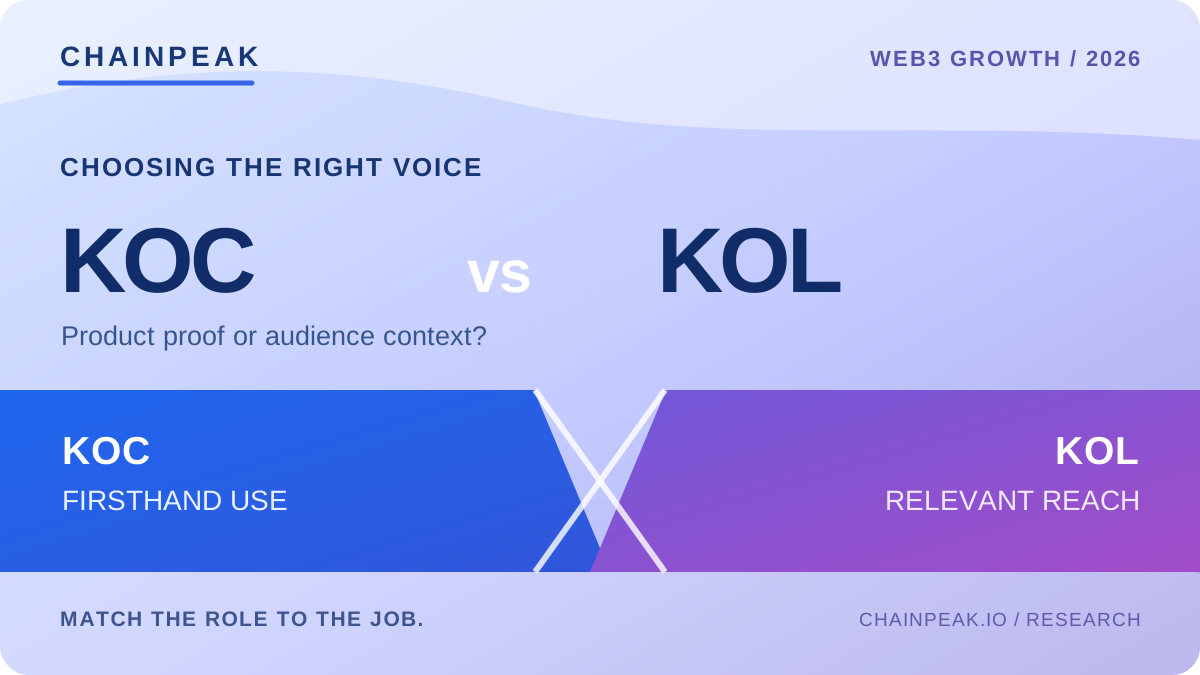
Web3 KOC vs KOL marketing is a choice between two sources of influence, not a contest over follower count. A KOC contributes firsthand experience with a specific product; a KOL contributes recognized expertise, interpretation or audience distribution. Choose KOCs when the buyer needs credible proof of a usable product journey, KOLs when a defined audience needs context or awareness, and both when you can connect the message to a measurable next action. Neither role guarantees qualified users.
The distinction matters because teams often buy reach and then report registrations as if they were product adoption. It also matters in reverse: a useful customer story may help a narrow audience but cannot automatically deliver launch-scale distribution. This guide gives founders and growth teams a conditional decision method, not a claim that one role always costs less or performs better.
Key Takeaways
- KOCs are selected for relevant firsthand use; KOLs are selected for expertise, reputation or audience access.
- A smaller following does not prove authenticity, and a larger following does not prove weak product understanding.
- Match the role to a named buyer question, market and eligible product action before setting deliverables.
- Paid or rewarded endorsements need appropriate disclosures and market-specific review, regardless of creator label.
- Compare qualified actions, exclusions, continued use and total cost; do not compare impressions with retained users.
Table of Contents
- Quick comparison
- Role definitions and overlap
- When to choose KOCs
- When to choose KOLs
- When a hybrid program makes sense
- Budget and operational trade-offs
- Measurement and compliance
- Decision worksheet
Web3 KOC vs KOL Marketing: Quick Comparison
| Decision factor | KOC: firsthand product user | KOL: expert or audience-led creator |
|---|---|---|
| Primary value | Specific, credible user journey | Interpretation, reach or topical authority |
| Qualification test | Has the person genuinely completed the relevant use case? | Does the person reach and inform the intended audience? |
| Typical content | Walkthrough, experience report, practical answer | Category explanation, market view, launch coverage |
| Best fit | Usable product with a clear action and real user friction | New category, launch, complex narrative or regional awareness |
| Main failure mode | Sponsored praise presented as spontaneous testimony | Broad impressions mistaken for qualified adoption |
| First useful KPI | Eligible product action or helpful answer | Qualified audience response or tagged visit |
| Longer-horizon KPI | Relevant continued use | Downstream eligible action, if measurable |
| Pricing | Often negotiated by scope; no universal public rate | Often negotiated by audience, format and rights; no universal public rate |
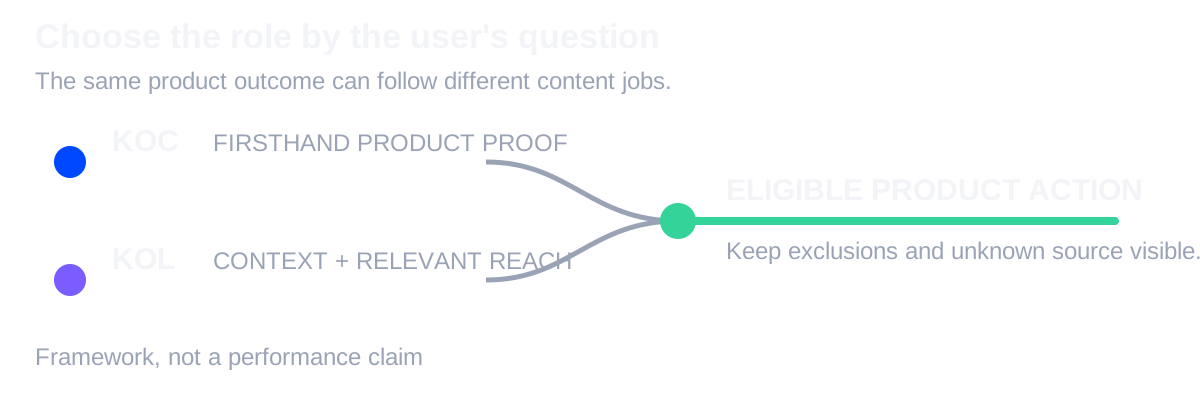
These are role descriptions, not rigid tiers. Decide what the campaign buys and what the creator can substantiate before choosing a label.
What Is the Difference Between a Web3 KOC and a KOL?
A KOC, or key opinion consumer, is valuable because the person can describe a real interaction with the particular wallet, exchange, DeFi application or network product. The proof is not that the person has fewer followers. It is that the account of the product is specific, current and consistent with the experience being claimed. A beta tester can be a valid contributor, but should be described as a beta tester rather than an established customer.
A KOL, or key opinion leader, is valuable because an audience follows the person's knowledge, viewpoint or coverage in a topic or region. A KOL may also have used the product, but use should never be assumed from reputation alone. For procurement, the team needs to verify audience fit, channel quality, prior claims and disclosed relationships. The crypto KOL due-diligence checklist covers that vetting task separately.
One individual can fill both roles when the evidence supports both. “Independent category analysis” differs from “my firsthand onboarding journey.” Payment, access, tokens or referral compensation should be disclosed under applicable rules. The FTC's social-media disclosure guidance includes non-cash benefits and says endorsers cannot describe experience with a product they have not tried.
When Should a Web3 Team Choose KOCs?
Choose KOCs when the product is usable and the audience's unanswered question is practical: “What happens when I try this?” That might mean showing a wallet's first setup, an exchange feature under local eligibility rules, a DeFi interaction on a specified version or an application built on a Layer 2. The story should include friction and limitations, not just a success screen.
Start from consent-based user cohorts or voluntary research invitations. Verify the claimed experience through a permitted product event, opted-in walkthrough or relevant support history. A wallet is not proof of one unique person; never request seed phrases or private keys. The Web3 KOC marketing playbook covers recruitment in detail.
KOCs are a poor fit when the product is unavailable, the brief requires scripted praise or the intended behavior is simply “join a channel.” A large pile of short testimonials does not solve an onboarding failure. An illustrative first test might contain one use case, one market and one primary eligible action. Those are scope controls, not published performance benchmarks.
When Should a Web3 Team Choose KOLs?
Choose KOLs when the obstacle is understanding or discovery among a relevant audience. Examples include explaining a new technical category, placing a launch in market context, or reaching a specific developer, trader or regional community. The strongest assignment specifies the audience's question and the factual boundary; it does not ask a creator to promise a token outcome.
Evaluate audience geography, content quality, engagement relevance and the creator's ability to explain the product. Broad reach in the wrong market is not automatically useful; a smaller specialist may suit a technical question. Use the crypto KOL campaign brief template to define deliverables.
KOL coverage is not proof of product use. For a review, allow enough time to test and form independent conclusions. The FTC's Endorsement Guides Q&A says endorsements must reflect honest opinion and cannot make claims the marketer could not lawfully make.
When Does a Hybrid KOC–KOL Program Make Sense?
Use both when the market needs context and proof. A KOL can explain the category and why a feature matters; a KOC can show what the product feels like in use. Their stories should point to the same verified destination, yet remain independently credible. A hybrid campaign is a sequence of distinct jobs, not a request for every creator to post the same script.
An illustrative 4-week pilot could allocate week 1 to product and claim checks, week 2 to a KOL category explanation, week 3 to opted-in KOC walkthroughs and week 4 to review of qualified actions and errors. This is a planning example, not a promised result or required timeline. Set a single primary product event before either role publishes, then review where each contribution appears in the journey.
If one creator does both jobs, record both deliverables and all material benefits. Do not present a paid KOC story as spontaneous user speech.
How Do Budget and Operating Work Differ?
Neither role has a reliable universal 2026 rate. Published rate cards are incomplete, formats vary, and rights, markets, channels and measurement can change the quote. Without a public, comparable price source for a specific creator or program, write Contact for pricing / Not publicly disclosed rather than inventing a KOC–KOL cost ratio.
KOC programs may require product access, user consent, experience checks, editorial support, moderation, privacy review and reward administration. KOL programs may require audience vetting, briefing, production, usage rights, amplification and reporting. A smaller creator fee can still sit inside a larger operating cost. Compare the full program budget, not a single post price.
Budget for the role that resolves the current bottleneck, plus verification and measurement. If the product journey is broken, neither role fixes it.
How Should KOC and KOL Results Be Measured?
Use three reporting layers for both roles: delivery, relevant response and product outcome. Delivery includes the live asset, correct link and disclosure. Response includes substantive replies, qualified visits or support questions. Outcome includes a predefined eligible action and, where appropriate, continued use. The KOL attribution setup checklist provides a pattern for unique links and the unknown-source bucket.
Report the layers separately. A KOC tutorial can help without large reach; a KOL can introduce a feature without an immediate product action. A view is not a customer, and a wallet connection is not a retained user. The real-user growth playbook explains why raw wallet counts can overstate participation.
An illustrative scorecard can review 7-day activation and 30-day continued use if those windows fit the product cycle; neither window is an industry benchmark. Define exclusions for duplicate, ineligible or incentivized actions. Keep unknown-source users separate rather than assigning them to the nearest post. Google Analytics lists sign_up, generate_lead and other recommended events, but states that these need implementation and relevant context; see Google Analytics' event documentation. Web3 teams must define their own valid product events.
What Compliance Checks Apply to Both Roles?
Incentives, content claims and audience market matter more than the KOC/KOL label. For U.S.-facing endorsements, the FTC guidance cited above discusses material connections and clear disclosures. For UK-facing cryptoasset promotions, the UK Financial Conduct Authority's cryptoasset marketing guidance describes restrictions that can apply to social-media promotions. These sources do not establish that every Web3 post is regulated in the same way; obtain qualified review for the actual asset, product and jurisdiction.
Before publication, check whether the person actually used the product, whether a benefit was received, whether the disclosure is visible in the content's own format, and whether claims about safety, returns, trading or eligibility can be supported. Pause an asset for fabricated experience, unsafe links, hidden compensation or unsupported financial promises. Keep a dated correction trail if a product feature changes after the post goes live.
A Copyable KOC-or-KOL Decision Worksheet
Use this short worksheet before buying either role. The answer can be “neither yet” when product readiness or compliance is the constraint.
1. Audience and market: [ ]
2. One buyer question to answer: [ ]
3. Product journey available in that market? [yes/no]
4. Main bottleneck: [discovery / understanding / firsthand proof / retention]
5. Primary eligible product action and exclusions: [ ]
6. Evidence required for a firsthand-use claim: [ ]
7. Creator qualification: [product use / subject expertise / audience fit]
8. Material benefits and disclosure placement: [ ]
9. Market-specific legal/compliance reviewer: [ ]
10. Delivery, response and outcome KPIs: [ ]
11. Full cost: [fees + production + verification + rights + reporting]
12. Decision: [KOC / KOL / hybrid / neither yet]
| If the main bottleneck is… | Start with… | Only if… |
|---|---|---|
| “How does this product work for someone like me?” | KOC | The contributor has genuine, verifiable experience |
| “Why does this category or launch matter?” | KOL | The creator reaches the intended audience and can explain it accurately |
| Both context and practical proof | Hybrid | Each role has a different brief and shared product measurement |
| Broken onboarding or unclear claims | Neither yet | Product and review issues are fixed first |
Conclusion
Web3 KOC vs KOL marketing is best decided by the problem the next user needs solved. KOCs can explain a real product journey; KOLs can provide category context and access to a relevant audience. Use both when those jobs are distinct and the product action is measurable. Do not promise that one role universally has better ROI, and do not replace experience verification with follower-count labels. Define the market, action, evidence, disclosure and full cost before contracting; then judge each role on qualified outcomes and honest content, not impressions alone.
