


Web3 KOC incentive design 2026 should pay for legitimate creator work and product experience without making positive reviews, empty engagement, or repeatable low-value actions the route to payment. The practical model separates two ledgers: compensation owed to a KOC for agreed work, and any incentive offered to ordinary product users. Each ledger needs its own eligibility rule, disclosure decision, cost record, and success metric.
KOC means key opinion consumer in this article: a product user whose experience is central to the content. A KOC campaign can involve a wallet, DeFi protocol, exchange, application, or community, but the payment rule must match the product and market. This guide helps founders and growth teams design a small pilot; it does not provide legal, tax, or financial advice.
Key Takeaways
- Separate creator compensation from user rewards so neither ledger hides the other's costs or incentives.
- Pay for agreed work and rights, not favorable opinions, token-price claims, or raw wallet counts.
- Define one eligible product action and explicit exclusions before anyone is recruited.
- Disclose material connections in the actual endorsement, including relevant non-cash benefits.
- Test the policy in a small pilot and review qualified behavior before increasing spend.
Table of Contents
- Separate the two incentive ledgers
- Choose a creator compensation model
- Design user rewards around genuine use
- Add disclosure and claim controls
- Measure the pilot and copy the policy
What Is Web3 KOC Incentive Design?
Web3 KOC incentive design is the set of rules governing what a consumer-creator receives, what actions qualify, when payment is released, and what relationship the audience must be told about. It also defines any separate benefits offered to the audience. A clear policy gives creators predictable terms while protecting the product team from counting paid clicks or self-generated wallets as real adoption.
The Web3 KOC marketing playbook covers recruitment and overall operations. The KOC verification checklist covers proof of account control and first-hand use. This page begins after a suitable KOC has been identified and asks how compensation and product-user rewards should work.
Step 1 — Keep Creator Pay and User Rewards in Separate Ledgers
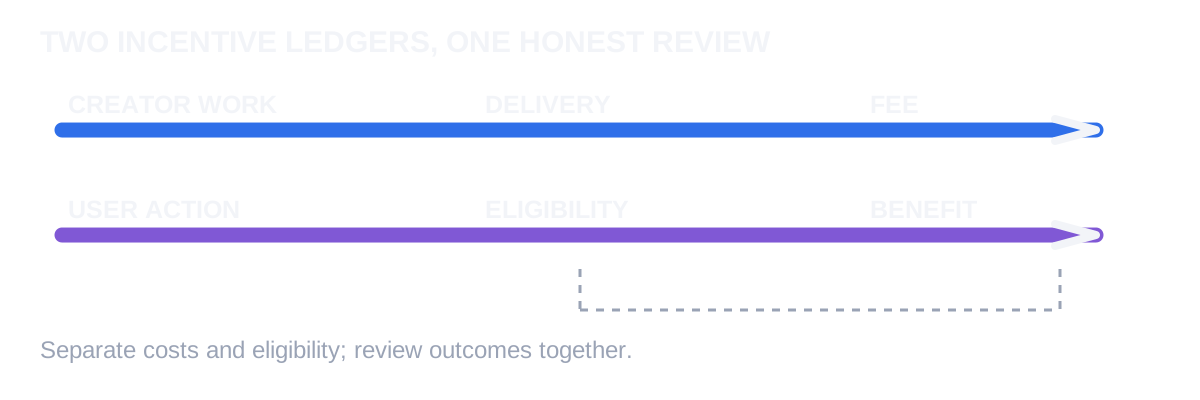
Creator compensation pays for labor: research, product testing, content production, distribution, revision time, and any agreed usage rights. User rewards, if the campaign includes them, are benefits offered to people who perform an eligible product action. Those are different economic relationships. Combining them in one “campaign reward” number obscures the true cost of content and the cost of acquisition.
Maintain two line-item ledgers, even if the same campaign manager owns both. A creator can receive a fixed content fee without any audience reward. A user can receive an eligible onboarding benefit without being a creator. If a creator also participates as a user, the policy should state whether they are eligible for the user benefit and how that activity is excluded from acquisition reporting.
| Ledger | What it pays for | Evidence for release | Main reporting question |
|---|---|---|---|
| Creator work | Agreed deliverables, revisions, rights, and distribution | Contract, delivered content, publication and rights records | Was the agreed work delivered accurately? |
| User benefit | Eligible product action under campaign rules | Product event and eligibility checks | Did distinct users complete meaningful actions? |
Treat the table as a control structure, not an accounting standard. Finance and legal teams should decide how each item is booked in the relevant jurisdiction. The operational point is to avoid presenting creator fees as if they were organic user rewards, or counting a creator’s own product activity as independent acquisition.
Step 2 — Pay KOCs for Work, Not Praise
A simple model is a fixed fee for a defined assignment plus separately negotiated rights or production costs. If a variable component is appropriate, tie it only to a measurable condition that does not require a positive opinion: for example, an approved publication on the agreed date, delivery of a factual demonstration, or completed reporting materials. Do not make payment contingent on the creator saying the product is safe, profitable, or better than competitors.
Specify four contract inputs before quoting a fee: the work, the publishing window, usage rights, and correction obligations. Use a written brief internally to define those inputs. The separate crypto KOL contract checklist can help with rights and approval terms, although KOC work should preserve the creator’s honest experience.
Avoid invented rate cards. A fee should reflect the actual scope and public or negotiated evidence available to the team; there is no universal KOC price for a wallet walkthrough or DeFi test. For tokens, discounted access, or other non-cash compensation, record the benefit and seek market-specific legal and tax review rather than treating it as “free” because cash did not change hands.
Step 3 — Define Eligible Product Use Before Offering Rewards
If the campaign rewards ordinary users, start with a product action that has value independent of the reward. A wallet connection alone may be a prerequisite but not a useful completion event. A DeFi action needs a rule that excludes test transactions and self-cycling; an exchange action needs a market and compliance rule; a community action should require something more substantive than joining a group.
Write the five-part eligibility rule before launch: qualifying event, unique-unit definition, allowed market, exclusions, and observation window. These are policy fields, not benchmarks. Google Analytics lists sign_up, login, generate_lead, and purchase as recommended events, but says such events must be implemented; do not assume a dashboard can identify product use without instrumentation. Google Analytics recommended events
Use an exclusion register for staff, creators, known testers, duplicate events, ineligible markets, and activity that violates published campaign rules. A wallet is not automatically a person. Do not accuse a user of fraud solely because a pattern looks unusual; mark the action for review and record the reason for any decision. The KOC campaign reporting template shows how to keep qualified, excluded, and unverified outcomes separate.
Step 4 — Make the Material Connection Clear
A creator’s fee, token allocation, free access, affiliate arrangement, or other benefit may affect how an audience evaluates the message. For U.S.-facing endorsements, the FTC says material connections should be disclosed clearly, including free or discounted products; it also says disclosure should accompany the endorsement, not hide on a profile page. Other markets may impose different or additional rules, so review each market before launch. FTC Disclosures 101 for Social Media Influencers
Put a disclosure example in the brief, then check the published post. The FTC's Endorsement Guides Q&A says endorsements should reflect the endorser’s honest opinion and should not be misleading. A brand may review factual errors and prohibited claims, but it should not require a favorable verdict that the KOC does not hold. FTC Endorsement Guides Q&A
Record a three-point publication check: visible disclosure, accurate product claims, and functional destination link. Recheck edited or reposted content where the disclosure may disappear. If a creator’s actual experience differs from the brief, correct the brief or stop the post; do not solve the conflict with scripted enthusiasm.
Step 5 — Avoid Paying for Easily Repeated Low-Value Actions
Incentives change behavior. If a campaign pays for a join, click, or wallet creation alone, those actions may be repeated without meaningful product use. Design the reward around a defensible product outcome and include a reasonable validation period. Do not add arbitrary friction that harms genuine users merely to create an appearance of anti-fraud rigor.
Prefer a small pilot with a fixed cap over a broad, open-ended reward pool. State the total eligible inventory, per-participant limit, and conditions for withholding or correcting a reward. Review suspicious clusters using product context and documented rules. A decision can be “unverified” when the evidence is incomplete; it need not be either “qualified” or “fraudulent.”
For illustration only, a team could test 10 KOCs, assign one post per KOC, cap a user benefit at one per eligible participant, close initial validation after 14 days, and inspect repeat use after 30 days. These values are hypothetical settings, not market averages or recommended thresholds. A real policy should size each limit to the product, compliance rules, and available review capacity.
Do not create public performance claims from the pilot before the cohort matures. If the reward is tied to a first action but the team cares about repeat use, keep those measures separate. A later repeat-action rate can inform whether the benefit attracted interested users, but it should not be retroactively substituted for the original payment rule.
Step 6 — Measure Creator Work and User Outcomes Separately
Assign each KOC a stable ID and tested campaign link. Google documents utm_source, utm_medium, utm_campaign, and utm_content for campaign tracking; a consistent convention lets the team compare creator-linked traffic without confusing the source with the medium. Google Analytics campaign URL guidance
Use two dashboards or clearly separated sections. The creator section records delivery, disclosure, corrections, fee, and rights. The user section records tagged visits, eligible actions, exclusions, follow-up, and the cost of user benefits. Report unattributed activity honestly; a tagged visit supports an attribution rule, not proof that one post caused the conversion.
The decision after the pilot should be explicit: repeat, revise, pause, or stop. A creator can deliver excellent content while the incentive design attracts low-quality actions; conversely, a good user reward may work through a different channel. Keeping the ledgers separate lets the team change the weak component rather than mislabel the whole campaign.
Copyable Web3 KOC Incentive Policy
Campaign and market:
Product action and target user:
Policy owner / legal reviewer / reporting owner:

Creator ledger
- Creator ID and proof-of-use status:
- Deliverables, dates, revision scope:
- Fixed fee and payment milestone:
- Variable component, if any, and prohibited outcome conditions:
- Rights, production costs, token or access benefits:
- Disclosure text and placement:
- Correction, takedown, and dispute process:

User-benefit ledger, if used
- Eligible action and event source:
- Unique-participant rule:
- Allowed markets and excluded groups:
- Per-participant limit and campaign cap:
- Validation and observation window:
- Unverified/appeal process:
- Reward cost and delivery record:

Measurement and decisions
- Creator-specific link and campaign ID:
- Qualified, excluded, unverified, and unattributed counts:
- Creator work cost / user-benefit cost / total cost:
- Pilot review date and decision: repeat / revise / pause / stop
No sample amount is included because a universal fee or reward size would be misleading. Fill the policy with the product's actual scope, budget, and market rules. Before any public claim about the campaign, check that the measured outcome matches the language used in the content.
Conclusion
Web3 KOC incentive design 2026 works when creators are paid fairly for specified work, users are rewarded only under a clear product-action rule, and both relationships are disclosed and measured separately. Start with two ledgers, a written eligibility test, a small capped pilot, and an honest post-campaign review. That makes it possible to improve genuine product use without confusing paid content, promotional activity, and real-user growth.
