


A Web3 KOC verification checklist 2026 should answer a narrower question than “Does this account look popular?”: can the prospective creator show first-hand product experience, control the account they will use, speak to a relevant audience, and make an honest, properly disclosed recommendation? No single wallet, screenshot, or follower count establishes all four. Use a layered review, record uncertainty, then run a small pilot before committing to a larger program.
KOC means key opinion consumer here: a person whose experience as a user is central to the content. The checklist is for Web3 founders, growth leads, and creator managers hiring people to demonstrate a wallet, protocol, exchange, or application. It is not an identity-proofing standard, a fraud verdict, or a substitute for legal review.
Key Takeaways
- Verify control of the publishing account before assessing product experience or audience fit.
- Request minimal, consented proof of a real workflow; a wallet address alone is insufficient.
- Separate observable evidence, creator claims, and unresolved questions in the decision record.
- Review sponsorship disclosure and product claims before publication, not only afterward.
- Use a small pilot with product-action metrics before scaling any KOC roster.
Table of Contents
- Define what verified means for this campaign
- Confirm account control and product use
- Review content, audience fit, and conflicts
- Check disclosure and claims
- Run a pilot and copy the decision record
What Does “Verified Web3 KOC” Mean?
For campaign procurement, verified should mean that a reviewer has checked a set of relevant claims against evidence and documented the remaining limits. It does not mean the reviewer has proved the creator's legal identity, identified every follower, or guaranteed the absence of coordinated activity. The required evidence depends on the product action the creator will describe.
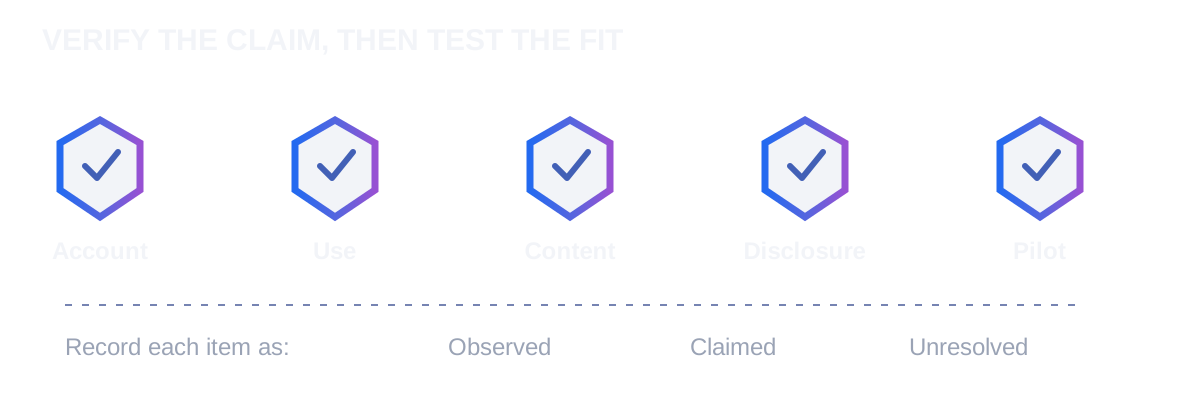
Keep three labels in every review: observed, claimed, and unresolved. A recorded screen-share of a supported workflow may show that the creator can use the product. A screenshot sent without context is only a claim until the reviewer can tie it to a controlled session or another suitable record. For the broader campaign design, see ChainPeak’s Web3 KOC real-user playbook; this article focuses only on verification before contracting.
| Claim to check | Acceptable evidence example | Limit of that evidence |
|---|---|---|
| Controls the publishing account | Agreed challenge phrase posted or sent through the account | Control today does not guarantee future control. |
| Has used the product | Live walkthrough or consented event record for a defined action | One action does not establish expertise. |
| Knows the target market | Relevant, original conversations in the market's language | Public discussion does not prove audience location. |
| Can disclose a benefit | Draft content with the relationship stated clearly | Final post still needs a publication check. |
Step 1 — Set the Web3 KOC Verification Checklist Before Outreach
Start with the campaign job, not the creator list. Write one product action the KOC must understand: first wallet setup, a supported DeFi workflow, exchange onboarding, or an application task. Then specify the target market, language, prohibited claims, disclosure requirements, evidence you can lawfully collect, and the decision owner.
Create a three-stage gate: basic eligibility, proof-of-use review, and content/compliance review. These are editorial process stages, not a universal scoring model. A creator can pass account control but fail product relevance, or show genuine product experience but be unsuitable for a regulated market. Keep each decision separate so a rejection does not become an unsupported accusation of fake followers or fraud.
Avoid demanding more personal data than the campaign needs. A password, seed phrase, private key, or unrestricted account access should never be requested as verification evidence. Prefer a supervised demonstration, redacted transaction details where appropriate, or a product-side event confirmation under a reviewed consent and retention process. Have the responsible team set storage access and deletion rules for any evidence retained.
Step 2 — Confirm Control of the Publishing Account
Ask the prospective KOC to respond through the account that will publish the content. A short challenge phrase or one-time confirmation sent via the account's established channel is more useful than a screenshot of a profile page. Record the handle, platform, confirmation time, and reviewer. Re-check control before the first paid post if the contracting process takes time.
Review recent content for continuity. Abrupt topic changes, copied posts, repeated low-effort replies, or an account that suddenly shifts languages may justify follow-up questions. None of those signals proves misconduct on its own; legitimate rebranding, account recovery, or market expansion can produce similar patterns. Record the observation and ask for an explanation before deciding.
If a third-party agency introduces the creator, verify that the person authorizing the work controls the publishing account and understands the deliverables. Do not treat the intermediary’s spreadsheet as proof of account ownership. The separate crypto KOL due-diligence checklist covers reach-oriented influencer checks; KOC selection should continue with product experience, not stop at account metrics.
Step 3 — Test First-Hand Product Experience
Define a task that resembles the content assignment. If the KOC will explain a wallet, ask them to walk through setup and a safe, supported action. For DeFi, ask for a test-environment or small, authorized workflow where available, with a clear explanation of risks and fees. For an exchange, verify that the creator has used the relevant interface and can describe the onboarding path without implying approval in a market where promotion may be restricted.
Use two evidence types where practical: an observed workflow and a product-side signal. Google Analytics lists sign_up, login, generate_lead, and purchase among recommended events, but says recommended events must be implemented; they are not automatically collected. A Web3 product may need its own event definitions for the actual eligible action. Google Analytics recommended events
A wallet address is not a person, and an on-chain transaction alone does not tell you who controlled the account or why the action occurred. Ask only for evidence relevant to the promised content. If a creator cannot demonstrate the task, classify the experience claim as unverified and either adjust the assignment to an honest first-impression format or decline the use-case claim. Never script an endorsement of an experience the person has not had.
Step 4 — Review Audience Fit and Content Quality
Read a sample of original posts and real conversations, not just engagement totals. Look for accurate explanations, useful questions, corrections when the creator is wrong, and language that matches the target market. For a beginner wallet campaign, clarity may matter more than technical jargon. For a DeFi governance campaign, careful reasoning and specific product knowledge may matter more than broad reach.
Check whether the proposed audience can actually use the product. A channel with many global followers may be a poor fit for a market-specific onboarding flow. A creator may also have authentic users but limited distribution, which is acceptable for a small learning pilot. The decision should match the job: an education pilot, user feedback study, or acquisition campaign demands different evidence.
Separate platform-reported reach from product behavior. Plan a distinct creator ID and tagged link for the pilot. Google documents utm_source, utm_medium, utm_campaign, and utm_content for campaign traffic; use consistent names and test redirects before publication. Google Analytics campaign URL guidance The KOC campaign reporting template explains how to report eligible actions and follow-up after launch.
Step 5 — Check Conflicts, Disclosure, and Claims
Ask about current sponsorships, affiliate links, token holdings or allocations relevant to the content, and any competing obligations that may affect the message. Do not assume every financial interest disqualifies a creator; the point is to identify what should be disclosed, reviewed, or excluded under the applicable rules. Document what the creator says and what the team can independently verify.
For U.S.-facing social endorsements, the FTC says a material connection can include payment, free products, or other benefits and should be made clear. It also says creators should not describe an experience they have not had. Local rules may differ, so the market-specific approval process belongs with counsel or the responsible compliance team. FTC social endorsement disclosure guide
Review a sample draft for four issues: unsupported return or safety claims, omitted material connections, unclear risk language, and scripted praise that conflicts with the creator’s experience. The FTC's endorsement guidance says an endorsement should reflect the endorser’s honest opinion and must not be misleading. FTC Endorsement Guides Q&A Approval should focus on factual accuracy and compliance, not forcing a positive verdict.
Step 6 — Run a Small Pilot Before Scaling
An approved KOC is still a hypothesis about audience fit. Start with a limited assignment, a clear publication window, a defined product action, and a review date. Specify who checks the live post, who handles corrections, and what happens if a link breaks or a claim is inaccurate. A pilot is more informative than an untested bulk roster.
Measure the product action rather than treating likes as evidence of real-user acquisition. A useful pilot report separates published content, tagged visits, eligible actions, excluded or unverified activity, and follow-up when the observation window matures. Compare cost and qualified outcomes only after the underlying evidence is checked. If tracking fails, classify the pilot as inconclusive rather than crediting the creator with unobservable results.
Copyable Web3 KOC Verification Decision Record
Use this record for each proposed creator. Replace the examples with a rule approved for your product and market; do not turn the sample into an automatic scoring threshold.
Creator ID / publishing handle:
Reviewer and review date:
Campaign objective / target market / language:
Assigned product workflow:

1. Account control
   Evidence link or record:
   Status: observed / claimed / unresolved
   Re-check date:

2. First-hand product experience
   Task observed:
   Product-side evidence, if available:
   Data collected and consent basis:
   Status: observed / claimed / unresolved

3. Content and audience fit
   Original content samples:
   Target-market relevance:
   Accuracy or correction concerns:
   Status: suitable / needs revision / unsuitable

4. Conflicts and disclosure
   Payments, benefits, affiliate or token interests declared:
   Required disclosure language and placement:
   Claims requiring factual or legal review:
   Status: cleared / pending / unsuitable

5. Pilot decision
   Approved deliverable and date:
   Creator-specific tracking link:
   Eligible product action:
   Post-publication reviewer:
   Decision: pilot / revise assignment / decline
   Reason and unresolved questions:
The record is deliberately short enough to use, but detailed enough to audit. Store supporting evidence under restricted access, retain it only under the team’s policy, and give creators a chance to correct factual misunderstandings. “Unresolved” is a legitimate result when the evidence does not justify a stronger claim.
Conclusion
A Web3 KOC verification checklist 2026 is useful only if it changes a decision. Confirm account control, observe the product workflow, inspect original content and audience fit, review disclosures and claims, then test the creator in a measured pilot. Record what was observed, what was merely claimed, and what remains unknown. That process gives a Web3 team a defensible way to choose real-user advocates without pretending that one wallet or engagement screenshot proves authenticity.
