


Stablecoin user acquisition by region starts with a specific money movement, not a global “crypto users” audience. Choose one eligible market and one use case—such as cross-border business settlement, household remittance or merchant payment—then verify that the product, partner rails and disclosures can serve it. Build acquisition around the user’s actual job, measure the completed eligible action and repeat usage, and keep on-chain volume separate from unique customers. The same campaign cannot simply be translated and expected to work everywhere.
This playbook is for stablecoin issuers, wallets, payment apps, exchanges and infrastructure teams planning a regional growth test in 2026. It is not a legal opinion or a forecast of demand. Market rules, licensing, sanctions controls and partner availability require local review before any launch.
Key Takeaways
- Select a market by customer job, operational readiness and permitted distribution—not headline transaction volume alone.
- Latin American stablecoin use is substantial, but Brazil and Mexico call for different acquisition journeys.
- Separate wallet creation, eligible first use, repeat use and retained customers in reporting.
- Localize pricing, fees, redemption and support explanations, not merely campaign language.
- Pilot one corridor or use case before expanding paid media or KOL distribution.
Table of Contents
- Why regional stablecoin acquisition differs
- Choose the first market and customer job
- Match channels to the use case
- Build a trustworthy onboarding journey
- Measure qualified activation and retention
- Regional pilot template and red flags
Why Does Stablecoin User Acquisition Vary by Region?
Stablecoin demand can represent distinct activities: trading liquidity, access to dollar value, cross-border transfers, domestic peer-to-peer payments or business settlement. These behaviors use different decision-makers, trust signals and operating rails. A high-flow market may still be unsuitable if the product cannot provide a reliable local on-ramp, clear fees, redemption path or supported customer service. For broader regional context, consult the Chainalysis 2026 Geography of Cryptocurrency Report.
Chainalysis reports $593.8 billion in Latin American crypto activity during July 2025–June 2026, up 9.8% over the preceding period. By June 2026, stablecoins represented 32% of cross-border value, 22% of domestic P2P activity and 17.6% of personal wallet balances in its regional analysis. These are market-level activity measures, not the number of reachable users or proof that a particular acquisition channel works. See Chainalysis Latin America research.
Its 2026 adoption index places Brazil first overall, Nigeria third, India sixth and Mexico eleventh under its methodology. An index rank is not a go-to-market priority list: the weighting, customer segment and product constraints may differ from your business. See Chainalysis 2026 adoption methodology. The ChainPeak regional growth framework explains why local execution should be tested rather than assumed.
Step 1 — Choose the First Market and Customer Job
Start with a written user job: “A [specific customer] in [market] needs to send, receive, hold or spend [currency value] for [purpose] through [available rails].” Do not combine remittance senders, merchants and treasury teams in a single persona. Specify who pays the fee, who completes identity checks, where redemption happens and what could prevent the transaction.
Score a candidate market against four gates: demonstrable customer problem, legal and partner feasibility, product readiness, and measurable distribution. The score should be a decision aid, not a fabricated market-size estimate. A market fails the first pilot if any critical rail or approval is unavailable, even when on-chain data appears attractive.
| Region or use case | Evidence to investigate | Acquisition question | Primary activation candidate |
|---|---|---|---|
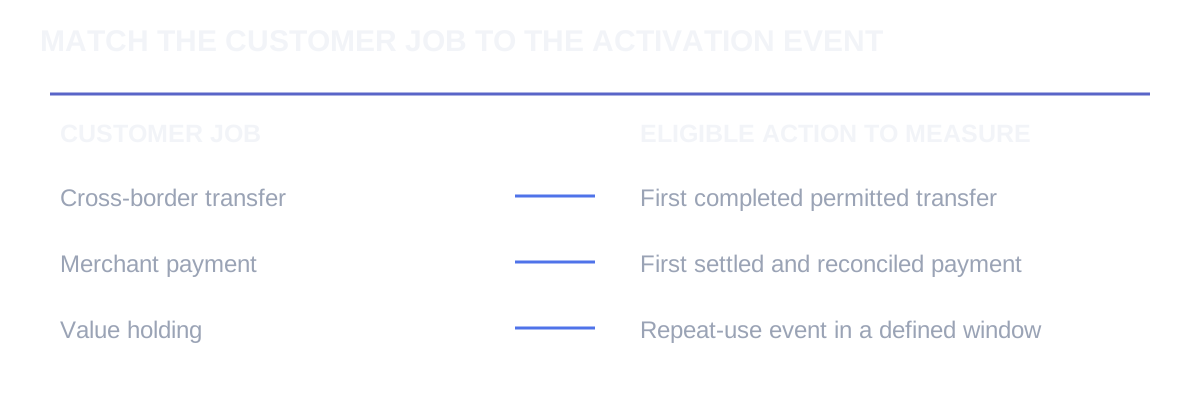
| Mexico cross-border transfers | Corridor flows, sender/recipient needs, payout rails | Can both ends complete a transparent transfer? | First eligible completed transfer |
| Brazil business payments | Business needs, partner integration, local rules | Can a merchant or treasury team reconcile the payment? | First eligible business payment |
| India-linked use case | Specific permitted corridor and local partner scope | Is this product and message allowed for this audience? | First permitted, completed action |
| Another market | First-party interviews and operating readiness | What customer job is unsolved here? | A use-case-specific event |
Chainalysis reports that Mexico had $77.6 billion in crypto activity in the report period, of which more than $47 billion, or 61%, came through stablecoins. Monthly stablecoin value on corridors with a Mexico endpoint reached $1.8 billion in June 2026. Those figures support investigating cross-border use, not assuming that every household needs the same remittance product. See Chainalysis Mexico analysis.
The India Web3 user acquisition guide can help frame local discovery, but any India-linked stablecoin campaign needs current product-specific legal and partner review. Do not lift an India funnel into an unrelated corridor or imply that national adoption rank grants marketing permission.
Step 2 — Match Channels to the Use Case
Channel choice follows the job. A business payments product may need partner referrals, finance-team education, integrations and a sales-assisted proof of concept. A consumer transfer product may need a trustworthy local landing page, partner distribution, customer-support content and explicit fee examples. A wallet feature may require in-product education for existing users before any external acquisition budget is justified.
Use search content for questions people actually have: transfer time, supported currency, fees, redemption and failure handling. Use community or creator distribution only when the contributor can accurately demonstrate the supported journey and disclose any benefit. Do not pay for claims of guaranteed savings, safety or returns that the product cannot substantiate. A localized campaign should link to a localized product route, not a translated headline on a generic homepage.
Plan one market-specific message test and one channel test at a time. For example, compare a partner-led explanation with an educational search page for the same eligible use case; do not interpret a difference in clicks as proof of customer value. Record audience, creative, landing page, spend, approved claims and source attribution before the test begins. If there are compliance or operational changes, pause rather than silently changing the offer mid-test.
Step 3 — Build a Trustworthy Onboarding Journey
Acquisition fails if a person arrives but cannot understand how money enters, moves or exits the product. Show fees, exchange-rate treatment, supported jurisdictions, transfer limits, identity requirements, custody model, redemption or payout timing, and a clear support route. Claims should describe the product as it works now, including partner-dependent steps and possible delays.
Localize the full journey: language, screenshots, currency examples, help articles and support hours. A Brazilian business user and a Mexican cross-border recipient may have different questions even if both touch a dollar stablecoin. In a pilot, test the journey with people in the target market who are not already expert crypto users. Note where they stop or ask for help, then fix the friction before scaling traffic.
Treat onboarding and safety as part of marketing quality. A “new wallet” metric can include duplicates, bots or people who never reach a useful action. The real-user acquisition playbook offers broader controls for excluding low-quality activity; this article applies the principle to stablecoin product actions. Do not demand private keys, seed phrases or unnecessary transaction history as proof of eligibility.
Step 4 — Measure Qualified Activation and Retention
Define the funnel before launch: eligible visitor, approved account if required, funded or ready account, completed use-case action, and repeat use in a defined window. Keep “unknown source” separate from attributed channels. Report both people or organizations and transactions; one business can generate many transfers, and one person can use more than one wallet.
Choose one primary event for the pilot. For a transfer app, it might be the first completed transfer to a permitted recipient; for a merchant product, the first settled and reconciled payment. A planning window of 7 days to inspect onboarding and 30 days to inspect repeat use is an illustrative choice, not an industry benchmark. Document the actual window, exclusions and denominator for each cohort.
| Metric | Unit | What it tells you | What it does not prove |
|---|---|---|---|
| Qualified sign-ups | Eligible people or organizations | Initial fit | Completed economic use |
| First eligible action | Deduplicated users or organizations | Activation | Retention |
| Repeat action | Same cohort within stated days | Ongoing use | Incremental campaign impact alone |
| Transfer volume | Currency amount | Economic throughput | Number of unique customers |
| Cost per activated user | Spend / eligible activated users | Pilot efficiency | Long-term value without a retention window |
Do not compare an issuer’s market-level transfer volume with a campaign’s activated-user count. Different units and denominators make the comparison meaningless. Retain a documented baseline and account for organic demand, partner traffic and product releases when interpreting a lift. The Channel and cohort report should make assumptions visible, not hide uncertainty behind a single return-on-ad-spend figure.
Copyable Regional Stablecoin Pilot Checklist
- [ ] Name one country or corridor, customer type and exact payment or savings job.
- [ ] Confirm permitted product scope, partner rails, local disclosures and support coverage.
- [ ] Test on-ramp, transfer or spend action, payout and recovery paths end to end.
- [ ] Write one localized value proposition with explicit fees and limitations.
- [ ] Select one primary eligible action and define exclusions and repeat-use window.
- [ ] Choose a small set of attributable channels and record the baseline.
- [ ] Review user questions and failure cases before expanding spend.
This checklist is an operating template, not a recommendation to launch in any jurisdiction. Local counsel and partners must review product-specific rules. Avoid three common mistakes: translating a generic campaign without local product readiness, counting wallet creation as meaningful use, and using market transfer value as a proxy for the number of potential customers.
Conclusion
Stablecoin user acquisition by region works when a product team chooses one real customer job, verifies the market and operating rails, explains the journey plainly, and measures completed eligible use rather than hype or raw on-chain volume. Start with a narrow corridor or segment, test the onboarding and message, then expand only when the same cohort can use the product again. Regional evidence can identify questions worth testing; it cannot substitute for product readiness or first-party customer research.
