


A Web3 KOC recruitment template 2026 should begin with a real product-use question, not a follower-count filter. Identify users who have voluntarily engaged with a relevant feature, invite them through a channel they agreed to use, explain the assignment and any benefit, and accept that a truthful response may be critical or negative. Only then should a team assess fit for a small pilot. This guide provides a sourcing plan, an outreach sequence, copyable messages and a decision tracker for wallet, DeFi and other crypto product teams.
Here, KOC means a key opinion consumer: a person whose useful contribution comes from firsthand product experience. It is an editorial operating definition, not a verified market standard. A creator can be both a KOC and a KOL; the distinction in this article is the selection signal, not an arbitrary follower ceiling. The Web3 KOC marketing playbook covers the full program; this page concentrates on recruitment.
Key Takeaways
- Source KOC candidates from permissioned product and community touchpoints, not purchased contact lists.
- Select for relevant firsthand experience before considering audience size or posting frequency.
- State compensation, content freedom, disclosure requirements and data handling in the first invitation.
- Use a small, defined pilot; separate replies, accepted contributors and eligible product actions.
- Stop outreach after a clear refusal, and never request private keys or unnecessary wallet history.
Table of Contents
- What a KOC recruitment template needs to decide
- Step 1: Define the user and product journey
- Step 2: Find opt-in KOC candidates
- Step 3: Screen for use-case fit
- Step 4: Send an honest invitation
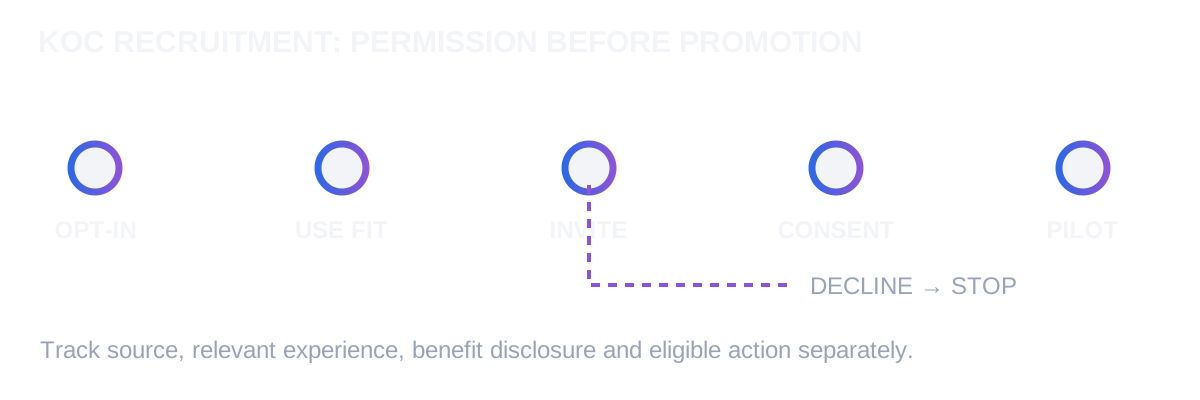
- Step 5: Record consent and run a pilot
- Copyable outreach and tracker templates
- Common mistakes and next steps
What Should a Web3 KOC Recruitment Template Decide?
Recruitment is a permission-and-fit process. The team should be able to explain why a particular person is being contacted, which product experience matters, how their contact details were obtained, and what the person is free to say. A candid product walkthrough may be more useful than a generic endorsement from an account that has never used the product. The FTC says endorsements must reflect the endorser's honest opinion, and a material brand connection must be disclosed clearly. See FTC Endorsement Guides Q&A.
| Decision | Record before outreach | Reason |
|---|---|---|
| Product task | One feature and one safe user journey | Keeps the invitation specific |
| Eligible source | Permissioned opt-in or legitimate public contact path | Protects user choice |
| Experience signal | An action the person can discuss voluntarily | Avoids invented testimonials |
| Benefit | Cash, access, tokens, referral value or none | Sets disclosure expectations |
| Content freedom | Factual boundaries without forced praise | Preserves honest opinion |
| Pilot outcome | One eligible action and attribution method | Separates activity from impact |
These are operational fields, not evidence that one channel performs better. Start with the product and market, then write the invitation.
Step 1 — Define the User and Product Journey
Write one sentence: “We want users in [market] who have completed [product task] to explain [use case] to [audience], with no obligation to give a positive review.” This prevents “crypto user” from becoming a meaningless audience label. A wallet team might focus on a first safe backup flow; a DeFi team might focus on explaining a disclosed risk screen. Neither should invite a user to promote returns or make an unsupported safety claim.
Set an initial pilot scope as an illustrative planning choice, not a benchmark: one market, one product journey and one primary eligible action. The team could review candidates over 7 days and assess a pilot after 30 days if those windows fit its release cycle. Decide this before outreach.
Define relevant experience. A completed tutorial or volunteered walkthrough may be useful, but neither alone proves suitability. The deeper checks belong in the Web3 KOC verification checklist. Never request a private key or seed phrase.
Step 2 — Find Opt-In KOC Candidates
The strongest starting point is usually a permissioned touchpoint where a person can choose to hear from the team about research, advocacy or creator opportunities. Examples include an in-product opt-in form, a community call for volunteers, a feedback program with suitable contact permission, or a public creator who has independently discussed the product and accepts business enquiries. These are possible sources, not a claim about their conversion rates.
For existing users, check why contact details were collected and where outreach is allowed. The European Commission explains that people must receive information about data-processing purposes and legal basis; local requirements vary. See European Commission data-protection guidance. Where permission is unclear, use a voluntary sign-up route.
In a community, post an open call before approaching members. Do not scrape lists, buy wallet-to-social-account matches, or send bulk DMs. Ask referred users to opt in directly; a referral is not contact permission. Record each candidate's source.
Step 3 — Screen for Use-Case Fit Before Asking for Content
Use a short first-pass screen. Can the candidate describe the feature in their own words? Is the intended audience relevant? Can they discuss the product without claiming a result they cannot support? Are language, region and channel appropriate for the assignment? A small audience does not automatically make someone authentic, and a large audience does not disqualify someone with genuine experience.
Separate screening from invasive verification. Collect only necessary evidence, with consent. Record a specific reason, such as “has used feature X and writes for first-time users,” rather than “looks real.”
The FTC's social-media guidance says a person cannot describe an experience with a product they have not tried, and paid endorsers cannot describe a poor experience as excellent. It also treats free products and other benefits as potential material connections. See FTC Disclosures 101. This is a useful minimum for drafting, though teams must check rules in each target market.
Step 4 — Send an Honest, Low-Pressure Invitation
A good invitation has five parts: the reason for contact, the exact product task, the proposed deliverable, the benefit and disclosure expectation, and an easy way to decline. It should not imply that the person has already joined the campaign. It should not promise rewards only for favorable content. The detailed assignment comes later in the Web3 KOC campaign brief template.
Keep the first message brief. Disclose any material benefit from the outset. The FTC says disclosures should be easy to notice and placed with the endorsement, not hidden in a profile or tags. Compensation must not purchase a positive opinion.
Existing opted-in user — email
Subject: Invitation to share your experience with [feature]
Hi [name], you opted in to hear about [program] and told us you had used [feature]. We are inviting a small group of users in [market] to explain their actual experience to [audience]. The proposed deliverable is [format]; the benefit is [exact benefit or “none”]. Your opinion is yours, including criticisms. Any material benefit must be clearly disclosed in the content. Would you like the short brief? It is fine to decline, and we will not follow up about this opportunity if you prefer.
Open community call — public post
Have you personally used [feature] for [task]? We are seeking volunteers who can explain what worked, what did not and what new users should know. The pilot covers [market/language], [format] and [benefit]. We do not ask for positive reviews, wallet secrets or private transaction history. If interested, apply through [opt-in form] by [date]; the form explains how we use and retain your information.
Independent product user — permitted business contact
Hi [name], I saw your public explanation of [specific product task]. Our team is inviting people with firsthand experience to consider an independently worded [format] about [feature]. We would offer [benefit], which would need disclosure if you participate. We can send the brief if this is relevant. If not, no reply is needed and we will not keep contacting you.
Remove “opted in” unless the record proves it. Fill each bracket with a verified fact. Follow platform contact rules.
Step 5 — Record Consent and Run a Defined Pilot
When someone replies, share the brief, benefit terms, rights, disclosure language and correction route. Confirm the experience they will describe. Review factual claims, but leave opinion with the contributor.
For a pilot, track a short funnel with distinct units: candidates identified (people), invitations sent (messages), positive replies (people), accepted contributors (people), published pieces (items), and eligible user actions (events or deduplicated users, explicitly defined). For example, a planning sheet might contain 20 candidate people, 10 invitation messages, 4 positive replies and 2 accepted contributors; these are purely illustrative rows, not ChainPeak results or expected rates. Do not present impressions as acquired users.
Record the observation window and attribution rule before content goes live. A campaign URL may help connect a visit to a post, but a click is not proof that someone is a unique or retained product user. Google's campaign URL documentation explains the UTM fields used to identify campaigns; see Google Analytics campaign URL guidance. The KOC campaign reporting template covers exclusions and outcome reporting in more detail.
Copyable Web3 KOC Recruitment Checklist and Tracker
Copy the following checklist into a recruitment brief or spreadsheet. It is intentionally short enough to use before any campaign asset is drafted.
- [ ] State one product task, target user, market and language.
- [ ] Identify the permitted source and purpose for each contact.
- [ ] Define the firsthand experience a contributor should be able to discuss.
- [ ] Document the benefit and disclosure requirement before outreach.
- [ ] Write a brief invitation that allows honest criticism and an easy decline.
- [ ] Set the first-pass screen and who will make decisions.
- [ ] Agree on rights, factual review, correction and withdrawal terms.
- [ ] Define one eligible outcome, attribution rule and observation window.
- [ ] Stop contact after refusal and remove unnecessary candidate data on schedule.
| Candidate ID | Source/permission | Relevant use case | Invite date | Response | Benefit disclosed | Next action |
|---|---|---|---|---|---|---|
| [ID] | [opt-in record or permitted public contact] | [feature/task] | [date] | [interested / declined / none] | [yes / no] | [brief / stop / optional follow-up] |
As an illustrative outreach policy, send one invitation and no more than one permitted follow-up after 7 days, then stop if there is no response. This is not a legal safe harbor or an evidence-based optimal cadence. A refusal should end contact immediately. Retain only the information necessary to explain the recruitment decision and meet applicable recordkeeping obligations.
Common Mistakes and Next Steps
The first mistake is treating followers as the primary qualification. That turns user advocacy into another reach purchase and can place the wrong person in a product explanation. The second is treating any on-chain activity as consent to contact or as proof of a unique person. The third is offering a reward without a clear disclosure requirement or asking for scripted praise.
The practical next step is to fill in the checklist for one product journey, publish a voluntary invitation route and review a small candidate pool. Then send an honest brief to interested people, complete proportionate verification and measure the predefined eligible action. A Web3 KOC recruitment template 2026 is useful only if each invitation can be traced to permission, relevant firsthand use, transparent terms and a decision the team can audit.
