


There is no global crypto market — and that is why web3 regional growth beats global campaigns. Crypto adoption is regionally structured: each market has its own channels, trust hierarchies, price sensitivity, and memory of past cycles. A crypto go-to-market strategy that ignores that structure pays for reach it cannot convert.
This is a positioning piece, and we argue it with data from 450+ project engagements across 20+ countries since 2022.
Key Takeaways
- There is no global crypto market; there are regional markets with separate channels and trust hierarchies.
- Asia-Pacific received roughly $2.4 trillion in on-chain value from mid-2024 to mid-2025, per Chainalysis.
- A "global" campaign is functionally a US-and-English campaign with international impressions attached.
- Incentives have a regional exchange rate: one reward size overpays Southeast Asia, underpays Korea.
- Web3 regional growth compounds: validation in one market beats weak signals in six.
The global crypto market is a spreadsheet artifact
Adoption data makes the point before any marketer does. The Chainalysis 2025 Global Adoption Index put India, the United States, Pakistan, and Vietnam at the top, with Asia-Pacific receiving roughly $2.4 trillion in on-chain value between mid-2024 and mid-2025 — the largest share of global activity, and with Southeast Asian on-chain activity growing on the order of 40–50 percent year over year per industry estimates as of 2026. Ownership research from firms like Triple-A tells the same story from the demand side: adoption rates vary several-fold between neighboring countries. None of those users share a feed, a language, or a default exchange.
English crypto Twitter is real, but it is the industry talking to itself. A "global" campaign reaches the professional layer — founders, funds, researchers — and almost nobody else. Functionally, it is a US-and-English campaign with international impressions attached, billed at global rates.
Why does web3 regional growth outperform global campaigns?
Because discovery, trust, and conversion are all regionally structured — and they only compound when addressed together, in one market at a time. Even crypto-native investors make a version of this argument: a16z crypto frames web3 go-to-market as community-driven rather than broadcast-driven, and communities are nothing if not regional.
Retail distribution proves it. Korean users discover assets through YouTube and convert on Upbit; Chinese-speaking users move between Chinese-language X, Telegram, and private WeChat groups; Vietnamese users trade inside Telegram and Zalo communities; Japanese users operate inside one of the most tightly regulated exchange regimes in the world. The channel where discovery happens and the channel where conversion happens differ by market — and they are rarely the same channel.
| Market | Where discovery happens | Where conversion happens |
|---|---|---|
| Chinese-speaking | Chinese-language X, crypto media (BlockBeats, Odaily, PANews) | Telegram and WeChat groups |
| Korea | YouTube, Naver blogs, Telegram | Upbit/Bithumb listings, Kakao open chats |
| Japan | X, YouTube | Licensed exchanges, Line communities |
| Vietnam | Facebook, TikTok, YouTube | Telegram and Zalo trading groups |
| Southeast Asia | TikTok, X, YouTube | Telegram communities |
Where do one-size campaigns break first?
Trust signals. In Korea — a market regulated by the Financial Services Commission — a tier-one domestic exchange listing is the trust signal; audits and VC logos barely move retail. In Chinese-speaking markets, credibility comes from which media covered you and which KOLs chose to write about you in their own voice. In Japan, regulatory standing dominates everything else. Reusing one proof stack across all four wastes most of it.
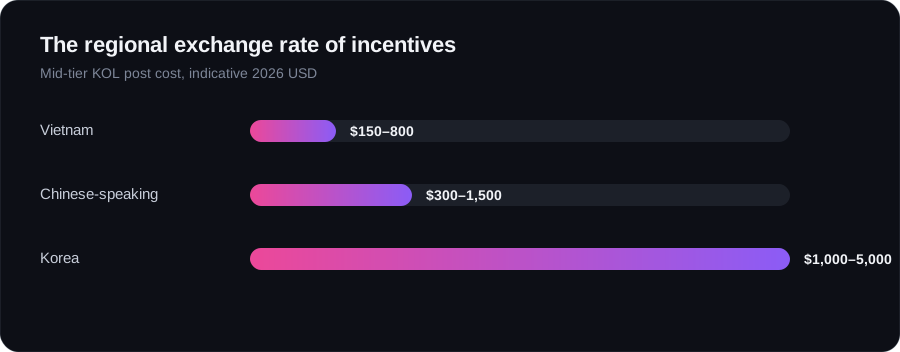
Pricing and incentives. An airdrop or referral reward sized for US users overpays in Southeast Asia — attracting professional farmers — and underpays in Korea and Japan, where it reads as trivial. The same mid-tier KOL post that costs $150–800 in Vietnam runs $300–1,500 in Chinese-speaking markets and $1,000–5,000 in Korea. Incentive design has a regional exchange rate, and so does every other line of your budget.
Language. Translation is not localization. Naming, meme vocabulary, and narrative framing either sound native or they sound like an outsider's press release. Machine-translated announcements are the fastest way to signal that a project has no local commitment.
The four-stage model: validation before scale
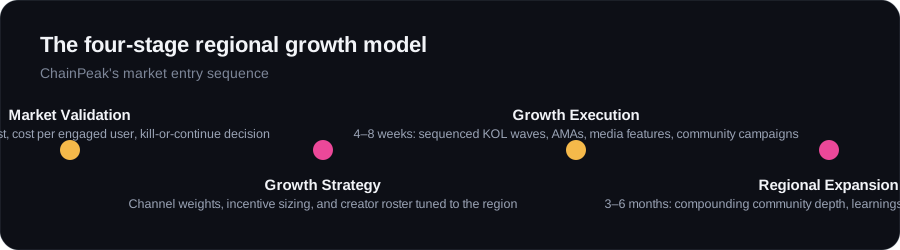
We run every web3 market entry through the same sequence — Market Validation, Growth Strategy, Growth Execution, Regional Expansion — because it forces budget discipline before scale.
Market Validation (2–4 weeks). A deliberately small test: localized narrative, a handful of KOC and mid-tier KOL posts, two or three media placements, a community soft-launch. The output is not headline reach — it is cost per engaged user, qualitative feedback from native speakers, and a kill-or-continue decision.
Growth Strategy. Validation data becomes channel weights, incentive sizing tuned to the region's exchange rate, and a creator roster ranked by measured conversion rather than follower count.
Growth Execution (4–8 weeks). The full mix goes live: sequenced KOL waves, AMAs, media features, community campaigns with mechanics tuned to regional incentive norms, and exchange and ecosystem partnerships where listings anchor trust.
Regional Expansion. What compounds carries forward: always-on community operations, a KOC layer that keeps the project in local conversation between announcements, and learnings that cut the cost of the next market. Compounding effects typically show up over 3–6 months.
Sequencing beats entering six markets at once for three reasons: budget concentration produces real signal instead of six weak ones, learnings transfer to the next market, and operational load — native moderators, content, timezone coverage — grows linearly instead of all at once.
Why regional experience compounds into playbooks
Every regional launch produces assets that outlive the campaign: performance data on which creators actually convert (we maintain a vetted network of 10,000+ KOLs, including 500+ Chinese-speaking creators, precisely because follower counts predict almost nothing), relationships across 20,000+ media outlets, benchmark rates that keep negotiations honest, and mechanics known to work or fail in a given market.
This is the real argument for specialization. The tenth Chinese-speaking market entry costs a fraction of the first, because vendor vetting, rate discovery, and channel testing are already paid for. Write down what each market taught you, or pay to relearn it. Our regional playbook exists because we got tired of relearning.
When is global-first actually right?
Sometimes. Developer tooling and infrastructure protocols sell to a genuinely global, English-speaking niche; B2B products follow enterprise sales logic, not retail distribution. If your buyers are 2,000 engineers on GitHub and X, regional consumer machinery is the wrong tool.
And regional-first is not free. It is slower to produce big top-line numbers, and it carries fixed overhead per market — native staff, localized content, separate community operations. Below roughly $15,000–30,000 of test budget per market, you cannot buy meaningful signal in expensive markets like Korea or Japan, so under-capitalized multi-market entries fail by default; cheaper markets like Vietnam support meaningful validation at $10,000–25,000.
The regional model is for anything that ultimately needs retail users, community depth, or KOL-driven distribution — which is most of consumer web3.
FAQ
What is web3 regional growth?
Web3 regional growth is a go-to-market approach that treats each crypto market — Chinese-speaking, Korea, Japan, Vietnam, Southeast Asia — as a distinct market with its own channels, trust signals, and incentive pricing, entered sequentially with localized campaigns instead of one global broadcast that converts almost nowhere.
How many markets should a web3 project enter first?
One or two. Concentrating budget in a single validated market produces stronger signal and better unit economics than spreading the same spend across five or six. Expand only after the first market shows retained users at an acceptable acquisition cost — that is what regional expansion means in practice.
How long does web3 market entry take?
In our model, market validation takes 2–4 weeks and growth execution 4–8 weeks; compounding effects — community depth, organic KOL coverage, media relationships — typically show up over 3–6 months. Teams expecting conversion in week one are usually measuring impressions, not users.
Which crypto markets should a project enter first?
Follow adoption and category fit, not familiarity. As of 2026, Vietnam and Southeast Asia offer the lowest cost per engaged user for consumer and gaming products, Korea rewards exchange-anchored trust for trading products, and Chinese-speaking communities remain the deepest capital-and-narrative market. Pick one where your category already resonates.
What budget does a regional crypto launch need?
Plan $15,000–30,000 of test budget per market as a floor in expensive markets like Korea or Japan — below that, web3 market entry buys noise, not signal. Cheaper markets like Vietnam support meaningful validation at $10,000–25,000. Under-capitalized six-market entries fail by default.
Final Thoughts
Regional growth is not a tactic we recommend; it is the thesis ChainPeak was built on. Founded in Singapore in 2022 and headquartered in Hong Kong, we have supported 450+ web3 projects on the same bet: that crypto adoption is regionally structured, that trust is earned channel by channel and language by language, and that a sequenced model — Market Validation, Growth Strategy, Growth Execution, Regional Expansion — compounds where global broadcasts evaporate. The 10,000+ KOLs in our vetted network and the 300,000+ active community users across our regional footprint are not reach; they are infrastructure, built market by market because there was no shortcut.
The projects that win the next cycle will not be the loudest in English. They will be the ones that showed up natively in two or three regions, measured retained users honestly, and expanded on evidence rather than optimism. If that is the kind of web3 market entry you are planning, talk to us — we will tell you which market to open first, and why.
