



To measure crypto AI search visibility, record what an answer engine shows for a fixed set of buyer questions, where and when it was checked, whether the brand appears, whether a source URL is cited, and what qualified users do after reaching the site. Keep that observation series separate from Google organic traffic and from broader campaign results. A single screenshot is not a stable ranking, and a citation is not a customer.
This guide gives crypto exchanges, wallets, DeFi protocols and Web3 growth teams a practical measurement template. It uses official platform data where available and a repeatable manual sample where it is not. It does not claim that every AI answer can be observed exhaustively or that a change in one metric proves an agency caused it.
Key Takeaways
- Build a fixed prompt set by product use case, buyer stage, language and market.
- Separate brand mentions, linked citations, cited URLs, referral visits and qualified actions.
- Use Search Console's generative AI reporting for Google visibility where available.
- Track ChatGPT referrals in analytics, but do not confuse referrals with all ChatGPT mentions.
- Preserve raw observations and product-release context before claiming a trend.
Table of Contents
- What AI search visibility means
- Step 1: Define the questions and markets
- Step 2: Record answers and citations
- Step 3: Use platform and referral data
- Step 4: Connect visibility to eligible actions
- Copyable scorecard and reporting cautions
What Does Crypto AI Search Visibility Mean?
Crypto AI search visibility is the observed presence of a brand, product or source page in AI-generated responses to relevant user questions. It has several layers. A brand may be mentioned without a link; a page may be cited without the preferred brand wording; a user may click through and still fail to complete a useful product action. Those outcomes should not be combined into one undefined “AI ranking.”
| Layer | Unit to record | Example question |
|---|---|---|
| Brand presence | Answer observations with a relevant mention | Was the exchange named for this task? |
| Source citation | Answer observations citing the domain | Did the answer link to a source page? |
| Cited-page quality | Distinct eligible URLs and page types | Was a current help page or an outdated article cited? |
| Referral activity | Sessions or visits from a known source | Did a user reach the site from an AI product? |
| Product outcome | Eligible users or organizations | Did the visitor complete the defined action? |
Google says AI Overviews and AI Mode can surface links to web sources, but the responses and links can vary, and an eligible page is not guaranteed to appear. Google also says the foundational SEO practices remain relevant. See Google Search Central AI-features documentation. That makes search fundamentals and AI-answer sampling complementary, not competing, workstreams.
Step 1 — Define the Prompt Set Before Looking at Results
Start with the questions real prospects ask at distinct stages. An exchange may need market-page comparisons, trading-fee explanations and account-safety questions. A wallet may need setup and recovery education. A DeFi protocol may need risk, mechanism and integration explanations. Remove questions that do not fit the product; volume alone is not a reason to track them.
Create a fixed set of 20–30 prompts as an illustrative pilot size, not an industry benchmark. Include branded, non-branded informational and comparison questions. For each prompt, record the exact text, language, country, target persona, product stage and intended landing page. Do not edit the set after seeing a favorable answer; version it and begin a new series if the customer language genuinely changes.
Use the same market and language for each repeat observation. If a question is only relevant in Japan or Brazil, do not compare its result with an English-language U.S. prompt as though they share a denominator. The regional growth approach offers the broader reason to keep market context explicit. Record important product or regulatory changes that may affect answer content.
Step 2 — Record Mentions, Citations and Source URLs
For every observation, save one row per prompt-engine-date-market combination. Record the engine and product surface, exact date and time, language, location context, answer text or export, brand mention, source domain, cited URL and whether the cited page is current. Use a clear three-way status: “not observed,” “mentioned without citation” or “cited.” A citation to a competitor belongs in a separate field rather than being silently discarded.
Repeat the observation at a declared cadence, such as once per week during a pilot. This is a practical scheduling example, not proof that weekly checks are optimal. If the platform changes its interface or your test method changes, mark the break in the series. Do not add together outputs from different engines and call the total a market share without knowing how those engines are used by your audience.
The source URL matters because the answer may cite a broad educational article when the buyer needs a specific product page. Review whether that URL explains fees, supported markets, product risks or documentation accurately. Fix outdated or ambiguous pages for users first. Then observe whether the same predefined prompts cite them later; do not promise a citation as a guaranteed result of editing.
Step 3 — Use Official Google Data and ChatGPT Referrals
Google announced dedicated Search Console reports for generative AI features in 2026 and stated that those insights were rolled out worldwide by August 31, 2026. The reports show impressions, pages, countries, devices and dates for appearances in generative AI features; the data also remains within overall Search performance. Check the current report available to your property rather than assuming identical fields in every view. See Google Search Console announcement.
An impression is not a click, and a click is not an eligible crypto customer. Compare the AI-feature page and country data with conventional search data, but avoid double-counting the same site activity across overlapping reports. Google notes that AI Overviews and AI Mode are part of its Search ecosystem and that links can vary by query and experience. Its generative AI search guide emphasizes useful, original content and Search fundamentals rather than a separate guaranteed optimization trick.
OpenAI's publisher FAQ says sites can track ChatGPT search referral traffic in analytics and that referred URLs include utm_source=chatgpt.com. It also explains the role of OAI-SearchBot in discovering content for summaries and snippets. See OpenAI publisher FAQ. Use the referral parameter as a traffic signal; it cannot tell you about users who saw an answer without clicking, and it should not be treated as every ChatGPT-related visit.
Check that intended pages are publicly accessible, indexable where appropriate and not blocked by accidental crawler rules or security layers. Do not change crawler permissions only to chase a visibility score without reviewing privacy, licensing and site policy. A bot-access check is a technical eligibility test, not evidence that the model will cite a page.
Step 4 — Connect AI Visibility to Qualified Actions
Define a primary action before measuring. For an exchange, it might be an eligible funded account rather than an account creation. For a wallet, it might be a completed setup and first safe transaction. For a protocol, it might be a qualified integration or permitted on-chain action. Align the action with the product and jurisdiction; do not use deposits or transaction volume as a universal answer.
Create a simple chain of evidence: answer observation, citation, referral visit when identifiable, landing-page engagement, and eligible action. Not every step will connect for every user, so mark unknown attribution rather than forcing a match. Keep branded search, paid campaigns, PR, product launches and creator activity in the context log. The real-user growth playbook explains why raw wallets or sign-ups can overstate acquisition.
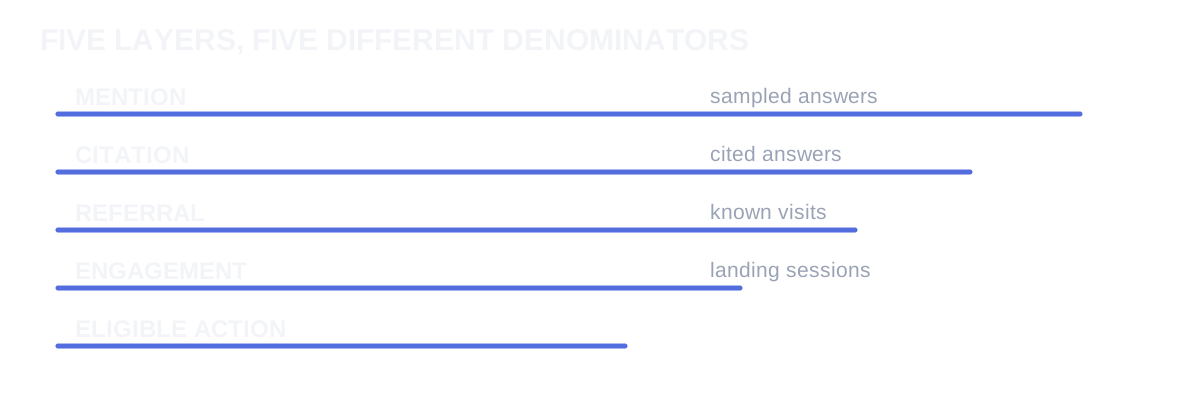
As an illustrative cohort rule, inspect the first action within 7 days of a referral and repeat use within 30 days. These are planning windows, not market averages. State the denominator for every rate: cited observations divided by sampled observations, referred sessions divided by known sessions, and activated users divided by eligible users. Never divide a prompt count by a user count and label the result a conversion rate.
Copyable Crypto AI Search Visibility Scorecard
| Field | Example entry | Why it matters |
|---|---|---|
| Prompt ID / version | W-014 / v1 | Preserves a fixed question set |
| Engine / surface | [product and feature] | Prevents unlike results being combined |
| Market / language | [country] / [language] | Defines the observation context |
| Observation date | YYYY-MM-DD | Creates a time series |
| Brand status | absent / mentioned / cited | Separates presence from citation |
| Cited URL | exact URL or none | Identifies the source page |
| Referral source | known UTM / unknown | Limits attribution claims |
| Eligible action | defined event / none | Connects discovery to product use |
| Change log | content, product, PR or policy change | Helps interpret movement |
Report a small number of clear measures: citation presence for the fixed prompt set, cited-page mix, Google AI-feature impressions and pages, identifiable ChatGPT referrals, and eligible actions from those referrals. Label each measure with its own source and limitation. A rise in one measure should trigger investigation, not an automatic claim that a single content edit caused it.
For teams comparing suppliers, the Crypto SEO and AI-search agency comparison provides a shortlist. Ask any agency to run the same scorecard before and after its work. Preserve access to raw observations and analytics so the buyer can review the claim independently.
Conclusion
To measure crypto AI search visibility responsibly, fix the questions and markets first, then observe brand mentions, citations and cited URLs on a repeatable schedule. Use Google Search Console and identifiable ChatGPT referrals where they are available, but treat both as partial views. Finally, report qualified product actions with explicit attribution limits. This process gives teams a defensible baseline without pretending that a changing AI answer is a permanent rank or that a citation automatically creates a customer.
