


A DeFi protocol SEO strategy should help users find the correct market, understand the contract and chain, assess current rates and risks, and reach the official application safely. AI search adds a second question: can an answer engine cite a current, checkable source for those facts? Useful pages connect discovery to eligible on-chain actions. A wallet connection, a TVL headline or an AI mention alone does not prove adoption.
This playbook is for lending, DEX and vault teams building an owned search system. It treats rates and risk parameters as changing product data, not evergreen marketing copy. The page examples and 30-day plan are editorial tools; they are not ChainPeak client results or protocol recommendations.
Key Takeaways
- Give each DeFi page one user job: explain a market, an action, a risk, a contract or a protocol concept.
- Index a pool or market page only if the product is active and the page has maintained, distinct facts that change a user's decision.
- Show the chain, contract or deployment, rate timestamp, fee method, risk conditions and official app link where relevant.
- Google AI features rely on ordinary Search eligibility; OpenAI describes crawler access for ChatGPT search. Neither platform guarantees citations.
- Measure eligible deposits, swaps, borrows or withdrawals and repeat use separately from visits, wallet connections, TVL and AI-answer mentions.
What Is DeFi Protocol SEO?
DeFi protocol SEO is the technical and editorial work of making a protocol's public information discoverable for people researching a financial action. The answer must be accurate for the specified chain, contract version, market and time. Search-visible pages should let a reader verify the fact and reach the official app without hiding material risk.
The job differs by protocol. A lending user asks how collateral, variable borrowing rates and liquidation work. A DEX user asks about route, pool, liquidity, price impact and slippage. A vault user asks what strategy holds the assets, how withdrawals work and which risks or fees apply. One generic “DeFi yield” page cannot responsibly answer all three. Aave's risk documentation and Uniswap's explanation of price impact versus slippage show why product mechanics need precise language.
| Protocol model | Searcher's decision | Facts to maintain | Eligible product action |
|---|---|---|---|
| Lending | Can I supply or borrow this asset, and what could trigger liquidation? | Market, chain, collateral rules, rate model, health factor or equivalent, withdrawal limits | Valid supply or borrow, then retained position or repeat use |
| DEX | Can I swap this pair at an acceptable route and cost? | Chain, token contracts, pool or route, fee, price impact, slippage, liquidity caveat | Completed eligible swap and later repeat swap |
| Vault or yield strategy | What assets and risks does this strategy expose me to? | Strategy, deposit asset, fees, withdrawal conditions, reward source, version | Valid deposit and retained or repeat use |
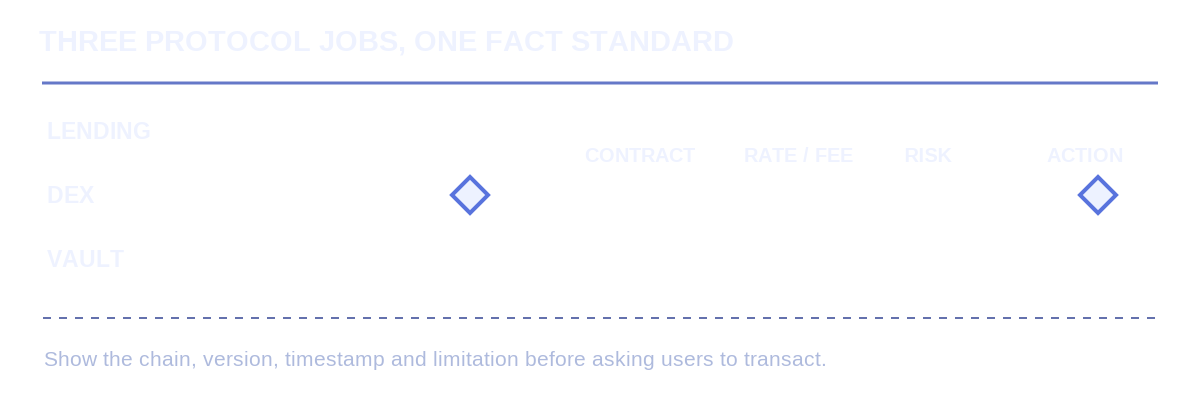
These are content and measurement categories, not financial advice. A particular protocol may combine models or implement them differently. Product and risk owners must approve the actual statements.
Step 1: Map Search Intent to Public Page Families
Start with the questions users ask before an action. Link each question to one maintained source page and one safe next step. A useful initial architecture has four families.
| Page family | User question | Minimum page content | Next step |
|---|---|---|---|
| Protocol and trust | “What does this protocol do and where is the official app?” | Scope, deployment, team or governance facts where available, risk links, official domain | Read docs or open app |
| Market and action | “Can I supply, borrow or swap this asset on this chain?” | Current market status, contract or pool, supported chain, action conditions | Open the exact market in the app |
| Fees and risk | “What can change my cost or loss?” | Rate model, fee components, liquidation or slippage explanation, date and caveats | Review conditions before action |
| Documentation and learning | “How does this mechanism work?” | Plain-language explanation, technical reference, examples, limitations | Read source docs or applicable market page |
This map avoids keyword cannibalization between a generic glossary, a protocol overview and many thin market templates. Keep the user-facing label consistent with the actual product operation. A “deposit” into a vault is not necessarily equivalent to supplying collateral to a lending market. Likewise, a quoted APY is not a fixed payout promise.
Step 2: Decide Which Market, Pool and Chain Pages to Index
Protocol interfaces can generate a URL for every asset, pair, pool, chain and filter combination. A URL's existence is not a reason to index it. Evaluate whether the page gives a real user a distinct, maintained answer. A market page should state which deployment it describes and whether the market is active. If a listing is paused or sunset, the page should not keep a live action prompt that implies otherwise.
Use five checks before marking a template indexable:
- Distinct intent: Does this asset, chain or pool change the user decision beyond a ticker swap?
- Current state: Is the action available now for the target audience and interface?
- Maintained data: Is there an owner for status, rates, fees, contract and risk parameters?
- Source link: Can users verify the facts in official docs, on-chain contracts or a clearly labeled data source?
- Lifecycle: Is there a policy for upgrades, migration, pausing and retirement?
If the answer is no, consolidate into a maintained market hub or exclude the thin URL from search according to the site's technical policy. A chain page may be worth indexing when deployment addresses, collateral factors, liquidity and user steps actually differ. Do not create duplicate “best yield” pages for each token while the only text that changes is a volatile rate. The exchange SEO playbook applies a similar discipline to trading pairs; DeFi additionally requires protocol-risk and contract-version clarity.
Step 3: Publish a Versioned Source of Truth for Rates and Risk
Financial facts can change faster than editorial pages. Assign a source and owner to each fact and display when it was last verified. If the product shows a current rate in the app, the public page should explain the calculation and link to the live value instead of hard-coding an old number into a paragraph. Use “current as of” language only when the page truly updates on that cadence.
| Fact | Source of truth | Page caveat or review trigger |
|---|---|---|
| Chain and contract | Official deployment registry and versioned docs | Migration, upgrade, chain expansion |
| Rate or yield | Protocol data and documented calculation | Variable rate, incentive changes, timestamp |
| Fees | Contract or interface fee schedule | Route, pool tier, fee update |
| Risk parameters | Governance-approved settings or official docs | Collateral, liquidation or oracle change |
| Audit or assessment | Full report with scope and date | New deployment, material code change |
| Market status | Protocol registry or app state | Pause, delisting, withdrawal restriction |
An audit report supports only the code and time period within its scope. Avoid turning “audited” into “risk-free.” For lending, Aave's published risk guide explains that collateral values, utilization, oracles, bridges and liquidation conditions can affect users. For DEX swaps, Uniswap distinguishes price impact from slippage. A protocol should describe its own mechanisms and risks with equal specificity rather than copying either product's thresholds or claims.
Step 4: Keep Public Documentation Crawlable and Private Flows Private
Many dApps load a shell before the wallet connects. Search engines need access to the public explanation without a wallet or transaction signature. Check the initial HTML and rendered page for title, market description, chain, risk summary, link to docs and official app route. Google's JavaScript SEO documentation explains that it can render JavaScript, while server-side or pre-rendered content can simplify access for crawlers and users.
Run an illustrative five-URL audit: homepage or protocol overview, one active market, one risk page, one documentation entry and one fee or rate-method page. Record HTTP status, canonical, robots, initial content, rendered content, mobile behavior, owner and update date. Check that an outdated or unavailable market does not return a misleading success page. Keep wallet-specific positions, private account views and signing flows outside public indexing; the search page should lead safely into the application, not expose user data.
If structured data is used, keep it aligned with visible text and actual page type. Google's structured-data policies do not endorse marking up a variable APY as a fixed offer or claiming a product feature absent from the page. No schema type guarantees an AI citation. An accurate title, canonical URL, clear headings and readable public text matter more than a speculative “GEO markup” layer.
Step 5: Make DeFi Facts Citable Without Overpromising
An AI assistant may answer “Can I withdraw at any time?”, “What is the liquidation threshold?” or “What does this vault invest in?” Publish a direct answer on the relevant official page, then state the conditions, contract version, chain, date and source. Do not place a risk caveat several clicks away from a simple headline that says “safe yield.”
Google's guidance for AI features says an eligible supporting link must be indexed and snippet-eligible under ordinary Search rules, with no additional AI-only technical requirements. OpenAI's ChatGPT search guidance describes crawler access as an eligibility step, not a placement promise. A team can improve access and clarity, then observe whether answers cite the official URL; it cannot purchase a guaranteed citation.
Separate a brand mention from a linked source citation. For volatile facts, save the exact prompt, engine, market, date, answer and cited URL. If an answer quotes an outdated rate, fix the owned source and investigate external pages that repeat it. The crypto AI-citation guide covers the broader process; DeFi's special obligation is keeping dynamic financial facts and risk conditions up to date.
Step 6: Measure Eligible Protocol Use, Not Only TVL
TVL can change when prices move or existing assets are moved between strategies. It is not the same as newly acquired, retained users. A wallet connection is even earlier in the path: it may indicate interest without an eligible transaction. Define an event dictionary with product, data and privacy teams before evaluating content performance.
| Stage | Example measure | What to keep separate |
|---|---|---|
| Discovery | Relevant search visit, observed AI mention or citation | A citation is not a click |
| Intent | Visit to the right market or risk page; eligible app handoff | A pageview is not wallet connection |
| Activation | Completed eligible supply, borrow, swap or vault deposit | A connection or failed transaction is not activation |
| Retention | Repeat eligible action or retained position in a stated window | Price-driven TVL changes are not user retention |
| Economics | Net fees or protocol revenue with attribution limits | Gross volume and incentives can distort value |
Exclude bots, internal tests, duplicate wallets where identifiable, unsupported markets and incentives according to a documented rule. Do not attach a person's browsing history to a public wallet address without a privacy basis and review. ChainPeak's AI visibility measurement guide keeps prompt observations and product outcomes in separate columns; the same discipline applies here.
A 30-Day DeFi SEO and AI Search Audit Sprint
This is an illustrative work sequence, not a promise of indexing, citations or deposits.
| Period | Work | Acceptance check |
|---|---|---|
| Days 1–7 | Inventory five public URLs and map lending, swap or vault actions | Each page has one user job, owner and official next step |
| Days 8–14 | Review market, contract, rate, fee and risk sources; mark stale pages | Every material fact has a version, date or live data source |
| Days 15–21 | Fix one market family and one risk or documentation page | Public text is crawlable, accurate and linked to the source |
| Days 22–30 | Sample AI answers and connect page visits to eligible product events | Mentions, citations, transactions and retained use are separate measures |
Scale only after the first page family passes these checks. A strong DeFi SEO system helps a user understand the action and risk before entering the app, then shows whether those users return for legitimate product use. If you need external implementation support, use the crypto SEO and AI-search agency comparison to assess technical and evidence capabilities rather than citation guarantees.
Frequently Asked Questions
Should every DeFi pool or market have an indexable page?
No. Index a page when the pool or market is active, serves a distinct user decision, and has maintained facts on chain, contract, fees, rates and risk. Consolidate or exclude thin and stale pages according to the protocol's technical policy.
Does a higher TVL prove DeFi SEO is working?
No. TVL can change with asset prices and capital movements without new retained users. Measure relevant search discovery, eligible on-chain actions and repeat use separately, and state attribution limits.
How should a DeFi protocol explain variable APY in search content?
Explain the rate's calculation, source, timestamp, variable nature, incentives and material risks. Link to the current product data rather than presenting an old number as a promised return.
Can a DeFi protocol guarantee AI-search citations?
No. Crawlable, accurate pages can improve eligibility, but Google and OpenAI do not guarantee that a page will appear in or be cited by an AI answer. Track linked citations separately from brand mentions and protocol transactions.
Which DeFi pages should a team improve first?
Start with the official protocol overview, one active market or pool page, risk and security information, fee or rate methodology, and a documentation entry. Confirm that each page names the correct deployment and links to the official app.
