


To get your crypto brand cited in AI search, make important pages accessible to search systems, publish facts that can be checked at a specific time, and answer the questions real users ask about your product. Then compare citations across a fixed set of prompts. No publisher can guarantee that ChatGPT, Google AI Overviews or another answer engine will cite a page. The practical goal is to make your information eligible, useful and easy to verify.
For an exchange, that may mean an accurate fee and market-availability page. For a wallet, it may mean clearly documented custody and recovery rules. For a DeFi protocol, it may mean contract addresses, risk disclosures and current audit links. A claim such as “the safest wallet” without a defined method or source is harder for a reader—or an answer engine—to evaluate than a dated, specific fact.
Key Takeaways
- Start with crawl access and indexability. Google says AI Overviews and AI Mode use ordinary Search eligibility; OpenAI says OAI-SearchBot access supports inclusion in ChatGPT search results.
- Keep one maintained source for facts that change: supported chains, regions, fees, token contracts, custody model and product status.
- Publish a direct answer with a dated source or method, then link to the underlying documentation. Avoid unsupported “best,” “fastest” and “safest” claims.
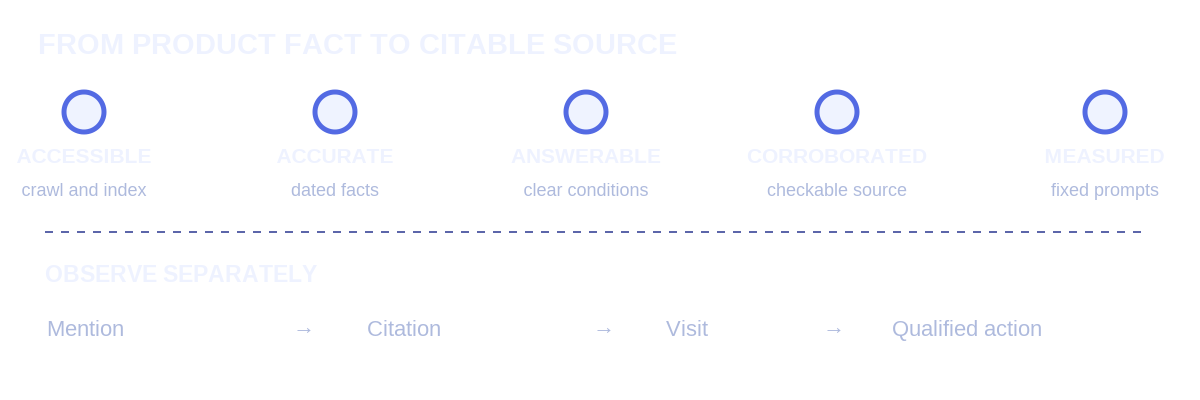
- Separate a brand mention, a linked citation, a visit and a qualified user action. They are different outcomes.
- Treat the 30-day workflow below as an editorial pilot plan, not a promise of indexing or citations.
What Counts as an AI Search Citation?
An AI search citation is a link from an AI-generated answer to a specific page or domain used as a source. A brand mention without a link is a separate observation. A link can be displayed without a click, and a click can occur without a signup or active user. Record these stages separately.
The distinction matters because the platforms do not work identically. Google states that a page must be indexed and eligible for a snippet to appear as a supporting link in AI Overviews or AI Mode; it also says there are no additional technical requirements for those features. Google's site-owner documentation does not promise that an eligible page will be shown. OpenAI's ChatGPT search guidance likewise says search placement is not guaranteed. Do not sell “AI citation placement” as an inventory item you can buy.
| Observation | What it proves | What it does not prove |
|---|---|---|
| Brand mention | The answer named the project | A source page was cited |
| Linked citation | The answer linked to a URL | The user clicked or converted |
| Referral visit | A visitor reached the site from an identifiable source | The visit was qualified |
| Qualified action | A defined event occurred, such as funded account, first swap or retained wallet use | The citation alone caused that action |
Step 1: Check That Your Important Pages Can Be Found
Before rewriting copy, test the page that should answer the question. Ask four plain questions: Does it return HTTP 200? Is it blocked by robots.txt or a CDN? Does it contain indexable text? Can a user reach it through an ordinary internal link? A JavaScript-only fee table or an inaccessible PDF is a weak source if the key facts are absent from readable page text.
For Google, use URL Inspection and the Search Console reports available to the verified site owner. Google's AI-features guide names crawl access, internal links, textual content and indexability as relevant fundamentals. For ChatGPT search, check that your robots and hosting rules allow OAI-SearchBot and the published crawler IPs where appropriate. OpenAI's guidance describes this as an eligibility step, not a ranking mechanism. A site can allow one crawler while blocking another; record the policy intentionally.
Use a small URL inventory for an initial audit: the homepage, one core product page, one documentation page, one pricing or fee page and one trust or risk page. Five pages are an illustrative pilot scope, not a platform rule. Record URL, status, canonical target, robots state, last substantive update and owner. If one high-value page fails a basic access check, fix that before adding new articles.
Step 2: Build a Governed Crypto Facts Sheet
Crypto facts change quickly. Token contract addresses, supported networks, withdrawal fees, jurisdictional access, audit status and incentives can become outdated in different parts of the same site. A facts sheet gives product, legal, support and marketing teams one reviewed source for what they may state publicly.
| Field | Example of a verifiable entry | Owner and review trigger |
|---|---|---|
| Product identity | Official project name, ticker, legal entity where relevant | Product / whenever branding changes |
| Network and asset | Full chain name, token standard, contract address with explorer link | Engineering / contract upgrade |
| Availability | Exact supported and excluded jurisdictions, with date | Legal / market launch or restriction |
| Fees and limits | Fee type, calculation, applicable route, timestamp | Product / pricing change |
| Security | Custody model, audit scope and date, known limitations | Security / new audit or incident |
| Evidence | Source URL, method, sample period and responsible reviewer | Research / every published statistic |
This is not an SEO trick. It prevents a common failure: one marketing page says “available worldwide” while the current terms exclude several markets. Google recommends helpful, reliable content and asks publishers to show who created it and how it was produced; its people-first content guidance highlights accuracy and trust for financially consequential topics. When a fact cannot be independently verified, label its origin and limitation rather than presenting it as an established market truth.
Step 3: Answer One Buyer Question Per Page or Section
Pick questions from support tickets, sales calls, product analytics and relevant search queries. Group them by decision, not by a list of near-identical keywords. An exchange buyer may ask “Which networks can I deposit USDC on?” and “What happens if I send it on the wrong network?” Both can belong in a supported-networks guide with a direct answer, a network table and a clear risk warning. A separate page that simply swaps “crypto” for “Web3” adds little.
Start each section with the answer in one or two sentences. Follow with the conditions that could change it: region, asset, chain, wallet version, date or user status. Link to the detailed source. Use labels that survive extraction from the page: “Supported network,” “Fee calculation,” “Last reviewed,” and “Known limitation.” The goal is to help a reader make a correct decision even if the paragraph is quoted out of context.
For a wallet, write “This product is self-custodial; users control their recovery phrase” only if the product documentation supports it, then link to the relevant recovery guide and explain any exceptions. For a Layer 2, distinguish transaction fees from bridge costs and state which route the estimate covers. For DeFi, separate a protocol's published audit from a claim that funds are risk-free. Specificity is more useful than promotional adjectives.
Step 4: Turn Original Evidence Into Reusable Source Material
Publish a source when your team has something first-hand to add: a documented fee method, a product changelog, a transparent regional eligibility matrix, a reproducible benchmark or a carefully scoped case study. Include the collection period, sample, methodology and exclusions. If a statistic is “4,200 activated users,” define activation, the dates and whether incentives were involved. Those numbers are an illustrative example, not a ChainPeak client result.
Do not imply that adding a statistic guarantees a citation. The stronger editorial test is: Could another researcher verify the claim from this page, or identify the accountable person and method? A screenshot of a dashboard without a denominator may be less helpful than a short table with dated counts and definitions.
Use links to the canonical source, not a chain of self-referential summaries. If the product has technical docs, keep a stable URL for each important fact and update it when the product changes. If a third party independently tests the product, link to that work and distinguish its findings from your own. Paid coverage and creator content must be identified honestly; they are not independent validation merely because they appear on another domain.
Step 5: Keep Structured Data and Visible Copy in Sync
Structured data can help describe a page, but it is not a special “AI citation schema.” Google says there is no additional markup required to appear in AI Overviews or AI Mode. It also requires structured data to match what a user can see on the page. See Google's AI-features guidance and structured-data policies.
For an article, use an accurate title, author, publication or update date and canonical URL where the site supports them. If you publish FAQ markup, keep each marked-up answer consistent with the visible FAQ and the current product facts. Do not generate FAQ schema for questions that are missing from the page. Avoid introducing an llms.txt file as a promised shortcut: Google says no new machine-readable file is needed for its AI search features. A file cannot compensate for inaccessible pages or weak evidence.
Step 6: Seek Independent, Relevant Corroboration
An owned page should be the primary source for your product facts; a credible outside source can add context. For a protocol, this might be a public audit report that names the contract version. For a wallet, it might be a documented integration listing. For an exchange, it might be a regulatory register or supported-market notice that a reader can inspect. Never claim that a media mention, partner logo or audit removes product risk.
Prioritize corroboration that answers a real user question. “Is this the same token contract?” needs an exact explorer link; “Is this audit current?” needs a date and scope; “Can users in this region access the product?” needs the current jurisdictional rule. Generic coverage with no checkable facts may increase awareness but does little to resolve ambiguity. ChainPeak's regional growth guide discusses market validation before distribution; the same principle applies to selecting which region's facts you publish first.
A 30-Day Editorial Pilot for Crypto AI Search Citations
The following is a suggested work sequence, not a guaranteed time to be crawled or cited. Assign a product owner and a reviewer before starting.
| Period | Output | Acceptance check |
|---|---|---|
| Days 1–7 | Audit five high-value URLs and create a versioned facts sheet | Each important claim has an owner, source and review date |
| Days 8–14 | Rewrite two decision pages with direct answers and current limitations | A reader can verify the answer and its conditions on the page |
| Days 15–21 | Publish one original evidence asset or reviewed documentation update | Method, period, denominator and source links are visible |
| Days 22–30 | Recheck crawl access, sample a fixed prompt set and review referral actions | Mentions, citations, visits and qualified events are separate columns |
Choose prompts from real product questions, including branded, category and risk queries. Keep wording, location, language and date in the log. Repeated answers can differ by engine and run, so do not claim success from one screenshot. ChainPeak's crypto AI-search visibility measurement guide provides a fuller measurement template. If an outside team is needed to implement the work, use the crypto SEO and AI-search agency comparison to evaluate vendors by evidence and scope rather than promises of guaranteed citations.
What Should a Crypto Team Avoid?
Avoid mass-producing near-duplicate pages for every token, region and query when the data is not maintained. Avoid unsupported rankings, fabricated endorsements, unverified performance claims and fee tables without timestamps. Do not hide material conditions in an image while the text gives a simpler, misleading answer. Do not block the crawler you intend to serve and then assume a sitemap alone fixes access. Do not use structured data to state something different from the visible page.
The key decision is which page should be the source of truth for a buyer's question. Make that page accurate, accessible and reviewable. Then measure whether the market finds and uses it. A citation is valuable only when it points to information the user can trust and act on.
Frequently Asked Questions
What counts as an AI search citation for a crypto brand?
An AI search citation is a link from an AI-generated answer to a specific source page or domain. A brand mention without a link is a separate observation. A citation does not prove that a user clicked, signed up or became active.
Can a crypto company guarantee citations in ChatGPT or Google AI Overviews?
No. Google says ordinary Search eligibility does not guarantee indexing or inclusion in its AI features, and OpenAI says placement in ChatGPT search is not guaranteed. A team can improve access, accuracy and usefulness, then measure observed citations.
Should crypto websites allow OAI-SearchBot?
If the publisher wants its public pages to be eligible for ChatGPT search summaries and citations, it should review robots.txt and host or CDN rules for OAI-SearchBot. OpenAI describes crawler access as an eligibility condition, not a promise of placement.
Does a crypto brand need special AI schema or llms.txt to appear in Google AI Overviews?
No. Google says there are no extra technical requirements for AI Overviews or AI Mode beyond ordinary Search eligibility, and no new AI-specific file or markup is required. Any structured data used should match visible page content.
Which crypto pages should be improved first for AI citations?
Start with pages that answer high-impact user decisions and can be kept current: product availability, supported assets and networks, fees, custody or security, and risk disclosures. Check access and factual accuracy before publishing more pages. The exact order depends on the product and target market.
