


A crypto wallet SEO strategy should help people find the official wallet, understand who controls their assets, verify supported networks and follow safe setup or recovery guidance. AI search adds a second test: can an answer engine link to a current page that states those facts accurately? The strongest program makes a user's decision safer and measures legitimate wallet use, rather than counting downloads or AI mentions as success by themselves.
This playbook covers browser extensions, mobile wallets, hardware wallets and products with different custody or recovery models. It is a publishing and measurement guide for wallet teams, not security advice for an individual user or a promise of search rankings.
Key Takeaways
- The official download and support path is a core wallet search asset. Keep platform links, publisher identity and scam warnings current and easy to verify.
- State the actual custody, key-control and recovery model for this wallet. Do not reuse generic “your keys, your crypto” copy when the implementation differs.
- Create supported-network and feature pages only when they explain a distinct user action and can be maintained after upgrades.
- For AI search, start with crawlable, accurate content and a reliable source URL. Google and OpenAI do not guarantee inclusion or citations.
- Measure installation, wallet creation, first eligible action and retained use separately; never collect or log a seed or recovery phrase for marketing attribution.
What Is Crypto Wallet SEO?
Crypto wallet SEO is the technical and editorial work of making a wallet's official product information discoverable for the decisions users face before and after installation. Those decisions include whether the app is authentic, how assets are controlled, which chains and features work, what recovery is possible and what happens if a device or credential is lost.
Wallet SEO differs from exchange SEO because the next action may be a secure installation, wallet creation, wallet import, first receive, send or supported transaction. A crypto exchange SEO strategy instead often tracks verification, funding and first trade. A wallet download is a starting signal; it does not prove setup, asset use or retention.
| Wallet model | Primary user question | Pages that need a clear answer | Meaningful product event |
|---|---|---|---|
| Self-custody software wallet | Who controls the keys and how can I restore access? | Official install, custody, backup, supported chains, help | Verified setup and first eligible receive, send or use |
| Custodial wallet or account | Who holds assets and what support or restrictions apply? | Custody terms, access, availability, fees, support | Eligible account and first funded action |
| Hardware wallet | How do I buy, authenticate and set up the device safely? | Official product, authorized sellers, setup, recovery, security notices | Device setup or other privacy-safe first-use event |
| Smart-account or assisted-recovery wallet | What can each party control and what can actually be recovered? | Account model, signers, recovery conditions, limitations | Setup plus an eligible first use |
These are editorial categories, not a substitute for the product's own technical and legal documentation. If a wallet uses several account types, explain each model rather than forcing one claim across the whole brand.
Step 1: Make the Official Installation Path Unambiguous
Searchers often begin with “download [wallet],” “[wallet] extension” or a mobile store query. An official installation page should clearly identify the publisher, supported platforms, current app or extension links, version or update guidance and the route to the official help center. It should explain how a user can check the destination before installing. If a product has regional or device limits, say so where the user makes that decision.
Create one canonical installation hub and direct links to genuine platform-specific pages where those pages have distinct instructions. Avoid multiple thin “download wallet” pages that point to different destinations or outdated store listings. Keep old campaign landing pages from competing with the official route. A high-ranking impersonation page can be especially harmful in this category, so brand and download queries deserve routine monitoring, but an SEO article alone cannot eliminate phishing.
Security warnings need concrete language. Coinbase Wallet's official help page says it will never ask for a user's recovery phrase and warns against pasting it into a website. Ledger's official support notice likewise says its support team will never ask for the secret recovery phrase. These statements describe those providers' policies; a wallet should publish its own reviewed policy and clearly link users to its verified support entry point.
Step 2: Publish the Custody and Recovery Truth Table
The page that answers “Is this wallet safe?” should describe the product's actual design and limitations. A broad security adjective is less useful than a precise answer to who can authorize transactions, where credentials are held, whether the provider can restore access and what support cannot do. The wording should be reviewed by product and security owners and updated when the account model changes.
| Claim to maintain | Question to answer on the page | Verification source |
|---|---|---|
| Key or signer control | Which party can authorize a transfer? | Product architecture or security documentation |
| Backup and recovery | What must a user retain, and what options exist after loss? | Versioned recovery guide |
| Supported devices | Which operating systems, extensions or hardware versions work? | Official download and compatibility pages |
| Incident handling | Where are current notices and support instructions? | Dated status or security notice |
| Network and asset support | Which chain and token standard does this feature cover? | Maintained product registry or docs |
The recovery page must avoid false reassurance. A user who has lost a key may face a different outcome depending on the wallet model, backup method and remaining device access. Do not copy a recovery procedure from another brand or instruct users to send a phrase to support. Separate what can be recovered, what cannot, and which official product flow applies. Link to a verified support channel and keep the page free of marketing pop-ups that could confuse the next action.
For example, Coinbase Wallet's recovery-phrase documentation is specific to its recovery-phrase wallets and describes separate phrase management for each wallet. A smart-account product may have different recovery conditions. The content team should transcribe only facts its own security team can substantiate.
Step 3: Build Network and Use-Case Pages That Have a Distinct Job
Multi-chain support can create many potential URLs: one per chain, token, feature, device or transaction type. Index a page when it genuinely changes the user's setup or risk decision. A supported-network page may need the chain name, compatible app version, native fee asset, token standard, known limitations, and a link to the official in-product action. A generic template with only the chain name swapped adds little.
Use an index decision for each candidate:
- Does the network or use case change the setup steps, fees, safety warning or next action?
- Is the feature supported now on the specified wallet version and platform?
- Can product data keep the page accurate after chain upgrades or feature removal?
- Does the page link back to the official help and installation path?
- If support ends, will the page be updated, redirected or retired appropriately?
A wallet should avoid publishing “supported” where only a third-party integration makes the action possible. Label native, bridged and external-app flows separately. This is especially important for AI answers: a short extracted paragraph may otherwise imply a feature is built in when it is not. The broad crypto AI citation guide explains how to make product facts citable; the wallet-specific source must still be accurate about platform, version and network.
Step 4: Check Crawlability Without Exposing Sensitive Flows
A wallet website may be built around a browser extension, app shell or wallet connection. Public product, documentation and help pages should not require a wallet connection to read. Check that important text appears in the initial HTML or rendered HTML, links use crawlable URLs, and pages return the intended status and canonical. Google's JavaScript SEO guidance explains that it can render JavaScript, while server-side or pre-rendered content can make pages faster and easier for users and crawlers.
Choose an illustrative five-URL audit: official download, custody, recovery, supported networks and one use-case page. For each, record status, canonical, robots directives, main text, mobile rendering, owner and last review date. Do not expose private account screens, personal transactions or recovery material merely to make them indexable. The search result should lead a user into the secure product flow; it should not turn the sensitive flow into public content.
If the wallet sells hardware, its product page may use relevant product structured data where it meets Google's actual requirements. If the wallet is software, evaluate the supported app markup for the official page. Do not assume that replacing Article with SoftwareApplication creates a ranking or AI-citation lift. Google's structured-data rules require markup to reflect visible content and do not promise rich results. Schema describes the page; it cannot repair an unclear custody model or an untrusted installation path.
Step 5: Make Wallet Facts Useful for AI Search
AI answer engines may be asked “Does this wallet support [chain]?”, “Is it custodial?” or “Can I recover it if I lose my phone?” Give each question a current, direct answer on the official site and state the condition that could change it. Keep an accountable owner and date for factual changes. If the honest answer is “only on version X” or “recovery depends on a prior backup,” say that in the first paragraph.
Google says that its AI Overviews and AI Mode use the same underlying Search eligibility: pages must be indexed and eligible for a snippet, and there is no special AI-only markup requirement. OpenAI's ChatGPT search guidance says OAI-SearchBot access and host/CDN allowance help make a public site eligible; placement is not guaranteed. Check those controls with the technical team rather than buying a supposed “guaranteed citation.”
An AI brand mention and a linked source citation are not the same event. A wallet can appear in a comparison answer because an outside article mentions it, while the assistant cites the outside article rather than the official product page. Sample prompts by use case and market, preserve the exact answer and cited URLs, and correct any inaccurate owned facts first. ChainPeak's AI visibility measurement guide gives a broader observation template.
Step 6: Measure Qualified Wallet Use Without Collecting Secrets
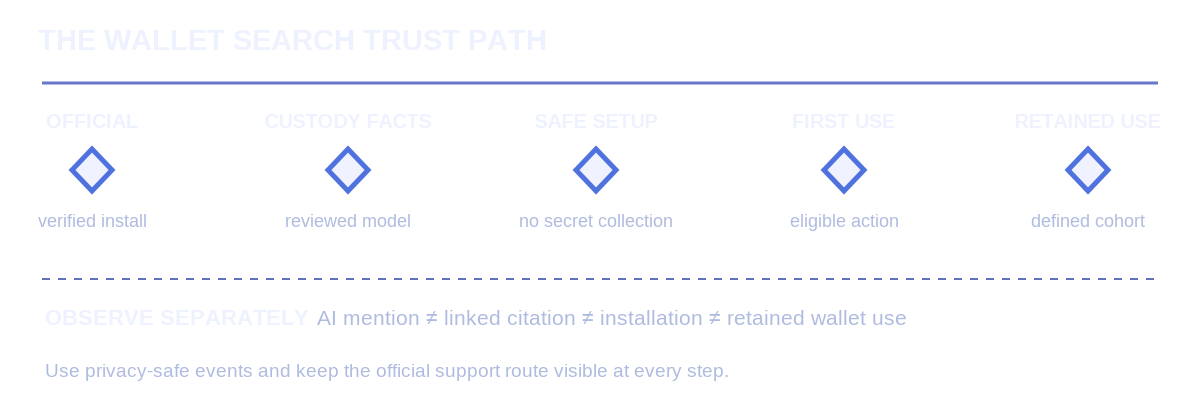
Connect search and AI discovery to privacy-safe, eligible product events. A sample path for a software wallet is: official landing page → verified store or extension click → completed setup → first receive or supported transaction → repeat use over a defined cohort window. The team must confirm which events it can observe and aggregate lawfully. A hardware wallet may use product purchase and setup milestones instead. A custodial wallet may require verification or funding.
| Stage | Example signal | Limitation |
|---|---|---|
| Discovery | Relevant non-brand search visit or observed AI citation | A citation may produce no click |
| Install intent | Click to verified store or extension listing | A click is not an installation |
| Activation | Privacy-safe setup completion or first eligible product action | Avoid counting test, bot or incentivized activity as ordinary use |
| Retention | Repeat eligible action in a stated window | Define the same window and denominator for each cohort |
| Safety | Support confusion, failed install or phishing reports | Attribution may be incomplete; handle reports through proper security channels |
Never use recovery phrases, private keys, full wallet addresses or sensitive support content as marketing attribution keys. If a product has a wallet address that is public on-chain, that does not make every linkage to identity or browsing behavior appropriate. Use aggregated event definitions and document consent and retention with the privacy team. A high-traffic recovery page that sends users into unsafe support channels is a failure even if it ranks.
A 30-Day Wallet SEO and AI Search Audit Sprint
This is an illustrative work plan, not a guaranteed time to rank or appear in AI answers.
| Period | Work | Acceptance check |
|---|---|---|
| Days 1–7 | Audit official install, custody, recovery, supported-network and use-case URLs | Every page has an owner, accurate destination and current facts |
| Days 8–14 | Fix conflicting claims and remove stale install or support paths | Security/product reviewer signs off on the visible copy |
| Days 15–21 | Improve two high-intent pages and decide which network pages deserve indexing | Each page answers a distinct user decision and links to official action |
| Days 22–30 | Test crawl access, sample fixed AI prompts and connect privacy-safe event reporting | Mentions, citations, visits, setup and retained use are separate columns |
The goal is a reliable path from question to official source to safe product use. If an outside provider is needed, the crypto SEO and AI-search agency comparison can help shortlist a partner; ask for wallet-specific security review and measurement practice, not just traffic promises.
Frequently Asked Questions
What pages should a crypto wallet optimize first for search?
Start with the official installation page, custody and security explanation, recovery guidance, supported networks and one or two high-intent use cases. Each page should have an owner, a current source of truth and a safe next action.
Can a wallet guarantee an AI-search citation?
No. Google and OpenAI describe eligibility and useful content, but neither guarantees that a wallet page will be shown or cited. Measure observed mentions and linked citations separately from visits and product use.
Should every supported chain have its own wallet page?
Only when that chain changes a real setup, fee, compatibility, risk or user-action decision, and the wallet can keep the page accurate. Otherwise, a maintained supported-networks hub may be clearer than many thin pages.
What should a wallet recovery page avoid?
It should never ask users to send a recovery phrase or private key to support, promise recovery the product cannot provide, or route people to an unverified site. State the wallet-specific conditions and direct users to the verified help entry point.
How should a wallet measure SEO performance?
Track relevant discovery, official install intent, privacy-safe setup or first-use events, and repeat eligible use with defined cohorts. Keep AI citations, brand mentions, visits and product activation as separate measures; do not collect secrets for attribution.
