


A crypto exchange SEO strategy should make the right trading, fee, trust and support pages discoverable, then connect those visits to funded accounts or completed swaps. AI search adds another test: can an answer engine retrieve a current, checkable source for the exchange's claims? The work starts with page selection and product facts, not publishing thousands of token URLs or promising citations.
This playbook is for CEX and DEX growth, product and SEO teams. It distinguishes a registration from a qualified trader, explains when a trading-pair page deserves indexing, and gives a practical audit sequence. The examples are editorial planning tools, not ChainPeak client results or universal conversion benchmarks.
Key Takeaways
- Prioritize pages that answer real trader decisions: supported assets and networks, fees, market availability, custody, liquidity conditions and the first transaction.
- CEX pages usually need the account, verification, deposit and trade path; DEX pages need a wallet, route, chain, slippage and completed swap path.
- Index a token or pair page only when it has a distinct user job, accurate live facts and a maintainable source. Control filter URLs that create large duplicate spaces.
- Google says its generative AI features use core Search eligibility; OpenAI says OAI-SearchBot access supports ChatGPT search eligibility. Neither promises citations.
- Report organic and AI-search observations separately from funded traders, first trades, repeat trading and net deposits.
What Is Crypto Exchange SEO in 2026?
Crypto exchange SEO is the process of making exchange information accessible and useful in search for the decisions a trader must make before depositing or swapping. The scope includes technical indexing, product and fee pages, educational content, localized eligibility and an outcome measurement path. AI search does not replace these foundations; it tests whether the same facts are clear enough to be linked in an answer.
Search intent changes with the product. “How to buy USDC” may need an educational guide. “USDC withdrawal networks and fees” needs a current product page. “Can I trade from country X?” needs an eligibility answer approved for that market. A single generic blog post should not try to satisfy all three. Google's AI-search guide emphasizes ordinary Search technical requirements, crawlable content and useful information rather than special AI files or markup.
CEX and DEX SEO require different outcome paths
| Exchange model | Searcher's key decision | Essential page facts | Qualified action to measure |
|---|---|---|---|
| CEX | Can I access, fund and trade here? | Region, verification requirements, deposit routes, fees, supported market, withdrawal terms | Eligible account → verified account → first funded trade → repeat activity |
| DEX | Can I swap this asset on this chain at an acceptable cost and risk? | Contract and chain, route, liquidity, slippage, transaction fee, wallet requirements | Wallet connected → eligible quote → completed swap → repeat use |
These are measurement definitions to customize with the product team. A wallet connection is not automatically a swap; a CEX signup is not automatically a funded trader. Define the business event before choosing keywords, because a page that attracts visits but cannot move a qualified user toward that event has limited acquisition value.
Step 1: Map Search Intent to Four Page Families
Start with a small inventory instead of generating every possible asset and market combination. For each planned page, write down the user question, source of truth, permitted market and next useful action.
| Page family | Example question | Minimum useful content | Next action |
|---|---|---|---|
| Trust and access | “Is this exchange available in my region?” | Current availability, entity or license claim where applicable, exclusions, support route, review date | Check eligibility or read terms |
| Fees and mechanics | “What will this trade or withdrawal cost?” | Fee method, asset and network, spread or routing caveat, timestamp, worked example | Open fee calculator or trading flow |
| Asset and pair | “Can I trade this asset here?” | Correct ticker and contract where relevant, supported chain, pair status, liquidity caveat, risk note | View live market or quote |
| Learning and comparison | “How does this route work?” | Plain-language process, conditions, source links, meaningful alternatives | Move to relevant product page |
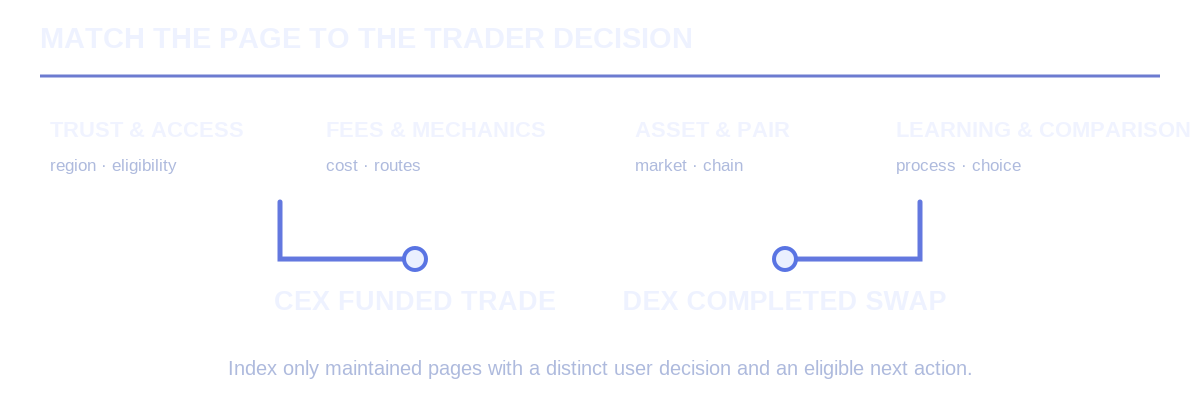
This map gives each page a job. It also prevents one keyword from being scattered across a glossary post, a buy page and a regional landing page with no clear canonical destination. Use the exchange agency ranking for vendor selection; this article focuses on the exchange's owned search system.
Step 2: Decide Which Asset and Trading-Pair Pages Deserve Indexing
An exchange may have hundreds of assets, pair variants, chains and filters. A page should be indexed because it answers a distinct, supportable question, not because the route exists in the trading interface. Create an indexable page only when the market is active, the facts can be maintained, the user can reach an eligible action, and the page adds information beyond a ticker substitution.
Use this decision rule for each template:
- User job: Is there a real difference in asset, network, pair, route or market that changes the decision?
- Fact ownership: Can product data populate status, fee, supported chain and risk text with a timestamp?
- Availability: Is the asset or product actually accessible to the intended audience?
- Distinct content: Does the page explain a condition a generic asset page cannot?
- Lifecycle: What happens if the asset is delisted, a pair is paused or the route changes?
If a page fails these checks, consolidate it into an authoritative asset or market page, remove it from indexable navigation where appropriate, or return the correct status for a retired route. Do not leave a stale “buy” button next to an unavailable market. For search filters, Google's faceted-navigation guidance warns that parameter combinations can create very large URL spaces and slow discovery of useful pages. Decide deliberately which filters need crawl access; canonical tags alone may take time to influence crawl volume.
Illustrative brief for a pair page: “BTC/USDC spot market”; last market-status update; exchange model; order types; fee calculation link; availability by region; risk and volatility note; live market action. This is a content specification, not a claim that such a page will rank. On a DEX, replace account and order-book details with chain, pool or route, contract, slippage and wallet requirements.
Step 3: Make the Technical Page Visible Before Adding More Content
Check both the initial HTML and the rendered page for the facts that matter. A dynamic trading interface may render charts and order books in JavaScript, but the indexable page still needs a meaningful title, explanation, status and link path. Google's JavaScript SEO guide explains that Google crawls, renders and indexes JavaScript pages, while server-side or pre-rendering can make content easier and faster for users and crawlers. Avoid assuming every other bot renders the same way.
Audit the following on representative URLs: HTTP status, robots directives, canonical URL, indexability, internal links, the initial HTML, rendered text, mobile usability and whether essential facts survive without a live chart widget. Test one asset page, one pair page, one fee page, one market-availability page and one support page as an illustrative five-URL pilot. A URL Inspection result is evidence about that URL at that time, not a guarantee of future indexing.
For a paused or delisted market, decide whether the page still serves a legitimate historical or support purpose. If it does, state the status prominently and remove misleading transaction prompts. If it does not, use the appropriate removal or redirect policy. Avoid blanket redirects to the homepage that hide the user's original question.
Step 4: Govern Facts That Change With Markets and Regions
An exchange's SEO risk is often factual drift: an outdated fee, an unsupported network, an unavailable country, or an asset with a confusing name. Assign one owner for each fact family and define what triggers review. Publish the date and scope where a user needs them to interpret the claim.
| Fact family | Source of truth | Review trigger | Visible caveat |
|---|---|---|---|
| Trading and withdrawal fees | Product fee schedule | Fee or tier change | Applicable asset, network, tier and time |
| Market status | Exchange listing service | Listing, halt or delisting | Spot, derivatives or swap availability |
| Regional eligibility | Legal and product approval | New market or restriction | Exact user location and product conditions |
| Security and custody | Security documentation | Audit, custody or incident change | Scope, date and limitations |
| Token identity | Project and chain records | Contract migration | Exact chain and contract address |
Do not use “regulated,” “secure,” “zero fee” or “available worldwide” as unqualified copy. State what entity, product, route, time and jurisdiction the assertion covers. Google's people-first content guidance places special weight on trust for information that could affect financial stability. The operational answer is a controlled fact record and named reviewer, not a vague authority badge.
Step 5: Localize Only Where the Exchange Can Serve the User
Country pages are useful when availability, fiat rails, language, verification, supported assets or fees genuinely differ. A translated page that promises a product unavailable in that market creates the wrong search outcome. Have local product and legal owners approve each market's claims before publishing; this article does not determine where any exchange may operate.
Use a localized page when it changes the decision. Record the version and country owner, link to the current terms and make exclusions easy to find. For equivalent language or region variants, Google's localized-version guidance explains how hreflang identifies alternate URLs. hreflang maps variants; it does not authorize an exchange to serve a jurisdiction or substitute for localized product facts.
ChainPeak's regional growth playbook provides a broader validation-first market framework. Keep this article's search implementation tied to the actual eligible product and users. If a market is uncertain, validate the constraints before building a large cluster of local landing pages.
Step 6: Prepare Accurate Pages for AI Search Citations
An AI answer may summarize an exchange's availability, fees or security information. Make the canonical source page easy to read and verify: answer the question directly, state conditions and date, link to the fee schedule or technical documentation, and label unknowns. For example, a fee answer should distinguish trading fees from spreads, network fees and withdrawal fees rather than compressing them into “low cost.”
Google's guidance for generative AI search says eligible pages still need ordinary Search accessibility and snippet eligibility. It also says new AI-specific files such as llms.txt are not needed for Google Search. OpenAI's ChatGPT search guidance says allowing OAI-SearchBot and its published IP ranges supports eligibility; placement is not guaranteed. Check robots and CDN rules with your technical team rather than claiming a citation can be bought or forced.
When using structured data, make it reflect visible, current text. Google's structured-data policies do not support marking up claims that users cannot see. FAQ markup, if used, should match a visible FAQ. ChainPeak's crypto AI-citation guide covers this general workflow in more detail; the exchange-specific task is to keep volatile product facts accurate.
Step 7: Measure the Path to a Qualified Trader
Create a shared event dictionary before reporting traffic. Organic sessions, AI-answer citations, ChatGPT referrals, registrations, funded accounts, first trades and repeat traders are different units. A page can win citations but fail because it answers a market the exchange cannot serve. A campaign can deliver registrations that never fund. Make these gaps visible.
| Layer | Example measure | Question it answers |
|---|---|---|
| Discovery | Eligible indexed URLs, relevant non-brand impressions, observed AI citations | Can the source be found? |
| Intent | Visits to fee, market, eligibility and comparison pages | Did the right decision page attract attention? |
| Activation | KYC-approved and funded accounts, or eligible wallet-to-swap completions | Did a suitable user take the first real action? |
| Retention | Repeat trades or swaps over a defined cohort window | Did acquisition lead to ongoing use? |
| Economics | Net deposits, trading fees or eligible revenue with cost and attribution limits | Was the growth commercially useful? |
Define exclusions: existing users, paid retargeting, affiliate overlap, bonus-driven activity, unsupported countries and bot traffic. The AI visibility measurement guide explains how to sample citations separately from visits and product outcomes. Do not combine a prompt count and a trader count into one “AI conversion rate.” Compare cohorts with the same definitions and note changes in listings, prices and product availability before attributing movement to SEO.
A 30-Day Crypto Exchange SEO Audit Sprint
This is an illustrative sequence for a team starting from limited data. It is not a time-to-rank promise.
| Week | Work | Deliverable |
|---|---|---|
| 1 | Audit five representative URLs, map CEX/DEX event path and identify fact owners | Search inventory and event dictionary |
| 2 | Classify asset and pair templates; fix status, canonicals, crawl traps and stale claims | Indexing decision log |
| 3 | Rewrite two high-intent pages with current fees, access conditions and next actions | Reviewed page briefs and source links |
| 4 | Check localized variants, AI-search eligibility and event reporting | Baseline dashboard and 30/60/90-day backlog |
Do not scale the template until one page family passes the factual, technical and measurement checks. The strongest exchange SEO program makes a trader's decision easier and shows whether that better decision produced sustained product use.
Frequently Asked Questions
How is CEX SEO different from DEX SEO?
CEX SEO must explain account eligibility, verification, deposits, fees and the funded-trade path. DEX SEO must explain wallet connection, chain and contract identity, liquidity or route, slippage and completed swaps. Both need crawlable, current product facts and separate outcome definitions.
Should a crypto exchange index every token and trading-pair page?
No. Index a page when it serves a distinct user question, the market is active and eligible, facts can be maintained, and the page adds value beyond a ticker substitution. Consolidate or control thin, duplicate and filter-generated URLs according to the site's technical policy.
Can a crypto exchange guarantee a citation in AI search?
No. Google and OpenAI describe technical eligibility and useful content, but neither guarantees that a page will be indexed, cited or shown in a particular answer. Treat citations as observed outcomes and measure them separately from visits and funded traders.
What content should an exchange publish before scaling a blog?
Start with accurate trust, availability, fee, asset, network and support pages for the products the exchange actually offers. Then add educational or comparison content that answers a distinct trader decision and links to the maintained product source.
How should an exchange measure SEO return?
Connect landing pages to eligible users, funded accounts or completed swaps, then to repeat activity and commercial outcomes. Report registrations separately from funded traders, and record attribution limits such as paid retargeting, affiliate overlap, incentives and unsupported regions.
