


A Web3 marketing agency helps exchanges, wallets, protocols, and on-chain products validate markets, build local trust, acquire users, and measure actions such as KYC completion, deposits, transactions, and retained wallets. The right partner connects narrative, creators, communities, media, and acquisition to business outcomes. The wrong one reports impressions while the product gains no durable users.
Choose an agency by defining one measurable outcome, checking its execution record in your target region, testing its attribution and compliance processes, meeting the delivery team, and running a scoped pilot before signing a long contract. Regional fit matters because Web3 adoption is not uniform: channels, regulation, payment behavior, and community trust change from one market to another.
Key Takeaways
- Define the business outcome and target region before comparing agency proposals or channel lists.
- Judge past work by activated and retained users, deposits, volume, or on-chain activity.
- Verify local operators, creator relationships, compliance controls, and the named team doing the work.
- Use a paid 30/60/90-day pilot with fixed metrics, deliverables, and exit conditions.
- Keep product knowledge and community ownership in-house while outsourcing specialist reach and execution.
Why Web3 marketing starts with market validation
The first agency question should not be “Which KOLs can you book?” It should be “Is this market commercially viable for this product?” A campaign cannot correct a weak product-market match, a prohibited offer, or a message that local users do not trust.
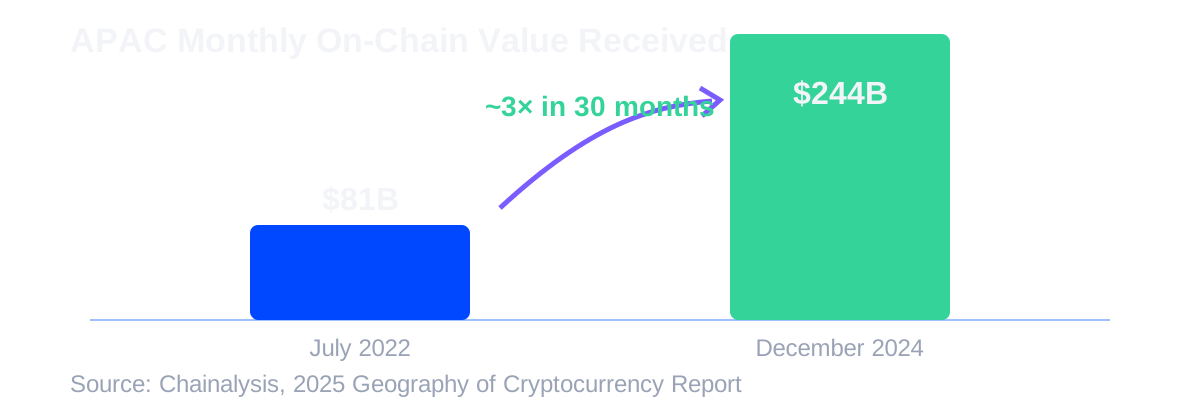
Crypto activity also varies sharply by region. Chainalysis estimates that monthly on-chain value received in APAC rose from about $81 billion in July 2022 to $244 billion in December 2024, roughly a threefold increase over 30 months. That scale does not make APAC one market: India, Japan, Korea, Vietnam, and Chinese-speaking communities have different platforms, regulations, and conversion paths.
ChainPeak’s Regional Growth Playbook uses four stages: Market Validation, Growth Strategy, Growth Execution, and Regional Expansion. Validation should produce a demand read, competitor map, local behavior analysis, and a go, no-go, or conditional-entry decision before a major launch budget moves.
Step 1 — Define the outcome before contacting an agency
Write a one-page brief that names the product, region, audience, launch milestone, budget range, and primary business outcome. “Grow the community” is not an outcome. “Acquire 2,000 verified users in Vietnam, with 25% completing a product action and 15% retained after 30 days” is specific enough to price and evaluate.
Select one primary metric and two guardrails. An exchange might prioritize funded accounts, with KYC completion and 30-day trading activity as guardrails. A wallet might prioritize first transactions, then monitor cost per activated wallet and 30-day retention. A Layer 1 may track active developers, deployed contracts, and repeat builder activity.
Without this brief, agencies quote different scopes and comparison becomes meaningless. With it, every proposal must explain how its channels produce the same defined result.
Step 2 — Match Web3 marketing agency services to the job
Web3 marketing agency services span several disciplines. Few firms are equally strong in every one, so match the agency type to the constraint.
| Capability | Best used for | Evidence to request |
|---|---|---|
| Research and validation | Choosing a market and testing demand | Research sample, test design, go/no-go criteria |
| KOL campaigns | Fast local reach and narrative distribution | Creator-level rates, audience geography, attributed actions |
| Community operations | Trust, support, retention, feedback | Moderator plan, response standards, retention cohorts |
| User acquisition | Registrations, KYC, deposits, wallet actions | Funnel definitions, anti-sybil controls, cohort results |
| PR and media | Credibility, search record, founder positioning | Named coverage, editorial process, disclosure policy |
| Ecosystem partnerships | Developers, integrations, local distribution | Partner pipeline, activation plan, ownership model |
| Events | Meetings, local trust, ecosystem presence | Qualified-meeting targets and post-event follow-up |
A full-service partner can coordinate several channels, while a specialist may offer deeper execution in one. The right choice depends on where the bottleneck sits. If market selection is uncertain, start with Research and Validation. If the market is proven but local distribution is weak, a specialist creator or community program may be enough.
Step 3 — Check regional execution, not global claims
Ask who operates in the target market, which language they work in, and which local channels they use every week. A global deck does not prove local execution. Request examples from the same product category and market, then verify the campaign publicly where possible.
Regional channel fit changes the operating plan. Korea depends heavily on Naver, YouTube, and KakaoTalk. Vietnam has strong Telegram, Facebook, and local creator networks. Japan rewards native-language consistency and credibility over fast promotional waves. Turkey and the Gulf should not share one “MENA” campaign because their audience economics and objectives differ.
The agency should also explain what it will not do. A credible partner will reject markets with weak demand, channels that cannot be measured, and promises it cannot control. ChainPeak reports experience supporting 450+ Web3 projects, access to 10,000+ verified KOLs, and a 300,000+ real-user network across seven core regional groupings. Treat these as first-party capability indicators and request relevant campaign evidence during diligence.
Step 4 — Audit Web3 marketing KPIs and attribution
Reporting should follow the user from source to meaningful product action. Impressions, followers, and group joins can diagnose reach, but they cannot prove growth. Ask the agency to define every metric before launch.
| Funnel stage | Weak metric | Better Web3 KPI |
|---|---|---|
| Awareness | Impressions | Qualified reach in the target market |
| Interest | Likes and reposts | Landing visits or community joins by source |
| Activation | Wallet connects | First qualifying transaction or funded account |
| Value | Total registrations | Deposits, volume, TVL, fees, or product usage |
| Retention | Community size | 7-day and 30-day retained active users |
| Efficiency | Cost per click | Cost per activated or retained user |
Attribution will never be perfect. A user may see an X post, join Telegram, read media coverage, and connect a wallet days later. The agency should combine tagged links, creator codes, referral identifiers, wallet events, CRM records, and cohort analysis instead of assigning all credit to the last click.
Demand scale also differs by market. Chainalysis reports that North America received $2.3 trillion in crypto value between July 2024 and June 2025 and represented 26% of transaction activity in its study. A credible agency converts market-level opportunity into product-specific targets rather than presenting adoption figures as guaranteed demand.
Step 5 — Review compliance before creative work begins
Crypto promotion has platform, financial-marketing, consumer-protection, and local legal constraints. Compliance cannot be added after creators have posted.
Google prohibits ads for several crypto categories, including ICOs, DeFi trading protocols, token liquidity pools, and unhosted wallets. Some exchanges, software wallets, hardware wallets, and coin trusts may advertise only in approved locations and after certification. Check the current Google Ads cryptocurrency policy before approving a paid-media plan.
Paid creator relationships also require clear disclosure. The U.S. Federal Trade Commission states that a material connection should be disclosed with the endorsement, in clear language, and in the same language as the endorsement. Ask the agency who approves claims, stores creator agreements, monitors live posts, and documents disclosures. Obtain qualified legal advice for each target jurisdiction.
Immediate red flags include guaranteed token-price performance, guaranteed exchange listings, undisclosed paid placements, fabricated communities, and claims that legal review is unnecessary.
Step 6 — Meet the team and verify evidence
The people in the pitch are not always the people running the account. Request the names, roles, locations, languages, and weekly time allocation of the delivery team. Ask who owns strategy, creator negotiation, community operations, data analysis, and escalation.
For every case study, request four details: the starting condition, exact scope, measured result, and agency contribution. A client logo without those details proves only that some relationship existed. Verify named media coverage, public campaigns, communities, and product activity where possible.
Use a weighted scorecard to prevent presentation quality from dominating the decision.
| Evaluation dimension | Weight |
|---|---|
| Target-region execution | 25% |
| Relevant, verifiable outcomes | 20% |
| Measurement and attribution | 20% |
| Named delivery team | 15% |
| Compliance and disclosure controls | 10% |
| Commercial terms and exit rights | 10% |
Score every finalist from 1 to 5 on the same evidence. Reject any agency with a critical compliance failure regardless of its total score.
Step 7 — Run a 30/60/90-day paid pilot
A pilot is long enough to test working quality and short enough to limit risk. It should be paid because serious validation and execution require real work, but it should have a defined end and no automatic long lock-in.
Days 1–30: validate and instrument. Confirm audience demand, competitor position, channels, compliance constraints, tracking definitions, and baseline metrics. Deliverables should include a market read, campaign hypothesis, measurement plan, and go/no-go decision.
Days 31–60: launch a controlled test. Run a narrow creator, community, content, or acquisition sprint. Keep the number of variables small enough to learn which source and message produce qualified actions.
Days 61–90: measure cohorts and decide. Review activated users, 30-day retention, acquisition cost, fraud signals, and operational quality. Expand only if the unit economics and user quality meet the agreed threshold.
Web3 agency vs in-house team: what should you own?
The strongest model is often hybrid. Keep product positioning, founder voice, customer knowledge, analytics access, and long-term community relationships inside the company. Use an agency for regional intelligence, temporary execution capacity, local creator and media relationships, campaign coordination, and specialist expertise.
| Situation | Better starting model |
|---|---|
| Uncertain market demand | Short validation engagement |
| Major launch in several regions | Agency-led execution with an internal owner |
| Daily product community and support | In-house core with agency overflow |
| One specialist need, such as Korean KOLs | Regional specialist |
| Repeatable mature channel | Build internal capability after agency proof |
Do not outsource final accountability. One internal leader should own the brief, data access, approvals, and the decision to continue or stop.
How to choose a Web3 marketing agency: final checklist
Before signing, confirm that the agency can answer each item with evidence:
- Which business outcome and region will the engagement target?
- What market-validation work happens before campaign spend?
- Which named people will deliver the work each week?
- Which local channels and partners are relevant, and why?
- How are activated and retained users defined?
- How are creator payments, claims, and disclosures controlled?
- Which past results can be independently checked?
- What happens in the first 30, 60, and 90 days?
- Who owns campaign data, accounts, and community relationships?
- What are the exit conditions if results or delivery fall short?
Conclusion
A Web3 marketing agency should reduce market-entry uncertainty and connect regional execution to product outcomes. Choose one by defining the job first, verifying its local operators and evidence, auditing its measurement and compliance systems, and testing the relationship through a bounded pilot.
The most reliable sequence is validation, strategy, execution, and expansion. Start with one market and one measurable outcome. Keep product knowledge, data ownership, and long-term community stewardship inside the company; bring in external expertise where regional access or execution speed creates a clear advantage.
