


Japan web3 market entry is a 6–12 month build, not a campaign: a licensed exchange regime under the FSA, JVCEA screening for every token, and roughly 12 million crypto users who diligence projects for months before committing. Teams that accept the pace compound trust; teams that run airdrop blitzes get polite silence.
The 2026 case is the strongest since 2017. Japan's tax reform program would move crypto gains from miscellaneous income — taxed at progressive rates up to about 55 percent — to a flat tax near 20 percent, with crypto reclassified as financial products under the Financial Instruments and Exchange Act; implementation is widely expected around 2027. This guide covers licensing, the IEO path, where the Japanese crypto community actually lives, and what entry costs.
Key Takeaways
- Japan web3 market entry takes 6–12 months of native-language consistency before communities self-sustain.
- A flat 20 percent crypto tax, replacing rates up to 55 percent, is expected around 2027.
- Roughly 30 FSA-registered exchanges and JVCEA screening define who may touch Japanese retail.
- The Japanese crypto community is X-native; Telegram-first playbooks signal foreignness and fail quietly.
- A six-month Japan entry program realistically costs $60,000–150,000 all-in as of 2026.
The licensing landscape that shapes Japan web3 market entry
Roughly 30 crypto-asset exchange service providers are registered with the Financial Services Agency as of 2026 — Coincheck, bitFlyer, bitbank, GMO Coin, and SBI VC Trade among the largest — and no unregistered venue may serve Japanese residents. The JVCEA screens tokens before they touch a yen order book; its green-list mechanism eases re-listing of assets already vetted elsewhere, but a first Japanese listing of a new token is a months-long process with real documentation demands.
Two implications for marketers. First, community and content marketing is workable without a license, but anything resembling solicitation of an unregistered token sale to Japanese residents is off-limits — get Japanese counsel before your first campaign, not after. Second, the licensed perimeter explains why Japanese users trust slowly and then deeply: they have not been rugged at scale since the exchange reforms that followed the Coincheck hack, and they expect projects to have accepted the same constraints they have.
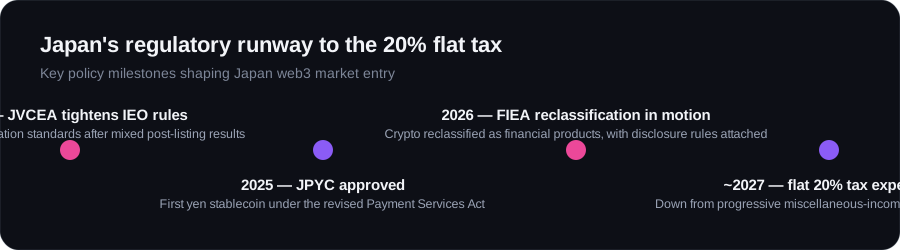
The regime is opening, not closing. Japan approved JPYC, its first yen stablecoin, in 2025 under the revised Payment Services Act; the FSA has signaled a stablecoin framework to be finalized around end-2026 and has set up a dedicated division for virtual assets; and the prime minister publicly backed Web3 startups at WebX 2026. Supervised, but increasingly welcoming — that is the trade.
Is Japan worth entering before the 20 percent tax reform?
Yes — and 2026 is specifically the window. The reform bundle in motion as of mid-2026 does three things: reclassifies crypto as financial products under the FIEA with disclosure requirements attached, moves qualifying gains to a flat tax near 20 percent in line with equities, and opens the path to crypto ETFs, a market some domestic estimates size in the billions of dollars. One caution: early drafts scope the flat rate to licensed-venue activity, while staking income, DeFi returns, and trading on foreign venues may remain miscellaneous income at up to 55 percent — the details are still moving, so hedge any user-facing claims.
The marketing logic follows from the trust horizon. If Japanese communities take 6–12 months to form, a team that starts building in 2026 is established when the tax tailwind lands; a team that waits for the reform starts the clock from zero in a more crowded, more expensive market. We saw the same dynamic in Korea after VAUPA: regulatory clarity rewards incumbency.
How does an IEO work in Japan?
Japan has a genuine IEO market — Coincheck and other licensed venues have run yen-denominated initial exchange offerings since 2021, frequently oversubscribed by retail. Post-listing performance was mixed enough that the JVCEA tightened IEO rules in 2024 around pricing and stabilization. The honest read: an IEO is the highest-legitimacy retail entry available in Japan, it takes six months to over a year of preparation with a licensed exchange partner, and it should be treated as a distribution and credibility event, not a fundraise multiple. Projects that market for two quarters before the IEO window consistently enter with stronger books than those that treat the exchange as the marketing plan.
Where the Japanese crypto community lives: X first
Japanese crypto is X-native to a degree no other market matches. The Japanese-language crypto cluster on X is one of the platform's largest non-English communities, anonymous accounts carry serious analytical reputations, and long-form follow-ups happen on note.com rather than Medium. Discord is the home for NFT and gaming communities; LINE, despite being Japan's dominant messenger, plays a smaller crypto role than KakaoTalk does in Korea; Telegram reads as foreign.
| Channel | Role | Notes |
|---|---|---|
| X (Japanese-language) | Core discovery and discourse | Anonymous analyst culture; threads and spaces move sentiment |
| note.com | Long-form trust layer | Research posts and project deep-dives |
| Discord | NFT and gaming community home | Expected for consumer and gaming projects |
| YouTube | Mainstream education | Slower, older audience; strong for exchange-adjacent content |
| Offline events | Legitimacy signaling | WebX and IVS Crypto draw tens of thousands; presence reads as commitment |
A Japanese X account run by a native speaker, posting consistently for months, outperforms any burst campaign. Machine-translated Japanese is detected instantly and quietly disqualifying. The media layer follows the same physics: Japan has fewer crypto outlets than Western markets, and the ones that matter — CoinPost at the top — carry real editorial weight, so coverage is harder to win and worth more once earned.
Why patience wins: the 6–12 month trust horizon
Japanese retail behavior is shaped by two decades of institutional memory — Mt. Gox and Coincheck happened here — and by a culture of collective diligence: prospective users watch how a project behaves over time before joining, and communities audit consistency (posting cadence, support responsiveness, whether the team shows up at events) as much as content. In our field experience the realistic horizon from first Japanese-language presence to a self-sustaining community is six to twelve months, a pattern consistent with the deliberate adoption curves Chainalysis observes in East Asia and with ownership surveys from Triple-A showing Japanese penetration well below regional peers despite deep infrastructure.
What compounds: an ambassador program with named, consistent local contributors; sponsorship of community events; visible partnerships with recognized Japanese entities. What does not: airdrop announcements, aggressive APY messaging, and any claim that outruns your documentation. This is community building as infrastructure, and it is the single largest line in a Japan budget done right.
The IP angle for consumer projects
Japan's differentiated asset is intellectual property. The gaming-chain ecosystem — Oasys, backed by major Japanese game publishers; Sony's Soneium; Square Enix's Web3 experiments — exists because publishers see blockchain as an IP distribution question. For consumer projects, an anime or gaming IP collaboration is the fastest trust transfer available in Japan, and the slowest deal to close. IP holders are famously protective; licensing conversations run three to nine months and collapse over quality concerns more often than over money. Budget the time, use a local business-development intermediary, and never ship fan-art-adjacent marketing without a license — that mistake is unrecoverable here.
Entry sequence and 2026 costs
The sequence we run for Japan, mapped to our playbook:
- Validate (6–8 weeks). Native-written Japanese X account and note.com presence, Japanese documentation, one CoinPost-tier media placement, and 5–10 KOL collaborations framed as analysis rather than promotion. Measure reply quality and follower composition, not volume.
- Launch (3–6 months). Ambassador program, event presence (WebX or IVS Crypto), Discord launch for consumer projects, and — where relevant — the start of exchange and IEO conversations with counsel engaged.
- Scale. IP partnerships, a sustained event calendar, and community rituals: regular AMAs at Japanese evening hours, translated release notes on day one.
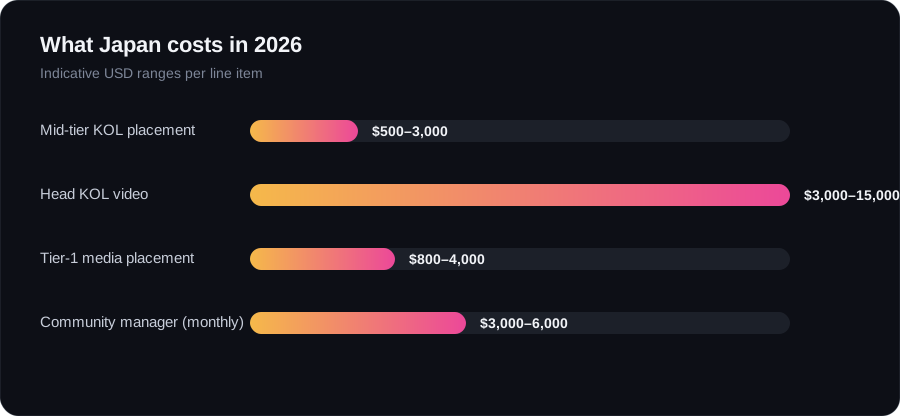
Indicative costs as of 2026: mid-tier Japanese KOLs run $500–3,000 per placement, head creators $3,000–15,000, tier-1 media $800–4,000, and a native community manager $3,000–6,000 monthly — Japanese professional salaries make local staffing the biggest fixed cost. A serious six-month entry program typically lands between $60,000 and $150,000 all-in.
FAQ
Is Japan worth entering before the tax reform takes effect?
Yes, if your horizon matches the market. The flat 20 percent tax expected around 2027 should expand retail participation meaningfully, and Japanese trust takes 6–12 months to build. Projects that begin Japan web3 market entry in 2026 hold position when the tailwind arrives; projects that wait start the trust clock in a more crowded market.
Do we need an FSA license to market crypto in Japan?
Community and content marketing does not require a license, but soliciting Japanese residents into an unregistered token sale violates the perimeter, and the line is fact-specific — engage Japanese counsel before your first campaign. Token distribution to Japanese retail runs through JVCEA screening and licensed exchanges, typically via the IEO route.
How long does Japan web3 market entry take?
Six to twelve months from first native-language presence to a self-sustaining community, and longer if an IEO or IP partnership is in scope. Budget $60,000–150,000 for a six-month program. Attempts to compress the horizon with spend mostly produce polite silence; consistency compounds where bursts stall.
How does an IEO work in Japan?
A licensed exchange such as Coincheck runs a yen-denominated token sale after JVCEA screening — the highest-legitimacy retail entry available in Japan. Preparation takes six months to over a year with the exchange partner, and rules tightened in 2024 around pricing and stabilization. Treat it as a distribution and credibility event, not a fundraise multiple.
Which channels matter most for the Japanese crypto community?
X is the core: Japan's crypto cluster is one of the platform's largest non-English communities, with anonymous analysts carrying serious reputations. Long-form trust builds on note.com, Discord hosts NFT and gaming communities, and offline events like WebX signal commitment. Telegram reads as foreign, and machine-translated Japanese is instantly disqualifying.
Final Thoughts
Japan is the opposite trade from every other Asian crypto market, and that is exactly its value. The licensed perimeter that makes entry slow also makes position defensible: competitors cannot buy their way past the same 6–12 month trust horizon you invested in, and the coming reclassification and flat 20 percent tax are set to reward whoever is already present when Japanese retail re-engages at scale. The playbook is unglamorous — a native-run X account, note.com deep-dives, an ambassador program, event presence, counsel on retainer — and it works because it matches how roughly 12 million Japanese crypto users actually evaluate projects. Budget $60,000–150,000 for the first six months, treat an IEO as a credibility event you prepare two quarters for, and measure reply quality before follower counts. If Japan fits your 2027 roadmap, the work starts in 2026. For a sequenced Japan web3 market entry plan with costs and counsel checkpoints, talk to us.
