

Korea crypto marketing in 2026 comes down to three facts: two exchanges — Upbit and Bithumb — clear roughly 87 percent of KRW spot volume, the Virtual Asset User Protection Act makes undisclosed paid promotion a legal risk, and community lives on KakaoTalk and Naver, not Telegram. Win those three and Korea compounds; miss one and budgets evaporate.
The prize is real. Korea's Financial Supervisory Service counted more than 16 million exchange accounts as of 2025 — roughly 30 percent of the population — and unique investor estimates sit near 11 million as of 2026. At points in 2024, the won traded as the busiest fiat pair in crypto. ChainPeak has supported Korean campaigns across exchanges, L1s, and consumer apps since 2022; this guide covers market structure, rules, channels, costs, and sequence.
Key Takeaways
- Upbit and Bithumb clear roughly 87 percent of KRW spot volume, so pre-listing community work decides outcomes.
- VAUPA plus a 2026 disclosure bill make undisclosed paid promotion a criminal risk, not reputational.
- Korea crypto marketing runs on Naver, YouTube, and KakaoTalk — Telegram-first playbooks read as foreign.
- Mid-tier Korean KOL placements cost $1,000–5,000, roughly 5–10x Southeast Asian rates per placement.
- No spend buys an Upbit listing; marketing makes a listing survivable through pre-built Korean community.
Two exchanges set the Korea crypto marketing agenda
Korea is the most concentrated major crypto market in the world: one language, one time zone, and two order books. Upbit has historically cleared 70–80 percent of KRW spot volume; as of early 2026 the split sits near 72 percent for Upbit, around 15 percent for Bithumb — a share Bithumb grew through its 2024–2025 fee-promotion push — close to 10 percent for Coinone, and low single digits for Korbit and Gopax combined, per market coverage such as Tiger Research. All five operate under real-name bank account partnerships and coordinate listing and delisting standards through DAXA, their joint self-regulatory body.
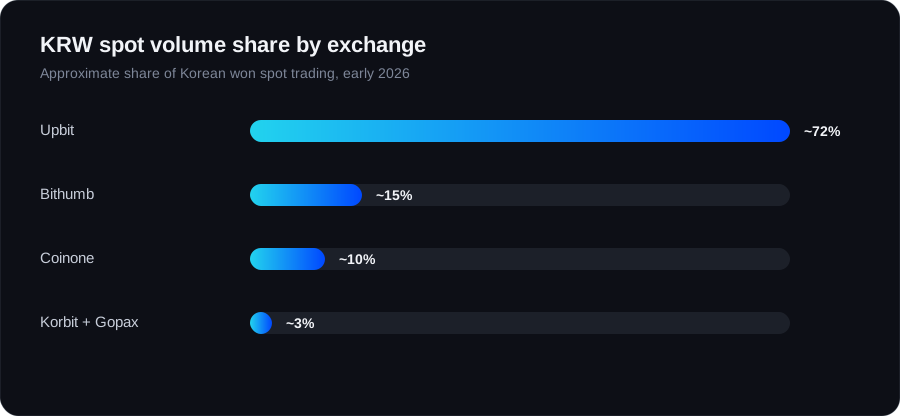
This concentration shapes every plan. There is no meaningful Korean DEX retail culture at scale; the KRW order book is the market. A token absent from Upbit and Bithumb effectively does not exist for mainstream Korean retail, which is why Korean community building is a pre-listing investment, not a post-listing one. It also means one structural shift matters for 2026 budgets: registered retail participation has cooled from its 2024 peak while institutional access — corporate accounts, ETF frameworks, and won-stablecoin rules on the policy agenda — expands. Legitimacy signals now carry more weight relative to hype mechanics than at any point since 2021.
How does VAUPA change crypto marketing in Korea?
The Virtual Asset User Protection Act has been in force since July 2024. It criminalized market manipulation and unfair trading in virtual assets, required exchanges to segregate customer assets and hold the large majority in cold storage, and gave the Financial Services Commission real enforcement teeth. Prosecutions of pump-style promotion followed through 2024–2025, including cases involving paid influencer activity, and a second legislative phase covering listings and disclosures is in progress as of 2026.
For KOL work, three rules matter. First, the Korea Fair Trade Commission has required clear disclosure of paid endorsements since 2020 — the "유료 광고" (paid advertising) label on YouTube and blog content is standard practice, not a courtesy. Second, under VAUPA, promotion that shapes price expectations without disclosing the economic relationship can intersect with unfair-trading provisions. Third, a bill introduced in February 2026 would go further, requiring crypto influencers to disclose both paid promotions and personal token holdings, with criminal penalties attached. The direction of travel is unambiguous.
Our operating rules for Korean KOL campaigns: every paid placement is labeled, briefs never include price language, and creators are vetted for enforcement history and holdings conflicts. Korean audiences are used to disclosure and do not punish it; regulators punish its absence. Note also what has not changed: token sales to Korean retail remain effectively closed — the 2017 ICO ban stands — so marketing means community, content, and creators, not solicitation.
Which channels do Korean crypto users actually use?
Korea has its own platform stack, and imported channel assumptions are the most common budget leak we see.
| Channel | Role | Notes |
|---|---|---|
| Naver blogs and cafes | Search-layer credibility | Korea searches Naver, not Google; a Korean-language blog presence is your landing page |
| KakaoTalk open chats | Core community layer | Trading rooms and project rooms; where retained users actually live |
| YouTube | Discovery and trust | Finance and crypto channels with mainstream reach; disclosure mandatory |
| Telegram | Trader tier | Signal rooms and high-velocity culture; useful but carries scam association |
| X | Internationalized tier | Smaller than Japan's; matters for builders and CT crossover |
The standard funnel we build: YouTube and Naver for discovery and legitimacy, KakaoTalk open chats for conversion and retention, Telegram for the trader cohort only. Running Korea entirely on Telegram — the default Southeast Asia playbook — reads as foreign and low-trust here. And everything must be native-written: machine-translated Korean is spotted immediately and quietly disqualifying.
Why Korean retail moves as one
Korea's herd velocity is structural, not cultural mythology. A single language, two order books, a handful of dominant communities — KakaoTalk mega-rooms, DCInside's coin gallery, the top YouTube channels — and real-time price visibility on portals mean information cascades finish in hours. This produced the famous kimchi premium, with Korean prices running percentage points above global venues during demand spikes, and it still produces single-day altcoin rotations with little global echo, a pattern Chainalysis data on East Asian flows has repeatedly captured.
For marketers this cuts both ways. Korea can take a project from unknown to top-of-mind faster than any market we work in, and it can drop it just as fast. Sustained presence — a staffed Kakao room, weekly Korean-language updates, a moderator who answers at Korean hours — is what separates a spike from a base. That is community operations work, and in Korea it becomes the majority of the budget after the first quarter.
What an Upbit listing is worth — and what it is not
Upbit listings have historically produced double-digit to triple-digit day-one price spikes, though the effect has compressed as DAXA standardized listing practices and VAUPA raised manipulation risk. Two honest observations from the field. First, listing-day volume is dominated by domestic momentum traders, and hold-through rates are low without a pre-built Korean community to absorb the attention. Second, no marketing spend buys a listing: DAXA-member exchanges make independent, opaque decisions, and any agency claiming listing influence is a red flag — walk away.
What marketing does is make a listing survivable. A staffed Korean community, Korean-language documentation, a Naver content footprint, and one or two credible media features turn a one-day event into a market. Teams that arrive at listing day with nothing local watch the spike sell into silence.
What Korea costs in 2026
Korea is the most expensive retail crypto market in Asia on a per-placement basis, and compliance review adds real overhead. Indicative ranges as of 2026, in USD:
| Line item (indicative, 2026) | Korea | Japan | SEA average |
|---|---|---|---|
| Mid-tier KOL post/video | $1,000–5,000 | $500–3,000 | $100–800 |
| Head KOL video | $5,000–30,000+ | $3,000–15,000 | $1,000–6,000 |
| Tier-1 local media placement | $1,000–5,000 | $800–4,000 | $200–1,500 |
| Native community manager (monthly) | $2,500–5,000 | $3,000–6,000 | $400–1,200 |
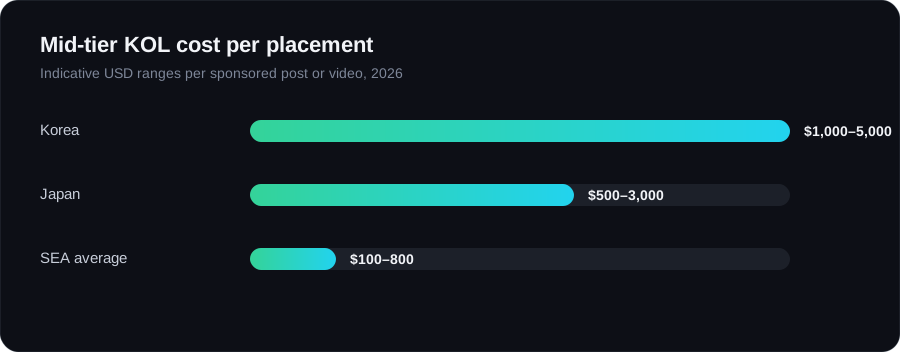
What you buy for the premium is depth: Korean users trade larger, churn slower once converted, and confer regional legitimacy that Southeast Asian markets notice. A serious validation-and-launch program typically lands between $30,000 and $60,000 over two to three months; below that floor, narrow the scope rather than thinning every line.
The entry sequence we run
The sequence we run for Korea, following the validate-launch-scale structure in our playbook:
- Validate (4–6 weeks). Korean-language Naver blog and documentation by native writers, a staffed KakaoTalk open chat, 5–10 mid-tier KOL placements with full disclosure, and one tier-1 media piece (Block Media or TokenPost tier). Measure engaged-member cost and sentiment quality, not raw joins.
- Launch (6–10 weeks). Two disclosed KOL waves anchored on YouTube, an AMA circuit across established Kakao communities, and a Korea Blockchain Week presence if the calendar allows — offline signaling matters disproportionately here.
- Scale. Always-on Korean moderation, weekly Korean-language updates, and creator relationships maintained between campaigns. Korea punishes absentee projects faster than any market we operate in.
FAQ
How much does crypto marketing in Korea cost in 2026?
Plan $30,000–60,000 for a serious two-to-three-month validation-and-launch program. Mid-tier KOL placements run $1,000–5,000, tier-1 media $1,000–5,000 per story, and a native community manager $2,500–5,000 monthly. Korea crypto marketing costs roughly 5–10x Southeast Asian rates per placement, offset by larger average positions and slower churn once users convert.
Do Korean crypto KOL partnerships have to be disclosed?
Yes. Fair Trade Commission rules have required clear paid-endorsement labels since 2020, and a bill introduced in February 2026 would add criminal penalties for crypto influencers who hide payments or personal token holdings. Label every placement, keep price language out of briefs, and vet creators for enforcement history before contracting.
Can marketing spend get a token listed on Upbit?
No. DAXA-member exchanges make independent, opaque listing decisions, and anyone selling listing influence is a red flag. What Korea crypto marketing does is make a listing survivable: a staffed Korean community, Korean-language documentation, and local credibility that turn a one-day volume spike into a durable market position.
What is the best channel for building a Korean crypto community?
KakaoTalk open chats are the retention layer where Korean users actually live, fed by YouTube and Naver for discovery and credibility. Telegram covers only the high-velocity trader tier. A staffed Kakao room with Korean-hours moderation outperforms any Telegram-first setup, which reads as foreign and low-trust to mainstream Korean retail.
Is Korea worth entering before an exchange listing?
Yes — Korean community building works best as a pre-listing investment. Because Upbit and Bithumb concentrate nearly all KRW volume, a token without local community, documentation, and media presence gets sold by momentum traders on day one. Teams that build for one or two quarters before listing hold attention afterward.
Final Thoughts
Korea rewards teams that respect its structure. The market is concentrated — two exchanges, one messenger, one search portal — which means a correct plan is short and an incorrect one is expensive. Build the Naver and YouTube credibility layer first, staff a KakaoTalk room with native moderators, disclose every paid placement as if the February 2026 bill were already law, and treat any listing as an event your community must be ready to absorb rather than a strategy in itself. Budget honestly: $30,000–60,000 for validation and launch, with community operations growing into the largest line by the second quarter. The payoff is a retail base that trades in size, churns slowly once converted, and signals legitimacy across all of Asia. If Korea is on your 2026 roadmap, the right time to start the community clock is one to two quarters before you need it. For a scoped Korea crypto marketing plan — channels, creator list, compliance checklist, and budget — talk to us.
