


MENA crypto marketing only works when you split the region into two tracks. Turkey is a mass retail market — close to 200 billion USD in annual on-chain value as of 2026 reporting, nearly four times the UAE — while Dubai and the Gulf form a regulatory and business-development hub. Each track needs its own language, creators, channels, and goals.
The "MENA" label covers at least three markets that share almost nothing: Turkish-speaking retail built on a decade of currency distrust, a small but wealthy Gulf audience surrounded by the industry's favorite regulators, and the wider Arabic-speaking world, where audiences are large and monetization rails are weak. This guide breaks down how each sub-market works as of mid-2026, what each is best for, and what campaigns cost.
Key Takeaways
- MENA crypto marketing splits into two tracks: Turkish mass retail and Gulf-based BD, media, and fundraising.
- Turkey records close to 200 billion USD in annual on-chain value, nearly four times the UAE.
- Dubai delivers exchange relationships and media density, not user acquisition; measure event spend accordingly.
- Turkish campaigns run in Turkish only: Telegram groups, crypto YouTube, and X carry the market.
- Mid-tier KOL posts range from 100–500 USD in Egypt to 500–5,000 USD in the Gulf.
- Sequence Turkey first for retail signal, the UAE for infrastructure, and Arabic-language scale third.
Why MENA Crypto Marketing Needs Two Separate Playbooks
The most common failure we see: a team flies into Dubai for a conference, hires an "MENA agency" the same week, and assumes the region is covered. What they usually bought is Gulf-facing PR with no Turkish-language presence at all — which means missing the one MENA market that behaves like a top-ten global retail market.
The two tracks differ on every axis that matters. Turkey is a conversion market: tens of millions of experienced retail users, deep local exchanges, and creators who move volume. The Gulf is a relationship market: regulators, exchanges, market makers, funds, and media concentrated in two emirates. Running one budget, one language, or one agency across both produces weak results in both. At ChainPeak we plan them as separate campaign tracks inside one regional strategy — the Market Validation to Regional Expansion sequence documented in our playbook.
Turkey: The Largest Crypto Market in MENA
Turkey is the retail engine of the region, and the numbers are not close. Chainalysis has ranked Turkey the largest crypto market in MENA, and industry estimates as of 2026 put its annual on-chain activity near 200 billion USD — roughly four times the UAE's. Ownership surveys from research firms such as Triple-A place crypto ownership anywhere from a third to roughly half of Turkish adults, depending on methodology. Even the conservative end means tens of millions of people who have held crypto.
The driver is the lira, not ideology. Turkish inflation peaked above 80 percent in 2022 and remained well above developed-market norms into 2026 despite real deceleration. A generation of savers learned to rotate out of lira on payday — historically into dollars and gold, increasingly into USDT. Chainalysis has repeatedly noted Turkey leading the world in stablecoin purchases relative to GDP, in the range of several percent. Stablecoins are not a crypto product in Turkey; they are a savings product.
Two practical consequences follow. First, Turkish users are experienced: local exchanges such as BtcTurk and Paribu have operated for a decade, and the 2024–2025 licensing regime under the Capital Markets Board of Türkiye formalized the sector rather than creating it. Second, Turkish retail is aggressive — fast rotation, strong altcoin appetite, heavy derivatives activity — which makes Turkey outstanding for trading products, token launches, and volume campaigns, and weaker for slow-burn ecosystem plays.
Everything happens in Turkish. English-language content effectively does not exist for this audience. Telegram trading groups, Turkish crypto YouTube, and X form the core stack, and the local event circuit is maturing: Istanbul Blockchain Week returned for its fifth edition in June 2026.
Is Dubai Good for User Acquisition or Just for BD?
Mostly BD — and that is not a criticism. Dubai's value is structural, not demographic. The UAE has among the highest per-capita crypto adoption in the region, but the resident population is small; you do not go to Dubai for users at scale. You go because the industry is physically there.
The Virtual Assets Regulatory Authority (VARA), established in 2022 as the world's first dedicated virtual-asset regulator, has — together with Abu Dhabi's ADGM framework — pulled major exchanges, market makers, and funds into the Emirates. Token2049 Dubai has grown into one of the two largest crypto gatherings on earth, drawing on the order of 15,000 to 20,000 attendees plus a sprawling side-event circuit. For exchange relationships, market-maker meetings, fundraising, or Tier-1 media visibility, the UAE is the highest-density venue in the Eastern Hemisphere.
The resident audience that does exist is premium: high-income expats, family offices, and professional traders. They are reached through events, English and Arabic business media, X, and increasingly LinkedIn — not through mass KOL blasts.
Saudi Arabia and the Wider Gulf: Fewer Users, Higher Value
Saudi Arabia is the demographic prize the industry has not yet been allowed to claim: a large, young population — median age under 30 — that ranks among the world's heaviest spenders on gaming and digital entertainment. But as of 2026 there is still no licensing regime for exchanges, and banks remain cautious, so Saudi marketing means brand-building and community cultivation, not conversion funnels. Gaming and NFT-adjacent products travel best.
Bahrain runs a functioning central-bank licensing regime and hosts licensed exchange operations; Qatar and Kuwait remain restrictive. Egypt and the Levant offer large Arabic-speaking audiences on weak banking rails — good for awareness and community scale, poor for monetization. Treat the Gulf outside the UAE as a patience play: small numbers, high average wallet value, long relationship cycles.
What Do Crypto KOLs Cost Across MENA and Turkey?
The Turkish and Arabic creator markets do not overlap. Turkish crypto YouTube and Telegram are mature, competitive, and cheap relative to reach — a legacy of ten years of retail trading culture. The Arabic scene is younger and fragmented across dialects: Gulf-based lifestyle-and-wealth creators command premium rates, while Egyptian and Levantine creators sell large reach at low cost into audiences with weaker banking access.
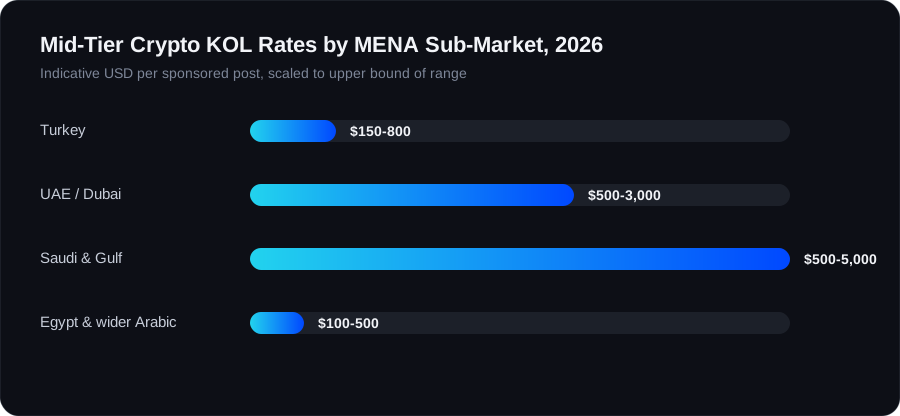
| Sub-market (indicative, 2026) | Primary driver | Best for | Core channels | Mid-tier KOL post |
|---|---|---|---|---|
| Turkey | Inflation hedging, trading culture | Exchanges, token launches, volume | Telegram, YouTube, X | 150–800 USD |
| UAE / Dubai | Regulatory hub, industry density | BD, listings, PR, fundraising | Events, X, business media | 500–3,000 USD |
| Saudi & Gulf | Young, high-income consumers | Gaming, brand, early community | X, Instagram, YouTube | 500–5,000 USD |
| Egypt & wider Arabic | Large audiences, weak rails | Awareness, community scale | Facebook, Telegram, TikTok | 100–500 USD |
Rates vary widely with vertical and exclusivity; treat these as planning bands, not quotes. Our KOL marketing team maintains vetted Turkish and Arabic rosters drawn from a network of more than 10,000 creators, because rate cards in both scenes are informal and inflate quickly for foreign buyers.
How We Sequence a MENA and Turkey Entry
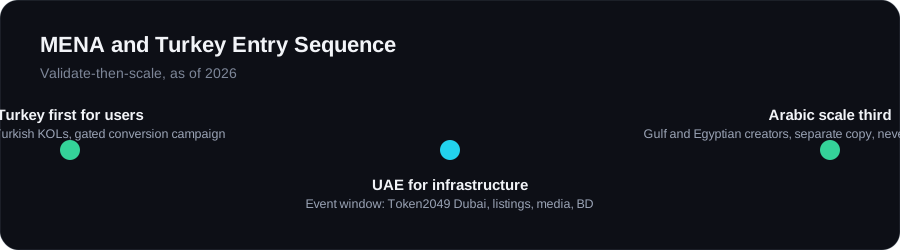
Our standard sequence for MENA and Turkey follows validate-then-scale logic:
- Turkey first for users. Turkish-language content, 10–20 mid-tier KOLs across YouTube and Telegram, and a conversion campaign with clear anti-sybil gating. Turkey returns honest retail signal within weeks at modest cost — the same role Vietnam plays in Southeast Asia.
- UAE for infrastructure. Time a Dubai push to an event window such as Token2049. The goal is meetings and media, not sign-ups; measure it accordingly.
- Arabic scale third. Once Turkish metrics validate the product, extend into Gulf and Egyptian Arabic content — separate creators, separate copy, never machine-translated.
Budget-wise, a serious regional entry typically routes 60–70 percent of paid media and creator spend into Turkey, with the UAE line dominated by event and PR costs rather than creator fees.
Common Mistakes That Waste MENA Budgets
Three recurring failures. Treating Dubai visibility as user acquisition — the CAC math never closes, because the users were never there. Running English or machine-translated Turkish content — Turkish users read it as absentee, and credible Turkish creators quietly decline association. And ignoring religious and cultural calendars: campaign performance across Arabic-speaking markets shifts materially around Ramadan, and scheduling against it wastes money.
FAQ
Is Turkey part of a MENA marketing budget or its own line?
Its own line. Turkey has a separate language, its own creator economy, a licensed exchange sector under the Capital Markets Board, and retail behavior closer to Vietnam than to the Gulf. Agencies selling Turkey inside an Arabic-language MENA package usually deliver neither market well.
Is Dubai worth the spend for a project with no BD agenda?
Usually not as a standalone line. Dubai delivers exchange relationships, market makers, funds, and media density around events like Token2049. If you only need users, Turkey, Southeast Asia, or Africa supply them at a fraction of the cost; the UAE works best as the relationship layer on top.
How strong is Turkey crypto adoption and stablecoin usage?
Among the strongest in the world relative to economy size. Chainalysis reporting has shown Turkey leading stablecoin purchases as a share of GDP, in the range of several percent, driven by lira depreciation. Savings messaging tests well, but the audience is experienced enough to punish hype.
What channels work for crypto marketing in Turkey?
Telegram trading groups, Turkish-language crypto YouTube, and X carry the market, with licensed local exchanges as distribution partners. English content effectively does not reach this audience. Plan 10 to 20 mid-tier Turkish creators at 150 to 800 USD per post, with conversion tracking and anti-sybil gating from day one.
When should a Web3 project attend Gulf events like Token2049 Dubai?
When there is a concrete BD agenda: exchange listings, market-maker meetings, fundraising, or Tier-1 media. Token2049 Dubai draws on the order of 15,000 to 20,000 attendees as of 2026, and meeting calendars fill weeks ahead. Attending for brand visibility alone rarely returns the cost.
Final Thoughts
MENA rewards teams that respect its seams. Turkey is one of the world's great retail crypto markets — near 200 billion USD in annual on-chain value, stablecoin adoption measured in percent of GDP, and a creator economy that prices reach lower than almost any market of comparable depth. The Gulf is the industry's meeting room: VARA-licensed infrastructure, capital, and media packed into two emirates. Confusing the two is the region's most expensive mistake, and running both from one Arabic-language budget is its most common one.
The sequence that holds up: validate in Turkey with native-language creators and gated conversion campaigns, put the UAE to work on listings, partnerships, and press during an event window, then widen into Arabic-speaking markets once the data supports it. ChainPeak has applied this regional split across engagements for 450+ projects since 2022, and the honest advice is sometimes that Turkey alone is the right first step. If you are weighing a MENA entry against other regions, talk to us and we will map the sequence against your product and budget.
