


The Vietnam crypto market combines top-five global adoption — an estimated 17–21 percent of the population holding crypto as of 2026 — with a legal framework that took effect on January 1, 2026. For Web3 teams, it is the highest-conviction, lowest-cost retail market in Asia, provided you enter through Telegram, Zalo, and native-language communities.
This guide covers the adoption data, the new licensing regime, how Vietnamese users behave, what channels and KOLs cost, and the launch sequence we run for projects entering Vietnam.
Key Takeaways
- Vietnam ranks fourth in Chainalysis's 2025 Global Adoption Index; an estimated 17–21 percent of residents hold crypto.
- Crypto became legal property on January 1, 2026, under the Law on Digital Technology Industry.
- A state-approved exchange market is expected in Q3 2026, with all trades settled in Vietnamese dong.
- Telegram converts, Zalo retains, Facebook and TikTok discover; search plays almost no role in the Vietnam crypto market.
- Mid-tier Vietnamese KOL posts cost $150–800, roughly 2–5x below Chinese-speaking market rates.
- Airdrop culture cuts both ways: fast Vietnam crypto adoption, professionalized sybil farms — gate incentives early.
The Vietnam crypto market by the numbers
Vietnam is the highest-conviction retail crypto market in the world relative to its size. Chainalysis ranked it fourth in its 2025 Global Adoption Index — behind only India, the United States, and Pakistan — and ownership research from firms like Triple-A puts holders at roughly 17–20 million people, around a fifth of the population. Industry estimates as of 2026 put annual received crypto value on the order of $100–120 billion, most of it through offshore platforms, against a national GDP near $500 billion. That is not a niche; it is a parallel financial habit.
The market also has native industry pedigree. Sky Mavis, the studio behind Axie Infinity, is Vietnamese, and the 2021 play-to-earn boom left behind millions of users who had already onboarded wallets, bridges, and DEXs before most Western retail knew what a quest was. Usage today spans remittances, savings in stablecoins, gaming, and aggressive spot and futures trading.
Is crypto legal in Vietnam in 2026?
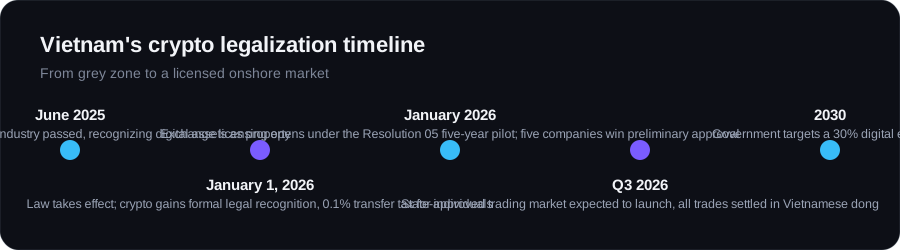
Yes — and 2026 is the year the grey zone formally ended. The Law on Digital Technology Industry, passed in June 2025 and effective January 1, 2026, recognizes digital assets as property for the first time. Crypto remains non-legal tender — it cannot be used to pay for goods and services — but holding and trading are recognized, with individuals taxed at 0.1 percent per transfer.
The second pillar is Resolution 05, a five-year pilot for licensed domestic exchanges. Licensing opened in January 2026 with charter capital requirements near $400 million and a 49 percent cap on foreign ownership. The Ministry of Finance, together with the Ministry of Public Security and the State Bank, has granted preliminary approval to five companies, and a state-approved trading market is expected to open in Q3 2026 — with all trades settled in Vietnamese dong through licensed platforms. The policy goal is explicit: pull volume onshore and support a national target of a 30 percent digital economy by 2030.
For marketers, the implications are practical. Legitimacy is a tailwind — mainstream Vietnamese media now covers crypto as policy rather than scandal — but compliance-aware messaging is the new baseline, and the arrival of licensed domestic venues will gradually pull volume onshore. Projects that build local goodwill in 2026 are positioning ahead of that shift.
How do Vietnamese crypto users behave?
Mobile-first, community-led, and fast. Discovery happens socially — a group admin, a KOL video, a friend's referral — almost never through search. Risk appetite is high: small accounts, big margin multiples, quick rotation, and prices mentally denominated in USDT.
Airdrop hunting is professionalized, which cuts both ways: Vietnamese users will find your campaign within hours, and so will Vietnamese sybil farms. Design incentives accordingly — cost-of-action gates and retention-based measurement are user growth disciplines in themselves here.
The GameFi inheritance is real. Guild structures, quest mechanics, and play-to-earn literacy remain widespread, which is why game and consumer-app launches consistently outperform pure DeFi launches in Vietnam web3 campaigns.
Which channels convert in Vietnam?
Telegram is the core trading layer — announcement channels plus discussion groups run by admins whose word moves their members. Zalo, Vietnam's domestic messenger with a claimed 70+ million users, is the high-trust local layer, closer to WeChat's role in Chinese-speaking markets: private groups, harder to enter, stickier once you are in. Facebook remains Vietnam's largest social platform, and its crypto groups are massive discovery surfaces, though moderation requires soft-sell content. TikTok and YouTube drive top-of-funnel discovery; X matters mainly for the internationalized trader tier.
The standard funnel we build for Vietnam crypto marketing: TikTok, YouTube, and Facebook for discovery; Telegram for conversion and campaign mechanics; Zalo for retention of the highest-value cohort.
KOL economics and crypto media
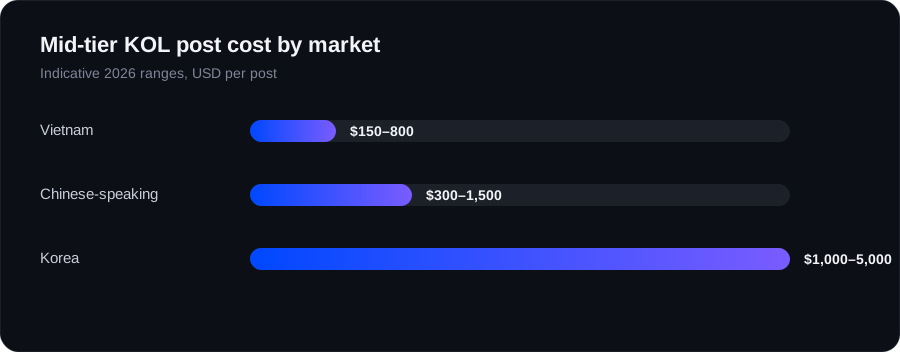
Vietnam's creator market is deep and inexpensive by regional standards. Mid-tier creators (10,000–100,000 followers) typically run $150–800 per post or video; head creators run roughly $1,000–6,000. Telegram group admins — arguably the most conversion-relevant creators in the market — often price by pinned post or AMA package rather than by follower count.
On media: Coin68 is the reference Vietnamese-language crypto outlet; Coin98 Insights carries research-flavored reach into an ecosystem audience; Kyros Ventures publishes widely cited market research; and communities in the Tradecoin tradition aggregate large trader audiences. AMA culture is strong and expected — a launch without a Vietnamese-language AMA circuit reads as absentee.
| Line item (indicative, 2026, USD) | Vietnam | Chinese-speaking | Korea |
|---|---|---|---|
| Mid-tier KOL post | 150–800 | 300–1,500 | 1,000–5,000 |
| Head KOL post/video | 1,000–6,000 | 1,500–20,000+ | 5,000–30,000+ |
| Tier-1 local media placement | 200–1,500 | 500–3,000 | 1,000–5,000 |
| Native community moderator (monthly) | 500–1,200 | 1,500–3,000 | 2,500–5,000 |
Vietnam delivers the lowest cost per engaged user of any major Asian market — but plan for volume: cheap distribution plus airdrop culture means raw numbers inflate quickly, and only retention-based measurement tells you what you bought.
A launch sequence that works
We run Vietnam entries through the same four-stage model as every market — Market Validation, Growth Strategy, Growth Execution, Regional Expansion — documented in our playbook.
Market Validation (2–4 weeks). Vietnamese-language materials written by native speakers, a Telegram group with local moderators, 10–20 KOC posts, one Coin68-tier media placement, and a small quest campaign with cost-of-action gating. Measure cost per engaged member and sybil share; a meaningful validation program typically runs $10,000–25,000.
Growth Strategy. Turn validation data into channel weights and incentive sizing: which creator tiers converted, what reward level attracted humans rather than farms, and whether GameFi mechanics belong in your funnel.
Growth Execution (4–8 weeks). Two KOL waves of 15–30 mid-tier creators each, a 3–5 stop AMA circuit across partner communities, Facebook group seeding, and a referral program with anti-farm caps.
Regional Expansion. A Zalo community for the retained core, guild partnerships for GameFi, and always-on community management — an unmoderated Vietnamese Telegram group degrades within days — before carrying the learnings into adjacent Southeast Asian markets.
FAQ
How big is the Vietnam crypto market in 2026?
As of 2026, the Vietnam crypto market ranks fourth in Chainalysis's Global Adoption Index, with an estimated 17–21 percent of the population — roughly 17–20 million people — holding crypto and $100–120 billion in annual received value, most of it still flowing through offshore platforms.
When do Vietnam's licensed crypto exchanges launch?
Vietnam's Ministry of Finance has indicated a state-approved trading market in Q3 2026, with five companies holding preliminary approval to operate licensed platforms. Trades must settle in Vietnamese dong, individuals pay a 0.1 percent tax per transfer, and the pilot runs five years under Resolution 05.
Which channels work best for Vietnam crypto marketing?
Telegram converts — it is where trading conversation and campaign mechanics live — supported by Facebook groups, TikTok, and YouTube for discovery. Zalo, with a claimed 70+ million users, is the retention layer for the highest-value cohort. Native Vietnamese content is a prerequisite; search barely matters.
How much does crypto marketing cost in Vietnam?
Vietnam delivers the lowest cost per engaged user of any major Asian crypto market: mid-tier KOL posts run $150–800, head creators $1,000–6,000, tier-one media placements $200–1,500, and native moderators $500–1,200 monthly. A meaningful validation program typically runs $10,000–25,000.
Do Vietnamese users respond to airdrop campaigns?
Faster than almost anyone — and so do Vietnamese sybil farms, because airdrop hunting is professionalized. Campaigns need cost-of-action gates and retention-based measurement from day one, or raw Vietnam crypto adoption numbers inflate while funded, retained wallets stay flat. Design incentives for humans, not scripts.
Final Thoughts
The Vietnam crypto market in 2026 offers a rare combination: top-five global adoption, new legal clarity, and the lowest creator and media costs in Asia. The window matters — licensed domestic exchanges are expected in Q3 2026, mainstream coverage is turning favorable, and projects building Vietnamese-language communities now will hold positions that get more expensive to buy later.
The discipline matters just as much. Vietnam rewards native-language content, Telegram-first campaign mechanics, and patient Zalo retention work; it punishes machine-translated announcements and ungated airdrops with inflated dashboards and empty communities. Enter with a validation budget, measure retained wallets rather than raw signups, and sequence spend behind what the data shows — not behind what the loudest KOL quotes you.
We have run Vietnam crypto marketing programs since 2022, backed by a vetted regional KOL network and a 300,000-plus active community footprint across Asia. If Vietnam is on your 2026 roadmap, talk to us — we will scope a validation sprint against your category, budget, and timeline.
