


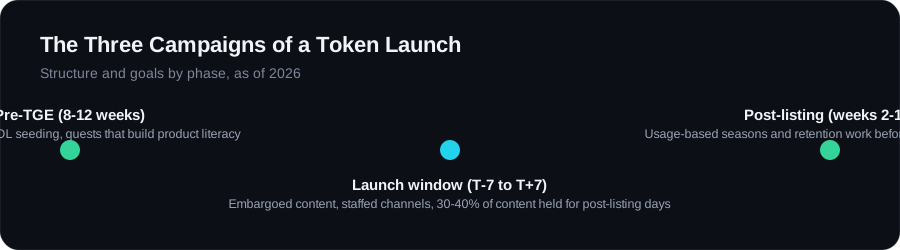
Token launch marketing is three campaigns, not one event: 8–12 weeks of pre-TGE conviction building, a coordinated launch window from T-7 to T+7, and 12 weeks of post-listing retention work. Teams that budget all three hold their communities through the first vesting cliffs; teams that stop at listing become a chart nobody defends.
Most launches do not fail at engineering or at listing; they fail at structure. The typical 2026 pattern: nine months and most of the budget spent on pre-TGE noise, a respectable listing day, then silence — at exactly the moment when price discovery, cliff anxiety, and airdrop sell pressure decide whether any users stay. This playbook is the structure we use in our token launch engagements, with budget bands and failure modes stated plainly.
Key Takeaways
- Token launch marketing spans three campaigns: pre-TGE, launch window, and post-listing retention.
- Reserve 30–35 percent of total budget for post-listing operations, the phase most teams zero out.
- Unfiltered open airdrop campaigns run 40–70 percent sybil share as of 2026.
- Start execution 8–12 weeks before TGE; Korean and Chinese-speaking communities take weeks to warm.
- If one region exceeds 40 percent of your engaged community, rebalance before listing.
- The market now expects community allocations of roughly 25–50 percent at TGE.
Why Token Launch Marketing Is Three Campaigns, Not One
Industry playbooks have converged on the same shape: guides from agencies such as Coinbound now describe a launch as a 12–20 week coordinated program spanning narrative, community infrastructure, media, KOLs, launch-day execution, and post-TGE retention. The market has moved with it: multi-season points programs are the default pre-TGE mechanic, anti-sybil profiling happens before distribution rather than after, and community allocations of roughly 25–50 percent are the expected norm — launches announcing much less have drawn immediate backlash.
Each of the three campaigns has different goals, different metrics, and a different regional footprint. Treating them as one continuous "launch push" is how budgets end up 90 percent spent before the only phase that determines retention has begun.
Phase 1 — Pre-TGE (8–12 Weeks): Seeded Conviction
The pre-TGE goal is not reach; it is conviction density — a core of communities and creators who understand the product well enough to defend it later. Three workstreams:
Narrative. One sentence a mid-tier KOL can repeat accurately without your deck. If your positioning needs three paragraphs, strangers will simplify it for you, badly. The public announcement window that performs best is 6–8 weeks before TGE.
KOL seeding in tiers. Start with small, credible, research-flavored creators 8–10 weeks out; widen to mid-tier reach 4–6 weeks out; reserve head creators for the final two weeks and the launch window. Inverting this — headliners first — buys a spike that decays before listing. Structure and vetting matter more than logos; this is the core of our KOL marketing practice.
Community with progression. Quest campaigns, points seasons, and testnet programs work when they build product literacy, not when they pay for clicks. Every task should leave the participant closer to being a real user.
Metrics that matter: cost per engaged (not registered) member, organic mention share, and sybil rate in campaign cohorts. Vanity totals — Discord headcount, follower counts — predict nothing.
Phase 2 — Launch Window (T-7 to T+7): Coordination, Not Volume
Launch-day marketing is an operations problem. Everything is pre-produced and time-zoned: KOL content embargoed to a coordinated window, media placements booked in advance, exchange announcement mechanics rehearsed, community channels staffed around the clock in every operating language, and a prepared response plan for the two most likely surprises — a listing delay and a violent first-day drawdown. Silence during a drawdown does more damage than the drawdown itself.
One discipline point: do not spend the entire creator budget amplifying the listing pump. Reserve 30–40 percent of launch-window content for the days after listing, when attention is still high and the narrative fight — "is this dumping or consolidating" — is actually being decided.
Phase 3 — Post-Listing (Weeks 2–12): The Campaign Nobody Budgets
Post-TGE, the goal shifts from acquisition to conversion: turning claimers and speculators into users before the first meaningful vesting cliff. The tools are unglamorous — usage-based incentive seasons, retention quests, regional community programs, second-wave listings and integrations as narrative beats, and honest communication around scheduled supply releases. Post-mortem research from firms like Messari keeps tracing failed launches to the same causes: narratives that never stabilized, communities built purely on airdrop anticipation, and post-launch silence that converted holders into sellers.
As a planning rule: if you cannot fund 12 weeks of post-listing operations, cut pre-TGE spend until you can.
When Should Each Region Light Up?
Lighting up every region simultaneously is a budget-shredder. The sequencing logic we use across 450+ project engagements:
| Phase | Regions | Why |
|---|---|---|
| Pre-TGE validation | Vietnam or Philippines, Turkey, Nigeria | Fast, low-cost, honest retail signal; campaigns iterate weekly |
| Pre-TGE depth | Chinese-speaking, Korea | High-conviction capital and exchange relevance; expensive, slower to warm, must start early |
| Launch window | All active regions plus Dubai/UAE layer | Coordinated global beat; UAE adds BD, media, and exchange density |
| Post-listing | LATAM, Africa, wider SEA | Cheapest retained users; community-led growth compounds after the noise |
The details differ by product — a GameFi title weights Southeast Asia and LATAM earlier; a DeFi protocol weights Chinese-speaking and Korean depth — but the principle holds: validate cheaply, build depth where capital lives, then widen into low-CAC regions for the retention phase rather than the hype phase.
The failure mode is single-region overconcentration: one strong airdrop community in one farming-heavy market can end up holding most of your float. If any single region exceeds roughly 40 percent of your engaged community pre-TGE, that is a rebalancing signal, not a success story.
How Much Does Token Launch Marketing Cost in 2026?
| Tier | Typical raise | Total launch marketing | Phase split (pre / launch / post) |
|---|---|---|---|
| Lean | under 10M USD | 100k–300k USD | 45 / 25 / 30 |
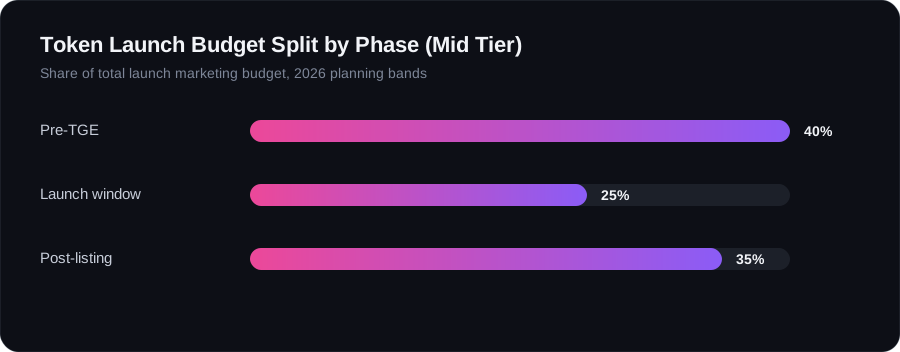
| Mid | 10–40M USD | 300k–800k USD | 40 / 25 / 35 |
| Major | 40M+ USD | 1M–3M+ USD | 40 / 30 / 30 |
These are planning bands from deals we see as of 2026, not quotes; vertical, chain, and exchange ambitions move them. The constant across tiers is the post-listing line — the one most teams zero out and most regret. With CoinGecko tracking millions of listed tokens, attention at TGE is scarcer every cycle, and the post-listing budget is what converts a listing-day spike into a user base.
Airdrop Marketing That Survives Sybil Farms
Unfiltered open campaigns in 2026 run 40–70 percent sybil share — professional farms, not bored users. The discipline that keeps a distribution honest:
- Cost-of-action gating. Every farmable task needs friction that is trivial for one human and expensive at 10,000 accounts.
- Retroactive, unannounced criteria. Publish that quality filters exist; never publish what they are.
- Usage-weighted allocation. Reward depth and duration of product use, not task completion counts. Points seasons weighted toward early, consistent users are now the standard mechanic.
- On-chain clustering before the snapshot. Funding-graph analysis of the kind popularized by Chainalysis catches most industrial farms; run it before allocation, not after Twitter does.
- Vesting for large allocations. A common 2026 structure releases about 25 percent at TGE with the remainder vesting over 6–18 months; instant full distribution converts your top recipients into launch-day sellers regardless of intent.
A filtered airdrop reaching 50,000 real users beats an unfiltered one reaching 500,000 wallets every time it has been tested against the chart. The full mechanics live in our airdrop campaign service.
Failure Modes We Keep Seeing
- All hype, no funnel. Big reach numbers with no path from impression to funded wallet. If a KOL post cannot lead somewhere a user can act, it is brand spend mislabeled as acquisition.
- Single-region overconcentration. Usually the region where the team has personal roots. It feels like traction until the first cliff.
- Listing-day-and-vanish. Marketing stops at TGE; the community reads the silence correctly and leaves first.
- Headline KOLs too early. Attention peaks weeks before there is anything to do with it.
- Airdrop as the strategy. An airdrop is a distribution mechanism inside a strategy, not a substitute for one.
FAQ
How early before TGE should launch marketing start?
Eight to twelve weeks of active execution, with narrative work and KOL relationship-building earlier than that. Korean, Japanese, and Chinese-speaking communities take weeks to warm, so depth markets started a month before listing are effectively skipped. Announce publicly 6–8 weeks out; seed research creators before that.
What share of the budget should go to post-listing marketing?
Around 30–35 percent as of 2026. Post-listing is the most consistently underfunded phase and the one that decides whether airdrop recipients and listing-day buyers become users. If the total budget forces a cut, reduce pre-TGE reach before touching post-listing operations.
Do airdrops still work for token launches in 2026?
Yes, as targeted distribution — no, as a growth strategy on their own. With usage-weighted allocation, cost-of-action gating, and clustering analysis before the snapshot, airdrops seed real ownership. Unfiltered, they hand 40–70 percent of the allocation to farms that sell within days.
What community allocation does the market expect at TGE?
As of 2026, roughly 25–50 percent, with points-based programs tracking contribution across seasons. Launches announcing sub-20 percent community allocations have drawn immediate backlash. Pair the allocation with vesting — a common structure releases about a quarter at TGE with the remainder over 6–18 months.
What is the most common token launch marketing mistake?
Stopping at listing. Budgets concentrate on pre-TGE hype, the team goes quiet after TGE, and the community reads the silence correctly and leaves first. The fix is structural: fund post-listing operations from day one and treat the listing as the midpoint of the campaign, not the finish line.
Final Thoughts
A token launch is won in the weeks nobody tweets about. The pre-TGE phase builds conviction density with tiered creator seeding and quests that produce literate users, not click counts. The launch window is an operations exercise — embargoed content, staffed channels in every language, and 30–40 percent of the creator budget held back for the days after listing. And the post-listing phase, funded at 30–35 percent of total budget, is where claimers become users before the first vesting cliff tests everyone's conviction.
The numbers that anchor planning as of 2026: 8–12 weeks of active pre-TGE execution, 100k–300k USD total for lean launches rising to 1M–3M+ USD for major ones, a 40 percent ceiling on any single region's share of your community, and a 40–70 percent sybil rate awaiting any unfiltered distribution. If you are 8–16 weeks from TGE and your current plan resembles any failure mode above, the fix is cheaper now than after listing — start with the sequencing framework in our playbook, or talk to us for a phase-by-phase budget review.
