


Telegram Mini App growth in 2026 is an engineering problem, not a virality lottery. The free-user era ended when mini app monthly actives corrected to an estimated 150–190 million after the tap-to-earn wave; what works now is deliberate loop design, retention mechanics, and a staircase from Telegram attention to funded on-chain wallets.
This playbook covers the launch loop, the retention mechanics that survive week two, realistic conversion math, regional targeting, and the churn numbers most guides omit.
Key Takeaways
- Telegram passed 1 billion monthly active users in 2025; Mini Apps open from chat in about two taps.
- Notcoin reached roughly 35 million users in three months — the ceiling of the category, not the baseline.
- Seed 20–50 regional communities first; buy Telegram Ads only after measured K-factor clears roughly 0.5.
- Telegram Mini App user acquisition commonly costs $0.03–0.30 per user in Southeast Asia.
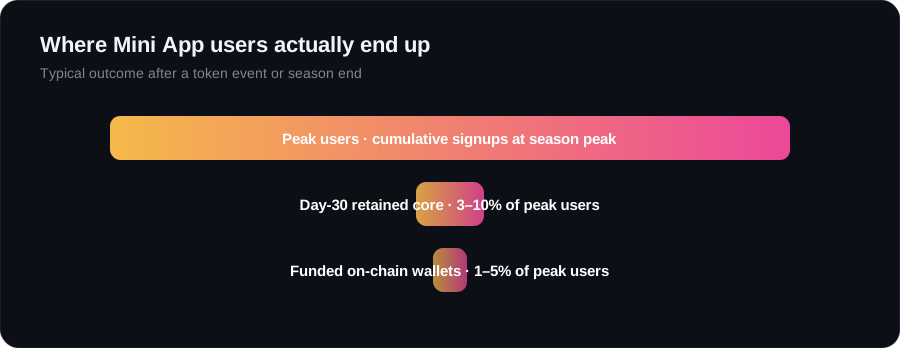
- Plan for 80–95 percent post-reward churn; a 3–10 percent durable core of peak users is success.
- Converting 1–5 percent of users to funded wallets is a normal, workable outcome at these costs.
Why Telegram Mini App growth still compounds in 2026
Telegram crossed one billion monthly active users in 2025, and Mini Apps turn that audience into something no app store allows. Four structural advantages explain the category. Zero install friction: a Mini App opens from a chat link in about two taps, versus an app-store funnel that loses most users before first open. Native identity: every user arrives with a persistent Telegram account, which makes referral attribution and re-engagement trivial. The chat graph is the growth channel: sharing happens inside conversations, where conversion is highest. The wallet is ambient: integration with the TON Foundation ecosystem — required for blockchain-integrated Mini Apps since early 2025 — means Telegram Stars payments and on-chain conversion never require leaving the app.
Notcoin proved the ceiling in 2024 by reaching roughly 35 million users in three months, with peak daily actives above 6 million. Then gravity arrived: after the tap-to-earn wave peaked, industry estimates put mini app monthly actives at 150–190 million by mid-2025 — still an enormous surface, but the era of free virality is over. The catch is symmetrical: frictionless entry means frictionless exit, and reward-driven users behave like reward-driven users everywhere.
How do you design a Mini App launch loop?
Every successful launch we have run combines four TON mini app marketing mechanics into one loop:
| Mechanic | What it does | Design note |
|---|---|---|
| Two-sided referrals | Core viral engine | Reward both sides; cap and decay rewards to blunt farming |
| Quests and tasks | Converts attention into actions | Gate later quests behind real usage, not clicks |
| Channel cross-promotion | Borrowed distribution | Swap placements with channels and Mini Apps of similar size |
| KOL and community seeding | Ignition | Regional Telegram admins outperform big global accounts |
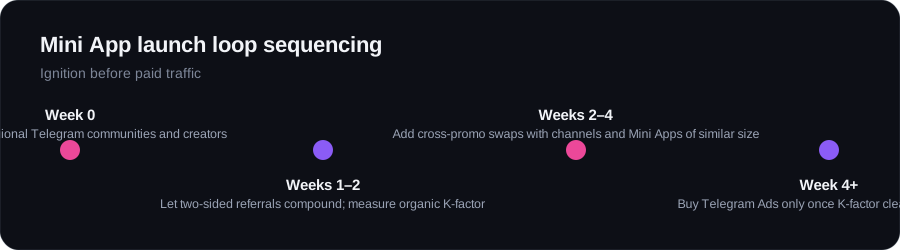
The sequencing matters more than the mechanics. Seed 20–50 regional Telegram communities and creators first (ignition), let two-sided referrals compound for 1–2 weeks, then add cross-promo swaps — and buy paid Telegram Ads only once organic K-factor is measured above roughly 0.5. Buying traffic before the loop retains is how teams turn small budgets into large churn. This channel work — creator seeding plus admin partnerships — is where a Telegram Mini App growth partner earns its keep.
Which retention mechanics survive week two?
Mini Apps die at day 7, not day 1. Mechanics that measurably help:
- Streaks with forgiveness. Daily streaks drive habit; one allowed miss per week keeps a broken streak from becoming an uninstall.
- Seasons and resets. Time-boxed seasons with fresh leaderboards give lapsed users a re-entry point instead of an unclimbable wall.
- Social structure. Squads, guilds, and team competitions consistently outperform solo progression — a user whose team depends on them returns.
- Progression toward ownership. The endgame of points must be legible: allocation, access, or in-app economy. Vague "points may become something" propositions stopped working after 2024's disappointments.
- Notification etiquette. Telegram bots can message users directly — the strongest re-engagement channel and the fastest way to get muted. One meaningful message per day is the ceiling; muted users are functionally churned.
Converting Telegram attention into on-chain wallets
The point of a Mini App is rarely the Mini App. Conversion works as a staircase, not a cliff: start fully off-chain (points, zero friction), introduce an in-app custodial balance, then offer optional on-chain actions — a TON wallet connection, a small transaction, an NFT claim — attached to real upside, and only push self-custody at the moment value is at stake: claim, allocation, withdrawal.
Two field observations. First, cost-of-action gates — a small paid boost, a Telegram Stars purchase, or a gas-bearing claim — are simultaneously your best sybil filter and your best predictor of durable users; users who pay 50 cents behave unlike users who never will. Second, conversion percentages are small: getting 1–5 percent of Mini App users to a funded on-chain wallet is a normal, and workable, outcome at this surface's acquisition costs.
Where do Mini Apps grow fastest?
Response is sharply regional. The strongest markets we see: Vietnam and the wider Southeast Asia belt (Indonesia, Philippines), South Asia, Nigeria, the CIS countries, and Brazil — everywhere Telegram is a primary messenger and reward-motivated audiences are large, markets that also cluster near the top of the Chainalysis adoption index. Korea and Japan respond poorly (Kakao and Line own messaging), and US iOS users hit platform friction.
Budget accordingly: a Mini App campaign is de facto an emerging-markets campaign, which is also why blended acquisition costs stay low — commonly $0.03–0.30 per user in Southeast Asia when the loop works, versus dollars per install on app stores. Ad formats inside Mini Apps continue to show unusually high engagement per PropellerAds reporting as of 2026, which keeps cross-promo and in-app inventory cheap relative to the attention it buys.
The honest math: churn and tourist users
Most Mini App users are tourists, and no mechanic changes that. Post-reward attrition of 80–95 percent within weeks of a token event or season end was the repeated pattern of 2024–2025, and 2026 is only modestly better. Plan on it: a durable core of 3–10 percent of peak users is a realistic target, and the economics must work at that number.
Practical consequences: report retained and funded users to stakeholders, never cumulative signups; design tourist value consciously — tourists still power referral reach and social proof even if they never convert; and size token allocations against expected sybil-plus-tourist share, or the airdrop subsidizes exactly the users who leave. We treat Mini App metrics with the same skepticism we apply to any user growth channel: wallets that stay, not accounts that arrived.
FAQ
How much does Telegram Mini App user acquisition cost?
When the referral loop works, blended Telegram mini app user acquisition commonly lands at $0.03–0.30 per user in Southeast Asia via cross-promo and quest traffic — versus dollars per install on app stores. The real number sits deeper: after 80–95 percent churn, cost per retained user runs 10–30x the headline.
Do you need to build on TON?
For blockchain-integrated Mini Apps, Telegram has required TON since early 2025, so wallet and Stars payments belong there. Teams still route users onward to EVM or Solana products, treating Telegram purely as an acquisition surface — the tradeoff is acquisition-only reach versus full-funnel conversion inside the app.
What K-factor should a Telegram Mini App target?
Measure K-factor during the first two weeks of ignition: above roughly 0.5, referral loops meaningfully subsidize paid traffic and cross-promo swaps compound; below it, fix the loop before spending. Buying traffic into a loop that does not retain converts small budgets into large churn.
How many Mini App users convert to on-chain wallets?
A normal outcome is 1–5 percent of peak Mini App users reaching a funded on-chain wallet. Conversion works as a staircase — points, custodial balance, optional on-chain actions, then self-custody at the moment value is at stake — not as a single wallet-connect cliff at first open.
What retention rate is realistic for Telegram Mini Apps?
Plan on 80–95 percent attrition within weeks of a token event or season end; a durable core of 3–10 percent of peak users is a realistic target for Telegram Mini App growth. Day-30 retention in the high single digits, measured on funded users, is solid.
Final Thoughts
Telegram Mini App growth in 2026 rewards teams that treat it as a full-funnel system: an ignition layer of regional communities, a referral loop measured by K-factor, retention mechanics that survive week two, and a staircase that converts a small, honest percentage of attention into funded wallets. The surface is still unmatched — 1 billion monthly users, two-tap entry, identity attached by default — but the free-virality era is over, and the winners engineer for the 3–10 percent who stay rather than the 90 percent who pass through.
We have run Mini App campaigns across Asia through both the boom and the correction, from Vietnamese Telegram communities to TON ecosystem launches, and the loop templates in this post are the ones that survived contact with real churn data. If you are planning a launch — or resuscitating one that stalled at the churn cliff — talk to us and we will scope the loop, the regions, and the conversion staircase against your product and budget.
