


Nigeria crypto marketing starts from a fact most regions cannot claim: users adopted crypto because banks, currencies, and remittance rails failed them first. That inversion makes Nigeria — and Africa web3 growth broadly — the cheapest place on earth to acquire a genuine, retained Web3 user as of 2026, provided you pair utility-first messaging with community-first distribution.
Elsewhere, projects sell speculation and hope utility follows. In Nigeria, Kenya, and Ghana, stablecoin savings, cross-border settlement, and remittances came first — speculation second, if at all. This guide covers why adoption runs so deep, which channels actually distribute (WhatsApp admins, campus clubs, community leads), what acquisition costs in 2026, and the sybil discipline that separates real African cohorts from farmed ones.
Key Takeaways
- Nigeria has ranked in the global top ten for grassroots crypto adoption every year since 2020.
- Stablecoins account for roughly 40 percent or more of sub-Saharan Africa's transaction volume as of 2026.
- Nigeria crypto marketing runs through WhatsApp groups, Telegram admins, and campus clubs, not paid ads.
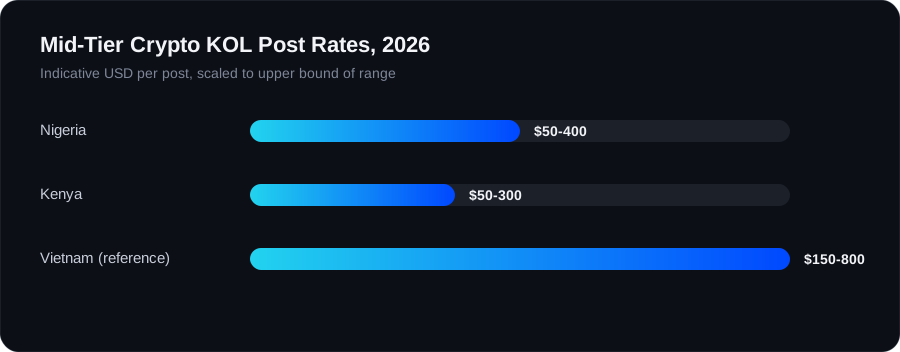
- Mid-tier Nigerian KOL posts cost 50–400 USD, the lowest user acquisition tier of any region.
- Professional sybil farms make unfiltered airdrops worthless; gate every campaign with cost-of-action mechanics.
Why Nigeria Crypto Marketing Starts With Utility
Sub-Saharan Africa is consistently the smallest region in Chainalysis reporting by raw on-chain value — on the order of 100–125 billion USD a year in recent periods, a low single-digit share of global volume. But it ranks at or near the top on every grassroots measure: small-transfer share, retail participation, and P2P activity. Nigeria placed second in the 2024 Chainalysis adoption index and has stayed top-tier since.
The 2025–2026 data sharpened the picture. Ecosystem reporting recorded peak daily P2P stablecoin transfers of 48.2 million USD on centralized exchanges in Nigeria during 2025 — among the highest single-market figures in the world. Investment follows the same utility logic: of the roughly 43 million USD Nigerian Web3 startups raised in 2025, about double the prior year, nearly 90 percent went to stablecoin-linked payments and fiat-exchange products. Small wallets, real usage, and capital chasing the boring use cases — that is the shape of this market.
Why Is Crypto Adoption So High in Nigeria?
The story is macroeconomic. The naira lost roughly 70 percent of its dollar value after the mid-2023 float, and inflation ran around 30 percent through 2024 before easing. For a young, urban, phone-native population — Nigeria's median age is about 18 — dollar-denominated stablecoins became the accessible savings account that domestic banking never offered. The IMF flagged fast-growing stablecoin use and creeping digital dollarization in Nigeria in 2026; for growth teams, that warning doubles as confirmation of scale.
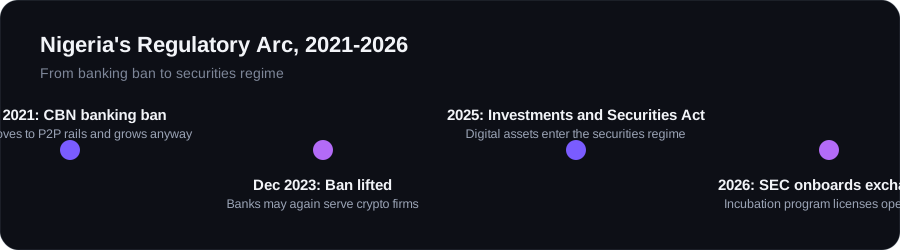
The regulatory arc reinforced the grassroots character. The Central Bank of Nigeria barred banks from servicing crypto firms in February 2021; the market moved to peer-to-peer trades settled over bank transfers and chat apps, and volume grew anyway. The ban was lifted in December 2023, and the Investments and Securities Act signed in 2025 formally brought digital assets into the securities regime, with the Nigerian SEC onboarding exchanges through its incubation program. Nigeria regulated itself into legitimacy after adoption, not before it — which is why user trust lives in communities and P2P networks rather than institutions.
The use cases are unglamorous and durable: salary preservation, cross-border trade settlement for import businesses, and remittances — where traditional rails into sub-Saharan Africa still cost around 7–8 percent per transfer according to World Bank tracking, the highest in the world. A stablecoin corridor cutting that to under 1 percent is not a pitch; it is arithmetic. The talent base compounds the case: Nigeria accounts for roughly 4 percent of global Web3 developers as of 2025 reporting, with the pool growing about 36 percent year on year.
Kenya, Mobile Money, and the Rest of the Continent
East Africa runs on a different rail with the same lesson. M-Pesa taught Kenya — and much of the region — that money lives in a phone number, years before Web3 existed. With tens of millions of active mobile-money users in Kenya alone, the behavioral leap to a wallet app is small; the trust leap is the hard part, and it is earned through agents, community leaders, and word of mouth, exactly as mobile money itself was.
Kenya adds a dense Nairobi developer and startup scene, an active P2P trading culture, and a regulatory framework moving toward formal licensing as of 2026. South Africa is the institutional counterweight: its financial regulator has licensed hundreds of crypto-asset service providers since 2024, making it the continent's most bankable market, though its adoption character is closer to traditional finance than to the grassroots pattern.
Which Channels Work for Web3 Growth in Africa?
Paid acquisition barely functions in most African markets — card penetration is low, ad fraud is high, and trust in ads is lower still. Distribution runs through three community structures:
WhatsApp and Telegram groups. WhatsApp is the default social layer across the continent; Telegram is the crypto-native layer. Real influence sits with group admins and local community leads, not follower counts. A respected Lagos or Nairobi community lead moving your message into twenty active groups outperforms any display campaign.
Campus networks. University blockchain clubs — Nigeria and Ghana host dozens of active ones — are the region's most underpriced channel. Student ambassador programs produce educated, sticky users at very low cost, and campus events convert at rates that look implausible to teams calibrated on Western funnels.
Local-context content. English works in Nigeria, Ghana, and Kenya, but context matters more than language: naira and shilling examples, P2P settlement walkthroughs, and data-light media formats built for expensive mobile bandwidth.
What African User Acquisition Costs in 2026
| Indicative figures, 2026 | Nigeria | Kenya | Vietnam (reference) |
|---|---|---|---|
| Mid-tier KOL post (10k–100k) | 50–400 USD | 50–300 USD | 150–800 USD |
| Community lead / ambassador, monthly | 100–500 USD | 100–400 USD | 300–800 USD |
| Campus event with club partner | 200–800 USD | 200–600 USD | 500–1,500 USD |
| Cost per engaged community member | Lowest tier globally | Low | Low–mid |
These are planning bands from live negotiations, not quotes; vertical and exclusivity move them. The headline holds across every line: Africa prices genuine attention lower than any other region we operate in.
The Catch: Sybil Pressure on Every Campaign
The same economics that make real users cheap make farmed users nearly free, and African quest-farming operations are as professionalized as Southeast Asia's. Open, unfiltered airdrops in Nigeria will report spectacular numbers and retain almost nobody.
We gate every campaign with cost-of-action mechanics and behavioral filtering — the discipline behind our user growth work — and we design airdrop campaigns so that rewards follow demonstrated usage, not sign-ups. Filtered correctly, African cohorts retain as well as any market we operate in; unfiltered, they evaporate at TGE.
The Early-Mover Case for Africa
Most projects still treat Africa as a post-launch afterthought, which is precisely why the region rewards early movers. Community memory is long: protocols that invested in African education and ambassador networks in the last cycle still enjoy default-choice status among the users who onboarded through them. Ecosystem projections as of 2026 put Nigeria at 40–45 million active crypto users by 2030 — around 20 percent of the population — and with CAC at a fraction of Asian or Western levels, the risk-adjusted case is straightforward: enter early, build community equity cheaply, and hold it as the market compounds.
The honest caveats: monetization per user is low today, off-ramps and banking integrations remain uneven outside South Africa, and data and device costs shape which products can work. Africa is a volume-and-loyalty play on a multi-year horizon, not a quarter-one revenue line. Our approach to the region — market validation first, then community-led execution — is laid out on our Africa page and in the ChainPeak playbook.
FAQ
Is Nigeria really a top crypto market or just a big population?
Both, and the distinction matters. Nigeria has ranked in the global top ten for grassroots adoption every year since 2020, placing second in 2024, on the strength of small-value, high-frequency, utility-driven usage. Raw volume is modest by global standards; user depth and retention potential are not.
What channels work for Web3 marketing in Africa?
WhatsApp and Telegram communities, campus blockchain clubs, local micro-KOLs, and ambassador programs. Paid social plays a minor supporting role. Influence is admin-based rather than follower-based, so channel strategy is really a relationship strategy with the community leaders who control distribution.
Is crypto legal in Nigeria as of 2026?
Yes. The Central Bank of Nigeria lifted its banking restriction in December 2023, and the Investments and Securities Act signed in 2025 formally placed digital assets under the securities regime. The SEC now onboards exchanges through its incubation program, so licensed operations have a clear path.
How do you keep airdrop farmers out of African campaigns?
Assume professional farming from day one. Use cost-of-action gating, behavioral and on-chain filtering, staged rewards tied to actual product usage, and retroactive criteria that are never pre-announced. Filtered correctly, African cohorts retain as well as any market; unfiltered, they evaporate at TGE.
Should a project enter Nigeria or Kenya first?
Nigeria first for most products: deeper adoption, a larger population, a stronger developer base, and the world's most active P2P stablecoin culture. Kenya first when the product rides mobile-money behavior or targets East African corridors. Both markets reward community-led entries and punish paid-media-only launches.
Final Thoughts
Africa inverts the standard growth playbook, and that inversion is the opportunity. Users arrived through utility — 48.2 million USD in peak daily P2P stablecoin transfers in Nigeria, remittance corridors priced at 7–8 percent begging for compression, salaries preserved in USDT — so campaigns that lead with utility inherit a decade of organic trust. The channels are relationships, not media buys: WhatsApp admins, Telegram community leads, campus blockchain clubs, and ambassador networks that cost 100–500 USD a month and outperform display budgets ten times their size.
The discipline requirement is equally clear. Sybil farms will find every open campaign, so gating, behavioral filtering, and usage-weighted rewards are not optional add-ons; they are the difference between a retained cohort and a vanity spike. If you are sequencing a global rollout and wondering where Nigeria, Kenya, or the wider continent fits — or when — contact us. We will give you a straight answer, including when the answer is "not yet."
