


Indonesia crypto marketing is the scale play of Southeast Asia — 20.19 million registered investors as of December 2025, oversight now under the financial regulator OJK, and a Telegram-and-TikTok culture built for trading products. The Philippines is the behavior play: P2E heritage, guild distribution, and GCash payment rails. They need different playbooks.
The two are frequently lumped together as "SEA growth markets," and that lumping produces bad plans: different platforms, languages, regulators, and user motivations mean the channel mix that works in Jakarta underperforms in Manila, and vice versa. ChainPeak runs campaigns in both continuously; this guide covers what each market is, the channel mix per country, quest discipline, costs, and which to enter first.
Key Takeaways
- Indonesia crypto marketing addresses 20.19 million registered investors — a base that quintupled since 2020.
- OJK Regulation No. 6 of 2026 requires certified competency for influencers promoting digital assets.
- The Philippines converts fastest: GCash's 90 million-plus wallets make funding a solved problem.
- Indonesian funnels run TikTok/X into Telegram; Philippine funnels run Facebook/YouTube into Discord.
- Unfiltered SEA campaigns commonly exceed 50 percent sybil share; budget against 30-day retained cohorts.
Indonesia crypto marketing: scale, Telegram, and a stricter OJK
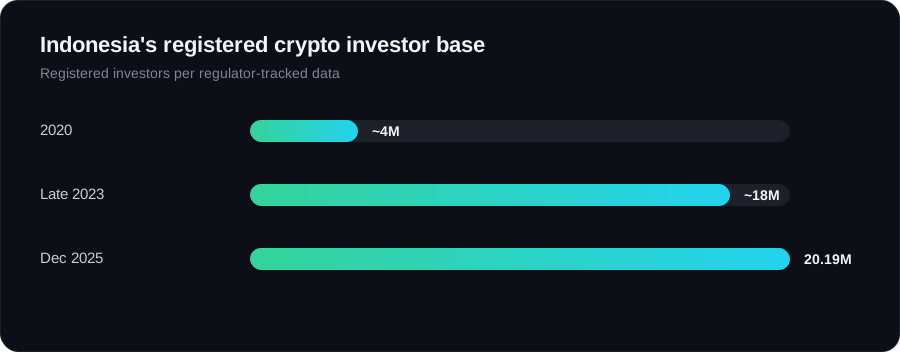
Indonesia's numbers are the headline: 280 million people, a median age around 30, and a registered crypto investor base that grew from roughly 4 million in 2020 to about 18 million by late 2023 and 20.19 million by December 2025 — now larger than the country's stock market investor base, per regulator-tracked data. Domestic exchange volumes roughly tripled year-over-year in 2024, and Chainalysis has kept Indonesia in the top tier of its global adoption index through 2025.
The regulatory ground shifted twice. In January 2025, oversight moved from the commodities regulator Bappebti to the financial services authority OJK — a legitimization step comparable in direction to Vietnam's 2026 law — with licensed venues such as Indodax, Tokocrypto, Pintu, and Reku anchoring a real onshore market. Then in 2026, OJK Regulation No. 6 required financial influencers who discuss or promote digital assets to hold a competency certificate. For campaign design this is the single most important 2026 change in the market: the creator pool now splits into a certified tier that can carry product claims and an informal tier that should stay on general content, and briefs need to reflect which is which.
Behaviorally, Indonesia is a Telegram-and-X market with a professionalized airdrop economy. Discovery runs through Telegram alpha groups — the largest count hundreds of thousands of members — Indonesian crypto X, and an enormous TikTok layer, since Indonesia is one of TikTok's largest markets globally. Retail skews young, mobile-first, and rotation-happy. And Bahasa Indonesia is a single campaign language that covers the archipelago — a real cost advantage over India or the Philippines' English-Taglish mix.
Philippines web3 growth: P2E heritage on mobile-money rails
The Philippines never stopped being a crypto country after Axie Infinity — at the 2021 peak Filipinos were widely estimated at around 40 percent of its player base, and the guild infrastructure born then (most famously Yield Guild Games) left hundreds of thousands of users who treat wallets, NFTs, and in-game economies as ordinary objects. Chainalysis has kept the country in or near its global top 20 through 2025, and ownership surveys from Triple-A consistently place Filipino crypto penetration among the region's highest.
The structural asset is payments. GCash — over 90 million registered users — and Maya put mobile money in most adults' hands, GCash offers crypto exposure in-app through a licensed exchange partnership, and Coins.ph and PDAX operate under VASP licenses from the central bank, the Bangko Sentral ng Pilipinas. Add annual remittance flows above $35 billion and near-universal English, and the Philippines is the easiest Southeast Asian market in which to move a user from discovery to funded wallet. The BSP's long-running moratorium on new VASP licenses keeps the perimeter tight, so partnerships with existing licensees matter more than in Indonesia.
Which channels work in Indonesia versus the Philippines?
| Channel | Indonesia | Philippines |
|---|---|---|
| Telegram | Core: alpha groups, campaign mechanics | Secondary: crypto-native tier only |
| Minor for crypto | Core: largest discovery surface, massive crypto groups | |
| X | Strong crypto-native layer | Moderate |
| TikTok | Huge top-of-funnel | Huge top-of-funnel |
| YouTube | Education and reviews | Education; strong P2E creator legacy |
| Discord | Gaming projects only | Core for gaming: guild culture lives here |
The practical difference: an Indonesian funnel is TikTok/X discovery into Telegram conversion; a Philippine funnel is Facebook/YouTube discovery into Discord (gaming) or a licensed-wallet action (consumer). Running Telegram-first in the Philippines reaches the trader minority and misses the mainstream; running Facebook-first in Indonesia buys reach that never converts. Industry trackers also report these markets among the world's largest sources of new non-custodial wallet activations as of 2026 — mobile-first onboarding, often via messenger referral loops, is not optional in either country.
How bad is airdrop farming in Southeast Asia?
Both countries rank among the top global sources of quest participants — and of sybil activity. Indonesian and Filipino airdrop communities are organized, tooled, and fast: expect your campaign to be indexed in farming groups within hours of launch. We treat this as a design constraint, not a moral failing. The discipline that works, drawn from our user growth practice: cost-of-action gating (tasks that take real time or small real money), retention-cohort measurement instead of raw completions, staged rewards that vest with continued activity, and device-and-behavior filtering before any reward settles.
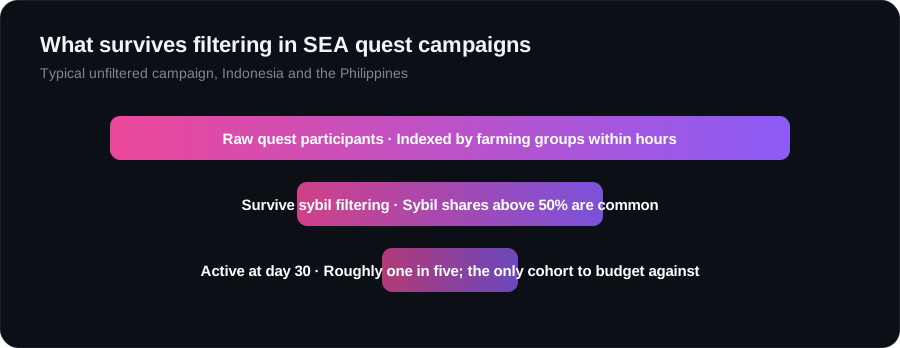
The numbers justify the discipline. In a typical unfiltered campaign in either market, sybil shares run above 50 percent — fewer than half of raw participants survive filtering — and roughly one in five raw participants is still active at day 30. Post-filtering, cost per retained user typically lands at 3–8x the raw per-participant figure. Raw participation numbers from either market are meaningless; 30-day retained cohorts are the only KPI we let clients budget against.
What do Indonesia and Philippines campaigns cost in 2026?
Indicative 2026 ranges, both markets among the cheapest per placement in Asia:
| Line item | Indicative range (USD, 2026) |
|---|---|
| Nano/micro creator post | $50–300 |
| Mid-tier KOL placement | $100–800 |
| Head creator video | $1,000–5,000 |
| Local media placement | $200–1,000 |
| Native community moderator (monthly) | $400–1,200 |
Indonesia skews to the lower end of KOL ranges; the Philippines runs slightly higher for English-language production. A meaningful single-country validation program runs $8,000–20,000; a dual-country program does not double that, because creative and mechanics carry over — plan roughly 1.6x. Two 2026-specific adjustments: in Indonesia, certified-influencer supply is tighter than the general creator pool, which is nudging rates for compliant placements upward; and in both markets the trap is mistaking cheap distribution for cheap users. Budget to the filtered number, not the placement price.
Which market should you enter first?
The rule we use with clients entering Southeast Asia, consistent with the sequencing logic in our playbook:
- Pick Indonesia first if you are a trading product, DeFi protocol, or exchange: the investor base is 4–5x larger, the Telegram culture matches trading mechanics, and one language covers the country.
- Pick the Philippines first if you are a game, consumer app, or anything needing fiat rails: guild culture gives structured distribution, English cuts localization cost, and mobile-money integration shortens the path from interest to funded action.
- If you genuinely serve both, sequence four to six weeks apart rather than launching simultaneously — the channel mixes differ enough that parallel launches split team attention at exactly the wrong moment.
FAQ
Should we launch in Indonesia or the Philippines first?
Indonesia first for trading and DeFi products — its 20.19 million registered investors and Telegram culture fit trading mechanics. The Philippines first for gaming and consumer apps — P2E heritage, guild distribution, English content, and GCash-era payment rails shorten the funnel. Sequence the two markets four to six weeks apart rather than launching both at once.
What do Indonesia's new influencer rules mean for crypto campaigns?
OJK Regulation No. 6 of 2026 requires financial influencers who promote digital assets to hold a competency certificate. For Indonesia crypto marketing this splits the creator pool into certified and informal tiers: put certified voices on product claims, keep uncertified creators to general content, and document every brief.
How serious is airdrop farming in Indonesia and the Philippines?
Both countries host some of the most organized airdrop-farming communities in the world; unfiltered campaigns commonly see sybil shares above 50 percent, and roughly one in five raw participants remains active at day 30. The fix is design: cost-of-action gating, vesting rewards, behavioral filtering, and budgeting against 30-day retained cohorts.
What budget do Indonesia and Philippines campaigns require?
A single-country validation program runs $8,000–20,000 over three to six weeks; a dual-country entry costs roughly 1.6x because creative and mechanics carry over. Mid-tier KOL placements run $100–800 and native moderators $400–1,200 monthly as of 2026 — but budget to filtered, retained-user costs, not raw placement prices.
Do Indonesian campaigns need local-language content?
Yes. Bahasa Indonesia is a single campaign language covering 280 million people — a genuine cost advantage over India's language matrix — and English-only funnels stall outside the crypto-native tier. The Philippines is the reverse: near-universal English works, with Taglish adding warmth in creator content rather than being a requirement.
Final Thoughts
Indonesia and the Philippines are the two fastest compounding growth markets in Southeast Asia, and the way to waste them is to treat them as one market. Indonesia offers scale — 20.19 million registered investors, a single campaign language, a Telegram culture built for trading mechanics — under a regulator that now certifies who may promote digital assets. The Philippines offers behavior: a P2E-literate population on mobile-money rails that make funded conversion cheaper than anywhere else in the region. Run the Indonesian funnel through TikTok and Telegram with certified creators on product claims; run the Philippine funnel through Facebook, YouTube, and Discord with licensed-wallet partners at the conversion step. In both, design for the farming economy you will definitely meet: gate actions, vest rewards, filter behavior, and hold every line of budget to 30-day retained cohorts. Enter one market, prove the filtered numbers, then sequence the second four to six weeks later. For a scoped two-market plan with channels, creators, and cohort targets, talk to us.
