


China web3 market entry in 2026 does not mean mainland China — trading and its promotion remain banned there — it means the offshore Chinese-speaking attention network: Hong Kong, Taiwan, Singapore, Malaysia, and the diaspora, connected through Chinese-language X, Telegram, and private WeChat groups. That network remains one of the largest, most sophisticated, and most capital-rich audiences in crypto.
It is also the most misunderstood. Teams either write China off because of the ban or burn budgets chasing platforms inside the Great Firewall where crypto content cannot live. ChainPeak has run Chinese-language campaigns continuously since 2022, with more than 500 vetted Chinese-speaking KOLs in a 10,000-creator network. This guide covers what the market actually is, the channels, real 2026 rates, media, compliance lines, and the entry sequence.
Key Takeaways
- China web3 market entry targets the offshore Chinese-speaking network; the mainland trading ban still stands in 2026.
- Hong Kong now hosts 13 SFC-licensed trading platforms, giving the region a regulated legitimacy anchor.
- Chinese crypto KOLs run $300–1,500 per mid-tier X post, negotiated and paid in stablecoins.
- The funnel is Chinese X for discovery, Telegram for conversion, invitation-only WeChat groups for trust.
- Bundled Chinese media distribution across 10–20 outlets typically costs $3,000–15,000 as of 2026.
- Meaningful China validation needs $15,000–40,000; competitive full launches run $50,000–150,000+ depending on project category.
What China web3 market entry actually means in 2026
Mainland China banned crypto trading and mining in 2021, and the perimeter has tightened since — authorities extended restrictions to stablecoin promotion in late 2025. Nothing in this guide is about circumventing that. What teams actually enter is a Chinese-language market that lives offshore, and it splits into four segments.
Hong Kong is the licensed hub. The Securities and Futures Commission has licensed 13 virtual asset trading platforms as of February 2026, the Hong Kong Monetary Authority issued its first stablecoin licenses in April 2026 under the ordinance that took effect in August 2025, and legislative proposals for virtual asset dealers and custodians are on the 2026 agenda. Most licensed platforms still skew toward professional investors, but the direction — spot ETFs, expanding license categories, government-backed Web3 events — makes Hong Kong the legitimacy anchor for the entire Chinese-speaking market. Taiwan has active retail and a maturing registration regime. Singapore hosts funds, founders, and much of the industry's Chinese-speaking professional layer. And mainland users participate informally at scale through offshore exchanges and VPNs — an audience you will reach indirectly but must never target with paid promotion of trading services.
Behaviorally, this is the most experienced market we operate in: high exchange penetration, deep derivatives usage, and a community that has survived multiple cycles — East Asian flows that Chainalysis consistently ranks among the world's largest despite the ban. It rewards substance and punishes obvious outsourcing faster than any Western audience.
The channel stack: Chinese X, Telegram, WeChat
Chinese-language X is the discovery layer — the Chinese counterpart of crypto Twitter, with its own head accounts, researchers, and news amplifiers whose threads set the day's agenda. Telegram is the conversion layer, where announcement channels and discussion groups hold the active audience and where campaign mechanics actually run. WeChat groups are the high-trust private layer: invitation-based, unadvertisable, and where serious capital discusses positions — you get in through relationships, not budget.
Note what is absent: domestic platforms. Crypto content on Weibo, Douyin, and Xiaohongshu is actively moderated away; they are not viable token-marketing channels, and any proposal built on them should end the conversation. The funnel that works is X discovery, Telegram conversion, WeChat trust — in that order, with native-quality Chinese at every step.
How much do Chinese crypto KOLs cost in 2026?
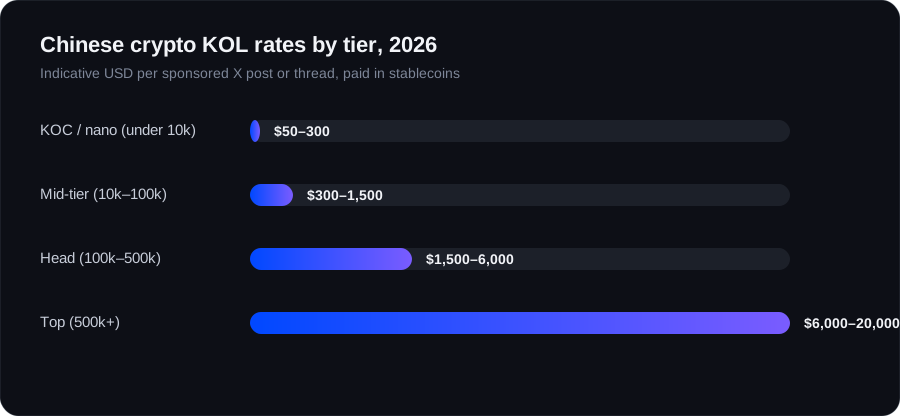
Chinese-speaking KOLs cluster on X and Telegram, with a long tail on YouTube. Rates are negotiated, not listed; the ranges below reflect what we see in 2026 negotiations for a single sponsored X post or thread, paid in stablecoins.
| Tier | Following | Indicative rate (USD) |
|---|---|---|
| KOC / nano | under 10k | $50–300 |
| Mid-tier | 10k–100k | $300–1,500 |
| Head | 100k–500k | $1,500–6,000 |
| Top | 500k+ | $6,000–20,000+ |
Telegram channel posts typically run $100–2,000 depending on channel size and quality; hosted AMAs run roughly $500–5,000. Three caveats from our KOL marketing practice. First, performance variance within a tier is enormous — the same $1,000 buys a creator who converts and a creator who does not, and only historical performance data distinguishes them; this is why we maintain conversion records on every creator we book. Second, bundles (post + AMA + pinned Telegram mention) usually price 20–40 percent better than the same items bought separately. Third, everything in this market is renegotiated with cycle conditions — rates quoted in a bull quarter do not survive a drawdown, in either direction.
Which Chinese crypto media outlets matter?
The Chinese-language crypto media layer is dense and fast. The core outlets teams should know: BlockBeats and Odaily for fast news and strong X crossover, PANews for research-leaning coverage, plus Foresight News, TechFlow, ChainCatcher, and the Wu Blockchain newsletter ecosystem. Formats range from news placement to in-depth interviews and event coverage, and the news cycle is measured in hours — a morning announcement is group-chat consensus by evening.
Be realistic about the economics: most placements are commercial. Single-outlet placements typically run from the low hundreds to low thousands of dollars; bundled distribution across 10–20 Chinese-language outlets commonly lands in the $3,000–15,000 range depending on outlet tier and format. Editorial deep-dives at top outlets are earned, not bought — and they are worth far more than any bundle. Our PR and media service exists largely to manage that distinction: paying for baseline visibility while building the relationships and story quality that earn the coverage money cannot buy.
Community norms that surprise Western teams
Four patterns catch first-time entrants off guard. The market is data-first and skeptical: token vesting schedules, backer quality, and on-chain traction get dissected in group chats within a day of your announcement, so publish the numbers before someone else frames them. Wealth-effect narratives — who made money and how — travel further than technology narratives; lead with what users gained, not what you built. AMA culture is strong and red packet (small token giveaway) mechanics are expected at community events — budget for them. And nothing kills credibility faster than machine-translated Chinese: hire native writers or do not publish. A Chinese project name matters more than teams expect; the community will coin one if you do not, and you will not get to choose it.
Compliance red lines you should not cross
Not legal advice, but hard-learned operating lines. Do not run paid acquisition for trading services aimed at mainland residents — no mainland-focused ads, payment rails, or RMB-denominated promotions, and since late 2025, no stablecoin promotion into the mainland either. Ensure Hong Kong-facing marketing respects the SFC regime, which restricts how unlicensed products may be promoted; the full licensed-platform list is public via Fintech News Hong Kong and worth checking before any co-marketing deal. Keep clear risk disclaimers on everything. Expect platform-level enforcement: WeChat accounts used for aggressive crypto promotion get banned, taking their group networks with them. Structure the campaign around the offshore community and you stay on the workable side of all of this.
How do you choose a Chinese crypto marketing agency?
The market is full of intermediaries reselling the same KOL spreadsheet at a markup, so test for three things. First, a real network: a credible Chinese crypto marketing agency can name creators, show conversion history per account, and explain why a specific 30-account list fits your category — not just quote a follower total. Second, native editorial quality: ask to see Chinese-language work product before signing; if you cannot judge it, have a native speaker you trust review it, because your audience will within minutes. Third, honest compliance lines: an agency that promises mainland reach, guaranteed exchange listings, or WeChat advertising is describing rule-breaking you will pay for later. Structural signals help too — stablecoin-denominated creator contracts, staged budgets tied to validation metrics, and reporting on engaged-member cost rather than impressions.
The entry sequence, week by week
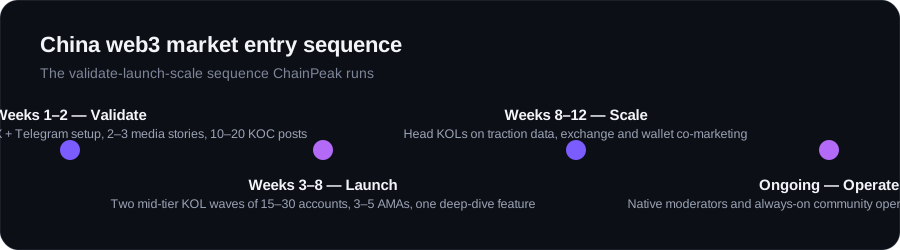
This is the validate-launch-scale sequence we run for the Chinese-speaking market, per our playbook:
- Weeks 1–2 (validate). Localize the narrative, not just the words — Chinese project name, positioning, one-pager. Stand up a Chinese X account and Telegram group with native operators. Place 2–3 media stories. Seed 10–20 KOC posts. Measure cost per engaged community member.
- Weeks 3–8 (launch). Two mid-tier KOL waves of 15–30 accounts each, spaced around real announcements. An AMA circuit of 3–5 sessions across partner communities. One in-depth media feature. Community quests with anti-sybil gating.
- Weeks 8–12 and beyond (scale). Head-KOL coverage once traction data exists, exchange and wallet co-marketing, Hong Kong event presence where the calendar fits, and always-on community operations with native moderators at Chinese hours.
Meaningful validation typically requires $15,000–40,000; a competitive full launch commonly runs $50,000–150,000+ depending on category. Below that floor, buy less market, not thinner presence everywhere — a strong Telegram-plus-X presence with 15 well-chosen creators beats a token gesture on every channel.
FAQ
Is crypto marketing legal in China in 2026?
Mainland China still bans crypto trading and its promotion to residents — extended to stablecoin activity in late 2025 — so China web3 market entry targets the offshore Chinese-speaking community in Hong Kong, Taiwan, Singapore, Malaysia, and the diaspora, on X and Telegram. Hong Kong permits marketing within its licensing regime. Take local counsel for anything ambiguous.
How much do Chinese crypto KOLs cost in 2026?
Roughly $300–1,500 per sponsored X post for mid-tier creators (10k–100k followers), $1,500–6,000 for head accounts (100k–500k), and $6,000–20,000+ for top voices, paid in stablecoins. Telegram channel posts run $100–2,000 and hosted AMAs $500–5,000. Performance varies more within tiers than between them, so vet on conversion history, not follower count.
Can you market web3 projects on WeChat?
Not through ads. WeChat's role in Chinese crypto marketing is private-domain: invitation-based groups where high-trust capital discusses positions. Teams earn access through KOL relationships, community partners, and referrals — and aggressive promotion risks account bans. Treat WeChat as a trust channel measured in relationships, not a reach channel measured in impressions.
How do you choose a Chinese crypto marketing agency?
Test three things: a real vetted network — named creators with conversion history, not a resale spreadsheet; native editorial quality, since machine-translated Chinese is instantly disqualifying; and honest compliance lines about the mainland ban and Hong Kong's SFC regime. Any agency promising mainland reach, guaranteed listings, or WeChat ads is describing rule-breaking.
What budget does China web3 market entry require?
Meaningful validation runs $15,000–40,000 over two to eight weeks: localized narrative, X and Telegram presence, 2–3 media stories, and 10–20 seeded KOC posts. A competitive full launch commonly runs $50,000–150,000+ depending on category. Below the validation floor, buy less market rather than thinner presence everywhere.
Final Thoughts
"Entering the China market" remains the most misunderstood phrase in Web3 marketing, and the misunderstanding is expensive in both directions: teams that skip the Chinese-speaking market forfeit one of the industry's deepest pools of experienced users and capital, while teams that chase mainland platforms buy risk with no reach. The workable position sits between — an offshore, Chinese-language campaign anchored on X and Telegram, earning its way into WeChat trust circles, with Hong Kong's 13 licensed platforms and expanding regulatory framework as the legitimacy backdrop. Execution standards are unforgiving: native writing, data-first messaging, disclosed relationships, creators chosen on conversion history rather than follower counts, and budgets that respect the $15,000–40,000 validation floor. Get those right and the Chinese-speaking community is also the fastest amplifier in crypto — a market where a strong story becomes group-chat consensus in a single day. For a China web3 market entry plan scoped to your category — creator list, media bundle, compliance lines, and week-by-week sequence — talk to us.
