


LATAM crypto marketing is community-led or it fails. Latin America moved on the order of 1 trillion USD in on-chain value in the year through mid-2025 per Chainalysis, with Brazil near 319 billion USD of it — yet retention still lives in Portuguese and Spanish community groups, not in paid reach.
The regional structure is legible. Brazil is the anchor: the largest economy, the most mature exchange and regulatory environment, and a creator-dominated media culture — and it speaks Portuguese, which alone disqualifies pan-Latin content plans. Argentina is the stablecoin laboratory. Mexico is the payments corridor. This guide lays out how each market converts, what KOLs and moderators cost in 2026, and the Brazil-first entry sequence we run.
Key Takeaways
- LATAM crypto marketing is community-led: creators open doors, WhatsApp and Discord moderators keep users.
- Brazil received close to 319 billion USD on-chain in the 2025 reporting year, ranking fifth globally.
- Stablecoins exceed 60 percent of Argentine retail activity and dominate Brazilian on-chain flows.
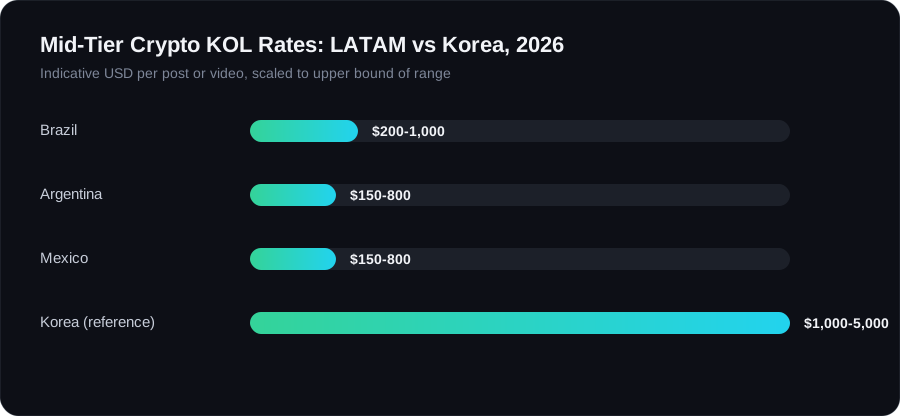
- Brazilian mid-tier creators run 200–1,000 USD per post, roughly one-fifth of Korean rates.
- Sequence Brazil first in Portuguese, Argentina for savings products, Mexico through fintech partnerships.
How LATAM Crypto Marketing Actually Works
Latin America is the region where crypto marketing most rewards patience and most punishes tourism. Audiences are large, warm, and communal; churn is low once trust is earned; and costs sit well below East Asian levels. But trust is earned in Portuguese and Spanish, inside communities that have watched a decade of foreign projects arrive with a translated landing page, run one campaign, and leave.
The momentum is real. Chainalysis ranked Brazil fifth globally for adoption in its 2025 index, and reporting from CoinDesk put LATAM's crypto user growth at roughly three times the US pace in 2025. Regulatory clarity is spreading — Brazil's virtual-assets law, Argentina's exchange registration rules, even Bolivia repealing its long-standing ban. The thesis we run every campaign on: KOLs open the door, but retention lives in WhatsApp, Telegram, and Discord groups run by local moderators with real, visible authority.
Brazil: Exchange-Mature and Creator-Driven
Brazil is the easiest major crypto market in the world to underestimate. It has a decade-old domestic exchange sector (Mercado Bitcoin and peers), deep penetration by global venues, one of the world's earliest crypto ETF markets on B3, and a functioning legal framework: the 2023 crypto law placed the sector under central-bank oversight, and a 2025 provisional measure moved individual crypto gains to a flat tax near 17.5 percent. Nothing about Brazil is a gray zone.
Two structural facts drive marketing there. First, Pix — the instant payment system operated by the Banco Central do Brasil and used by the large majority of Brazilian adults — makes fiat on-ramps nearly frictionless, so a campaign can carry a user from first touch to a funded account in one session. Second, Brazilian media culture is creator-dominated: finance YouTube and Instagram are enormous, audiences form parasocial loyalty quickly, and a respected creator's endorsement converts better than any earned-media placement. As of 2025 reporting, stablecoins made up the large majority of Brazilian on-chain flows — by some measures over 90 percent — as banks, brokers, and neobanks folded digital dollars into everyday finance.
Why Do Argentines Save in Stablecoins?
Because the peso taught them to. Inflation ran above 200 percent in 2023, and although stabilization policy brought it down sharply through 2024–2025, decades of currency distrust do not unwind in two fiscal years. Argentines buy stablecoins the way earlier generations bought physical dollars: regional exchange data has consistently shown stablecoins at over 60 percent of Argentine retail purchase volume — among the highest shares in the world — and industry reporting counted around 5.4 million crypto app downloads in Argentina in 2025, with monthly active penetration near 12 percent. Local apps like Lemon, Belo, and Ripio made USDT balances an everyday consumer product.
For marketers this means Argentina converts on savings, yield, and dollar-access messaging, not on trading-and-margin messaging. The audience is unusually literate about stablecoin mechanics and detects hand-waving instantly. Argentina is mid-sized by volume but outsized for DeFi, savings, and payments products — and Argentine crypto Twitter punches far above its weight in Spanish-language influence across the whole region.
Is Mexico a Crypto Market or a Payments Corridor?
Both, but the corridor is the prize. Mexico receives on the order of 60–65 billion USD a year in remittances — the world's second-largest inflow per World Bank data — and exchanges and fintechs have moved billions of dollars of the US–Mexico corridor onto stablecoin rails, compressing costs against traditional transfer services. Survey work as of 2025–2026 puts the share of Latin American institutions using stablecoins for cross-border payments around 70 percent, the highest of any region.
Practically, Mexico rewards partnerships over campaigns: integrations with local fintechs and wallets outperform standalone user acquisition. And Spanish-language content produced for Mexico travels well into Colombia, Chile, and Peru, which makes Mexico the sensible hub for Spanish-market content operations.
KOL Rates and Community Costs Across LATAM
| Indicative figures, 2026 | Brazil | Argentina | Mexico | Korea (reference) |
|---|---|---|---|---|
| Mid-tier KOL post/video (10k–100k) | 200–1,000 USD | 150–800 USD | 150–800 USD | 1,000–5,000 USD |
| Head creator post/video | 2,000–10,000 USD | 1,500–6,000 USD | 1,500–7,000 USD | 5,000–30,000+ USD |
| Community moderator, monthly | 300–800 USD | 250–700 USD | 250–700 USD | 800–2,000 USD |
| AMA with established community | 300–1,500 USD | 200–1,000 USD | 200–1,000 USD | 1,000–4,000 USD |
Ranges vary with vertical and exclusivity. The headline: LATAM delivers reach at roughly a fifth of Northeast Asian creator costs, with retention economics that reward whoever builds the community layer properly. Our KOL marketing practice maintains vetted Portuguese and Spanish rosters precisely because rate cards in this region are informal and inflated for foreigners.
Community Activation That Sticks
The patterns that hold up across our LATAM work:
- Local moderators with real authority. Brazilian and Argentine communities detect absentee management within days. Moderators must be native speakers, publicly named, and able to run events without headquarters sign-off — the operating model behind our community management work.
- WhatsApp for the mainstream, Telegram and Discord for the crypto-native. WhatsApp is where Brazilian and Mexican mainstream users live; using it compliantly for retention cohorts is a structural advantage most global teams never build.
- Football-cadence engagement. LATAM communities respond to recurring, ritualized events — weekly calls, prediction games, regional tournaments — far better than to one-off announcement pushes.
- Education before incentives. Airdrop farming exists here too, but the bigger risk is shallow incentive-chasing displacing the education-driven cohorts that actually retain.
The Entry Sequence We Run
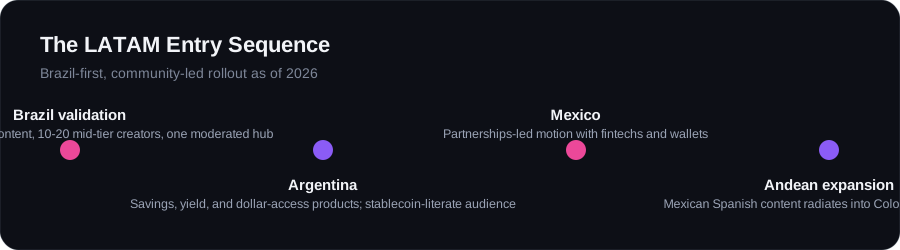
For most projects entering LATAM, the sequence is: Brazil first — validate with 4–6 weeks of Portuguese content, 10–20 mid-tier creators, and one community hub with local moderation. Argentina second if the product has a savings or DeFi angle. Mexico third with a partnerships-led motion, then let Mexican Spanish content radiate into the Andean markets. The full validate-launch-scale structure is documented in our playbook.
FAQ
Can one Spanish campaign cover all of Latin America?
No — and it cannot cover Brazil at all, which speaks Portuguese and accounts for roughly a third of regional on-chain value. Run Portuguese content for Brazil and Mexican-hubbed Spanish for the rest, with local moderators per market. Accent and idiom mismatches are noticed and quietly resented.
Is Argentina worth targeting given its economic volatility?
Yes, for the right products. Volatility built the strongest stablecoin savings habit in the Western Hemisphere, and disinflation since 2024 has not erased it. Savings, yield, and dollar-access products convert well; trading-and-margin pitches fit Argentina poorly. Expect a literate audience that checks the mechanics.
How do LATAM crypto marketing costs compare with Asia?
Creator and community costs run at roughly 20–40 percent of Korean or Japanese levels and are comparable to Southeast Asia. The difference is retention: community-led LATAM cohorts churn slowly once trust is established, so effective cost per retained user is often the region's real advantage.
What makes Brazil different from other LATAM crypto markets?
Language first — Portuguese, not Spanish — plus regulatory maturity: a 2023 crypto law under central-bank oversight, early crypto ETFs on B3, and Pix rails that fund accounts in one session. Add a creator-dominated media culture, and Brazil behaves like a self-contained top-five global market.
Which channels retain crypto users in LATAM?
WhatsApp for mainstream users in Brazil and Mexico, Telegram and Discord for crypto-natives, with local moderators who hold visible authority. Recurring ritual events — weekly calls, prediction games, tournaments — outperform one-off announcement pushes. Paid reach opens the funnel; community structure keeps it.
Final Thoughts
LATAM's fundamentals as of 2026 are hard to argue with: on the order of 1 trillion USD in annual on-chain value, Brazil ranked fifth globally with near 319 billion USD of it, Argentine stablecoin adoption above 60 percent of retail activity, and a Mexican remittance corridor worth 60–65 billion USD a year moving steadily onto stablecoin rails. Costs sit at a fraction of Northeast Asian levels — 200–1,000 USD for a Brazilian mid-tier creator against 1,000–5,000 USD in Korea — and retention rewards whoever invests in the community layer first.
The execution bar is cultural, not financial. Portuguese for Brazil, Mexican-hubbed Spanish for the rest, moderators with real authority, and rituals that give communities a reason to return weekly. Projects that treat the region as a translation task keep re-learning why churn erases cheap reach. If you are deciding whether LATAM should precede or follow Asia in your rollout — or which of Brazil, Argentina, and Mexico fits your product first — talk to us for a candid, sequenced read.
